
Company Income Tax Calculator South Africa & Corporate Tax Rate 2026 Guide
Calculate your company’s SARS income tax instantly. Full guide to corporate income tax South Africa 2026 — rates, SBC brackets, deductions, provisional tax and ITR14.
⚡ Quick Answer — Company Income Tax South Africa 2026
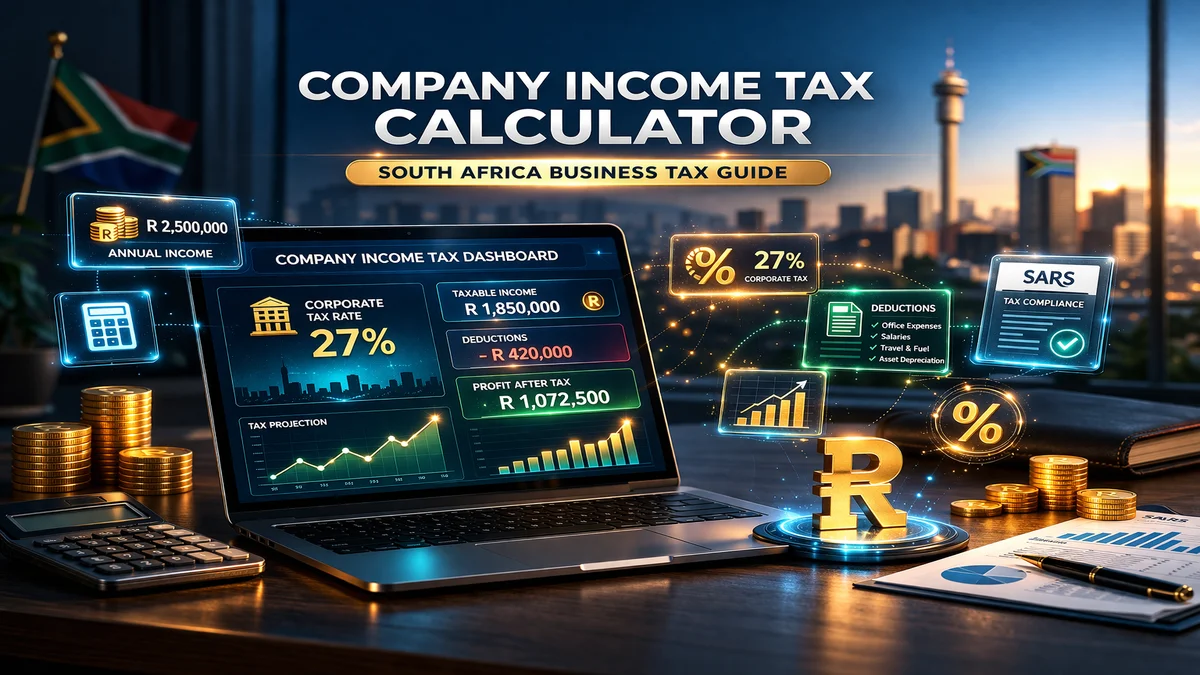
The corporate income tax rate in South Africa is 27% flat for most registered companies (Pty Ltd, CC). Small Business Corporations (SBC) pay 0% on the first R95,750, then sliding rates up to 27%. Use our free calculator below to work out exactly how much company tax your business owes SARS for the 2026/2027 tax year.
📋 Table of Contents
- Company Income Tax Calculator South Africa
- Corporate Income Tax Rate South Africa 2026
- Small Business Corporation Tax Rates 2026
- Company Tax vs Personal Income Tax South Africa
- How to Calculate Company Income Tax South Africa
- Provisional Tax for Companies South Africa
- Company Tax Deductions South Africa 2026
- How to File ITR14 — SARS Company Tax Return
- FAQ — Company Income Tax South Africa
Every registered company in South Africa — whether a Private Company (Pty Ltd), Close Corporation, or Small Business Corporation — is required to pay Corporate Income Tax (CIT) to SARS. Understanding how company income tax works, what rate applies to your business, and how to calculate your tax liability correctly can save your company thousands of rands every year.
This guide covers everything you need to know about company income tax in South Africa for 2026/2027 — including the latest SARS tax rates, an interactive calculator, SBC brackets, allowable deductions, provisional tax deadlines, and how to file your ITR14 return online.
Company Income Tax Calculator South Africa — 2026/2027
Use our free company income tax calculator to instantly estimate your SARS corporate tax liability for the 2026/2027 tax year. Simply enter your company’s taxable income and select your company type.
🧮 Company Income Tax Calculator — South Africa 2026/2027
⚠️ This calculator provides estimates only. Consult a registered tax practitioner for official tax advice. Figures based on SARS 2026/2027 tax tables.
💡 Note: This calculator covers the three main company tax types in South Africa. If your company qualifies as a Small Business Corporation (SBC), you may pay significantly less tax than the standard 27% rate — especially on lower income levels.
Corporate Income Tax Rate South Africa 2026
The corporate income tax (CIT) rate in South Africa for 2026 is a flat rate of 27% on taxable income, applicable to all registered companies including Private Companies (Pty Ltd), Public Companies, Close Corporations, and Personal Liability Companies.
South Africa reduced the corporate income tax rate from 28% to 27% in 2022, and this rate has remained unchanged for 2026/2027. This makes South Africa’s corporate tax rate competitive within the African continent, though slightly above the global average of around 23%.
Important: The 27% CIT rate applies to taxable income — not total revenue. Taxable income is your gross income minus all allowable deductions. A company with R1 million revenue but R600,000 in deductible expenses would pay 27% on R400,000 = R108,000 in tax.
Small Business Corporation Tax Rates South Africa 2026
If your company qualifies as a Small Business Corporation (SBC), you pay significantly less tax than the standard 27% rate. The SBC tax brackets for the 2026/2027 tax year (year ending 31 March 2027) are:
| Taxable Income (R) | Tax Rate | Tax Payable |
|---|---|---|
| R0 — R95,750 | 0% | R0 |
| R95,751 — R365,000 | 7% | 7% of amount above R95,750 |
| R365,001 — R550,000 | 21% | R18,848 + 21% above R365,000 |
| R550,001 and above | 27% | R57,698 + 27% above R550,000 |
Do You Qualify as an SBC?
To qualify as a Small Business Corporation, your company must meet ALL of the following SARS requirements:
✅ All shareholders/members must be natural persons (no companies as shareholders)
✅ Gross income must not exceed R20 million per year
✅ No shareholder may hold shares in another company (with limited exceptions)
✅ No more than 20% of income from investment income or personal service
✅ Company must not be a personal service provider
💡 SBC Tax Saving Example: A qualifying SBC with R400,000 taxable income pays approximately R27,898 in tax (effective rate: ~7%). The same income in a standard company would attract R108,000 at 27%. The SBC structure saves R80,102 per year!
Company Tax vs Personal Income Tax South Africa
One of the most common questions business owners ask is whether to operate as a company (Pty Ltd) or as a sole proprietor taxed under personal income tax. Here is a full comparison:
| Factor | 🏢 Company (Pty Ltd) | 👤 Sole Proprietor (Personal Tax) |
|---|---|---|
| Tax Rate | 27% flat (or SBC rates) | 18%–45% progressive |
| On R500,000 income | R135,000 (27%) | ~R147,000+ (personal brackets) |
| Tax-Free Threshold | R0 (no threshold) | R99,000 (under 65) |
| SBC Option | Yes — if qualifying ✅ | No |
| Dividends Tax | 20% on dividends | Not applicable |
| Admin Requirements | Higher — ITR14, provisional | Lower — ITR12 |
| Liability Protection | Separate legal entity ✅ | Personal liability |
| Best For | Higher income, growth plans | Low income, simple structure |
How to Calculate Company Income Tax South Africa
Calculating your company income tax in South Africa follows a straightforward formula, though the details can be complex. Here is the step-by-step process:
Provisional Tax for Companies South Africa
All companies in South Africa must pay tax through the provisional tax system — meaning you make advance payments of estimated tax during the year, rather than one lump sum at year-end. Missing provisional tax deadlines results in interest and penalties from SARS.
| Provisional Tax Payment | When Due | Based On |
|---|---|---|
| 1st Provisional Payment | 6 months into financial year | Estimated taxable income for full year |
| 2nd Provisional Payment | End of financial year | Revised estimate of actual taxable income |
| 3rd Payment (Optional) | Within 6 months after year-end | Top-up to avoid interest if estimates were low |
| Final Tax (ITR14) | 12 months after financial year-end | Actual taxable income — balance due or refund |
Penalty Warning: If your 2nd provisional tax payment is less than 80% of your actual tax liability, SARS charges a 20% underestimation penalty on the shortfall. Always base your estimate on realistic income projections to avoid penalties.
Company Tax Deductions South Africa 2026
Reducing your company’s taxable income through legitimate deductions is the most effective way to lower your corporate income tax bill legally. Here are the key deductions available under South African tax law:
Section 11 — General Business Deductions
Under Section 11 of the Income Tax Act, the following expenses are deductible if they are incurred in the production of income and not of a capital nature: employee salaries and wages, rent and leases, utilities and telephone costs, marketing and advertising, professional fees (accounting, legal), bank charges, insurance premiums, repairs and maintenance, and bad debts written off.
Section 11(e) — Depreciation / Wear and Tear
Assets used in your business depreciate in value over time. SARS allows companies to deduct this depreciation (called wear and tear) against taxable income. Common rates include: computers and IT equipment (3 years), motor vehicles (5 years), office furniture (6 years), and industrial machinery (varies by asset class).
Section 12C — Manufacturing Plant Allowance
Manufacturing companies can claim accelerated depreciation on new plant and machinery — 40% in the first year, then 20% for three years thereafter. This is a powerful deduction for capital-intensive manufacturing businesses.
Section 12H — Learnership Allowance
Companies that register learnership agreements with the Department of Labour can claim additional deductions of up to R40,000 per learner per year, plus completion bonuses. This incentive reduces tax while supporting skills development in South Africa.
How to File Your ITR14 — SARS Company Tax Return
The ITR14 (Income Tax Return for Companies) is the annual tax return that every registered South African company must submit to SARS. Here is how to complete and file it:
💡 Deadline Tip: Most companies use February 28 as their financial year-end (aligned with SARS’s tax year). For these companies, the ITR14 is due by February 28 of the following year. Companies can choose a different year-end, but must notify SARS accordingly.
❓ FAQ — Company Income Tax South Africa
Most searched questions about company income tax in South Africa — tap any question for the full answer.
The corporate income tax rate in South Africa for 2026/2027 is 27% — a flat rate applied to taxable income for all standard registered companies including Private Companies (Pty Ltd), Close Corporations, and Public Companies. This rate was reduced from 28% to 27% in 2022 and has remained unchanged. Small Business Corporations (SBCs) qualify for significantly lower rates — 0% on the first R95,750, rising to 27% only on income above R550,000. Use our calculator above to estimate your exact tax liability.
A standard company pays 27% of its taxable income to SARS. For example: a company with R1 million in taxable income pays R270,000 in corporate income tax, keeping R730,000 after tax. If the same company qualifies as an SBC, it would pay approximately R139,198 — saving R130,802. Additionally, when the company pays out profits as dividends to shareholders, a further 20% dividends tax applies on the dividend amount. Use our company income tax calculator above for your specific figures.
A Small Business Corporation (SBC) is a qualifying company that benefits from reduced tax rates under Section 12E of the Income Tax Act. To qualify, your company must: have only natural persons as shareholders (no corporate shareholders), have gross income under R20 million per year, not have shareholders who hold shares in other companies (with limited exceptions), and earn no more than 20% of income from investment or personal service income. SBCs pay 0% on the first R95,750 of taxable income, rising to a maximum of 27% — significantly lower than the standard flat rate for lower income levels.
Companies must make two mandatory provisional tax payments per year. The first payment is due 6 months into the financial year, and the second is due at the end of the financial year. A third optional top-up payment can be made within 6 months after year-end to avoid interest if your estimates were too low. For companies with a February 28 year-end, the first provisional payment is due August 31 and the second is due February 28. Missing these deadlines results in interest charges and potentially a 20% underestimation penalty from SARS.
South African companies can deduct all expenses incurred in the production of income that are not capital in nature. Key deductions include: employee salaries and wages, rent and lease payments, utilities and telephone, marketing costs, professional fees (accounting, legal), depreciation/wear and tear on assets (Section 11(e)), bad debts, insurance premiums, repairs and maintenance, interest on business loans, and learnership allowances (Section 12H). Manufacturing companies can also claim accelerated depreciation on plant and machinery (Section 12C). Maximising legitimate deductions is the most effective legal strategy to reduce your corporate income tax bill.
It depends on your income level and business situation. At lower income levels (under R200,000 profit), a sole proprietor may pay less tax because the personal tax-free threshold (R99,000 for under 65s) exempts the first portion of income. At higher income levels (above R300,000–R400,000 profit), a company (Pty Ltd) — especially an SBC — typically pays significantly less tax than personal income tax rates, which reach 45% at the top bracket. Additionally, a company provides legal liability protection and can retain earnings for reinvestment at the 27% rate rather than paying them out and attracting the higher personal tax rates. We recommend consulting a registered tax practitioner to determine the optimal structure for your specific situation.
The ITR14 is the Income Tax Return for Companies — the annual tax return that every registered South African company must submit to SARS. It reports your company’s taxable income, deductions, and final tax liability for the financial year. The ITR14 must be submitted within 12 months after the end of your company’s financial year. For most companies with a February 28 year-end, this means the ITR14 is due by February 28 of the following year. The ITR14 is filed online through SARS eFiling (efiling.sars.gov.za). Late submission results in administrative penalties from SARS, starting at R250 per month.
Turnover Tax is a simplified tax system for very small businesses with annual turnover under R2.3 million (increased from R1 million as of 1 April 2026). It replaces corporate income tax, provisional tax, and capital gains tax — making compliance much simpler. Turnover Tax rates range from 0% to 3% based on total turnover — not profit. This means even a business with no profit still pays some tax if turnover is above R335,000. Turnover Tax is optional — qualifying businesses can elect to use it instead of the standard corporate income tax system. It is particularly beneficial for service businesses with low expenses but modest turnover.
When you register a company with the CIPC (Companies and Intellectual Property Commission), SARS automatically generates an Income Tax reference number for your company. You then need to register on SARS eFiling using this reference number to access your company’s tax profile online. You must register for income tax within 60 business days of commencing business activities. If your company’s annual turnover exceeds R2.3 million, you must also register for VAT. If you employ staff, PAYE registration is required from your first payroll. All registrations can be completed online via the SARS eFiling platform or at any SARS branch office.
Failure to pay corporate income tax in South Africa results in serious consequences from SARS. Late payment interest is charged at the prescribed rate on outstanding amounts. Administrative penalties apply for late or non-submission of returns — starting at R250 per month and increasing for repeat non-compliance. SARS can issue an estimated assessment if you fail to submit a return, which is usually higher than your actual liability. In serious cases, SARS can issue a preservation order to freeze company bank accounts or institute criminal proceedings for tax evasion. SARS has significantly strengthened its enforcement capabilities through data matching and third-party reporting — non-compliance is increasingly difficult to hide.
📊 Need More Tax Calculators?
Use our full suite of free South African tax tools — PAYE calculator, tax refund estimator, capital gains tax, and more.
Income Tax Calculator → PAYE Calculator →