
How to Calculate Your Income Tax in South Africa — 2026/2027 Complete SARS Guide
A complete step-by-step guide to calculating your South African income tax using the official SARS 2026/2027 tax brackets, rebates, and medical aid credits — with a free interactive calculator.
South African income tax is calculated by applying the SARS 2026/2027 progressive tax brackets (18%–45%) to your taxable income, then subtracting your age-based rebate (R17,820 to R29,824) and medical aid tax credits. The result is your annual income tax payable. Divide by 12 for your monthly PAYE amount.
Table of Contents
How South African Income Tax Works
South Africa uses a progressive income tax system — meaning different portions of your income are taxed at different rates. As your income increases, higher portions are taxed at higher rates. However, only the income in each bracket is taxed at that bracket’s rate — not your entire income.
Your final tax liability is calculated in this order: gross tax from brackets → minus rebates → minus medical aid credits → equals net tax payable. Allowable deductions (pension, RA, travel) reduce your taxable income before the brackets are applied.
SARS collects income tax from employees monthly through the PAYE system. Your employer deducts PAYE from your salary and pays it directly to SARS. At year-end, you file an ITR12 return to reconcile your total tax. Read our guide on PAYE calculators South Africa 2026 for monthly calculations.
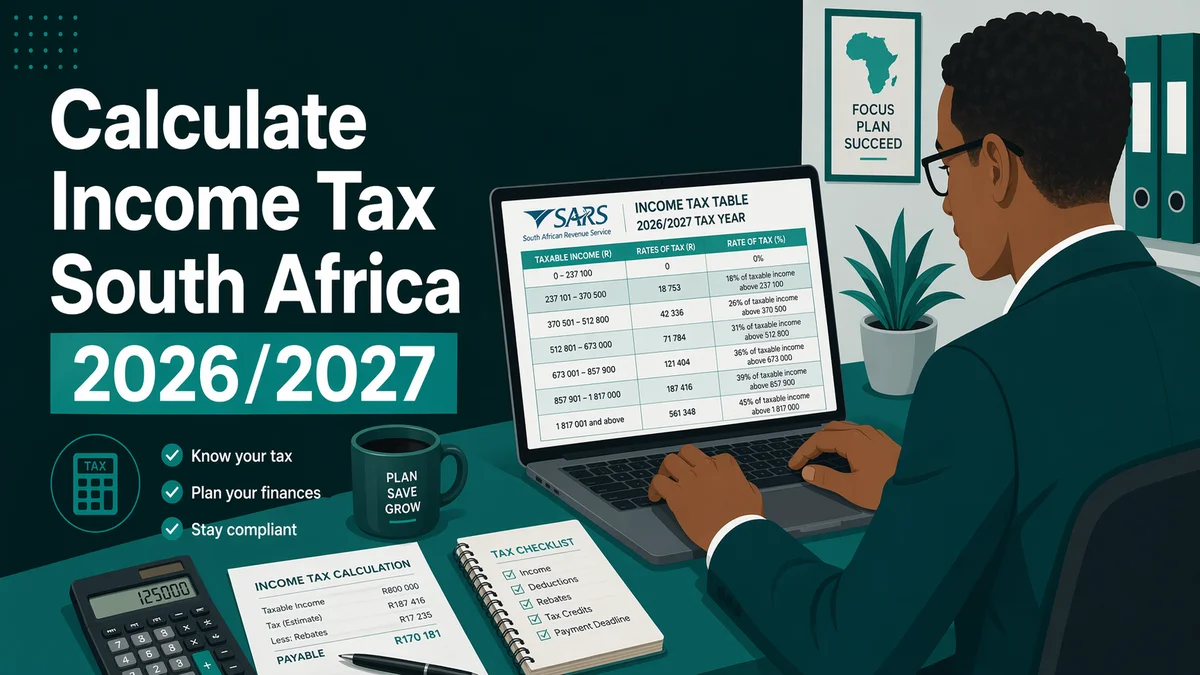
2026/2027 SARS Income Tax Brackets
These are the official SARS tax brackets for the 2026/2027 tax year (1 March 2026 — 28 February 2027):
| Taxable Income (Annual) | Marginal Rate | Base Tax | Tax on Excess |
|---|---|---|---|
| R0 – R245,100 | 18% | R0 | 18% of taxable income |
| R245,101 – R383,100 | 26% | R44,118 | + 26% above R245,100 |
| R383,101 – R530,200 | 31% | R79,998 | + 31% above R383,100 |
| R530,201 – R695,800 | 36% | R125,599 | + 36% above R530,200 |
| R695,801 – R887,000 | 39% | R185,215 | + 39% above R695,800 |
| R887,001 – R1,878,600 | 41% | R259,783 | + 41% above R887,000 |
| R1,878,601 and above | 45% | R666,339 | + 45% above R1,878,600 |
Income Tax Calculator — South Africa 2026/2027
Enter your details below to calculate your exact annual income tax and monthly take-home pay using the official SARS 2026/2027 rates:
Step-by-Step Income Tax Calculation Method
Here is exactly how SARS calculates your annual income tax — the same method used by employers for monthly PAYE:
Tax Rebates and Tax Thresholds 2026/2027
Tax rebates are fixed amounts that reduce your final tax bill — they are NOT deductions from income. Every South African taxpayer receives a primary rebate:
| Rebate | Annual Amount | Cumulative Total | Who Qualifies |
|---|---|---|---|
| Primary Rebate | R17,820 | R17,820 | All taxpayers |
| Secondary Rebate | R9,765 | R26,679 | Age 65 – 74 |
| Tertiary Rebate | R3,249 | R29,824 | Age 75 and older |
| Age Group | Tax-Free Threshold (Annual) | Monthly Equivalent |
|---|---|---|
| Under 65 | R99,000 | R8,250/month |
| 65 – 74 years | R153,250 | R12,771/month |
| 75 years and older | R171,300 | R14,275/month |
Medical Aid Tax Credits 2026/2027
Medical aid tax credits (MTC) reduce your tax payable — not your taxable income. They are applied after rebates:
| Medical Aid Member | Monthly Credit | Annual Credit |
|---|---|---|
| Principal member (yourself) | R376 | R4,512 |
| First dependant | R376 | R4,512 |
| Each additional dependant | R254 | R3,048 |
For example, a family of 4 (yourself + 3 dependants) would have annual MTC of: R4,368 + R4,368 + R2,952 + R2,952 = R14,640/year — directly reducing your tax bill.
Key Deductions That Reduce Your Taxable Income
Pension Fund / RA
Maximum 27.5% of taxable income or remuneration — whichever is greater — capped at R430,000/year. Unused deductions carry forward to future years.
Travel Allowance
Business km × SARS approved rate for your vehicle value. Requires a logbook. 80% of travel allowance is included in taxable income — the logbook deduction offsets this.
Home Office
Proportional home expenses for a dedicated workspace — calculated as (office m² ÷ total m²) × qualifying annual costs. Employer must permit home working in writing.
Section 18A Donations
Donations to SARS-approved PBOs — deductible up to 10% of taxable income. Requires a valid Section 18A receipt from the organisation.
Worked Calculation Examples — 2026/2027
Example 1 — R25,000/month salary, under 65, no medical aid, no RA
| Annual income | R300,000 |
| Gross tax: R44,118 + 26% × (R300,000 − R245,100) | R44,118 + R14,274 = R58,392 |
| Less primary rebate | − R17,820 |
| Annual tax payable | R41,157 |
| Monthly PAYE | R3,430/month |
| Monthly take-home | R21,570/month |
Example 2 — R55,000/month salary, under 65, 2 medical aid members, R5,000/month RA
| Annual gross income | R660,000 |
| Less RA deduction (R5,000 × 12) | − R60,000 |
| Taxable income | R600,000 |
| Gross tax: R125,599 + 36% × (R600,000 − R530,200) | R125,599 + R25,128 = R150,729 |
| Less primary rebate | − R17,820 |
| Less medical aid credits (2 × R376 × 12) | − R9,024 |
| Annual tax payable | R124,758 |
| Monthly PAYE | R10,397/month |
| Monthly take-home (after PAYE + UIF) | R43,878/month |
Example 3 — R15,000/month salary, under 65, no medical aid, no RA
| Annual income | R180,000 |
| Gross tax: R180,000 × 18% | R32,400 |
| Less primary rebate | − R17,820 |
| Annual tax payable | R15,165 |
| Monthly PAYE | R1,264/month |
| Monthly take-home | R13,586/month |
Marginal vs Effective Tax Rate — What Is the Difference?
Many South Africans confuse their marginal tax rate with their effective tax rate. Here is the key difference:
| Concept | Definition | Example (R420,000 income) |
|---|---|---|
| Marginal Rate | The rate applied to your last rand of income | 31% (falls in R383,101–R530,200 bracket) |
| Effective Rate | Total tax ÷ total income — your average rate | Approximately 18–20% after rebates |
| Why it matters | Marginal rate is used for decisions about extra income | Every extra rand earned at R420k is taxed at 31% |
Understanding your marginal rate is essential for decisions like whether to invest in an RA — since every rand contributed saves tax at your marginal rate. Use our income tax calculator to see both your marginal and effective rates.
Ready to file your tax return and claim any refund you are owed for 2026/2027?
File Your SARS Tax Return →