
Planning for retirement in South Africa involves understanding complex tax implications that can significantly impact your retirement income. Whether you’re contributing to a pension fund, provident fund, or retirement annuity, knowing how your retirement savings will be taxed is essential for making informed financial decisions. With the introduction of the two-pot retirement system in 2024 and ongoing tax regulations for 2026, South African workers need accurate tools and comprehensive knowledge to maximize their retirement benefits while minimizing tax liability. This definitive guide covers everything you need to know about retirement tax calculations, contribution limits, withdrawal tax tables, the two-pot system, and strategies to optimize your retirement savings for 2026 and beyond.
Understanding Retirement Funds in South Africa
Before diving into tax calculations, it’s crucial to understand the different types of retirement funds available in South Africa and how they work. Each type has distinct characteristics, rules, and tax implications that affect your retirement planning strategy.
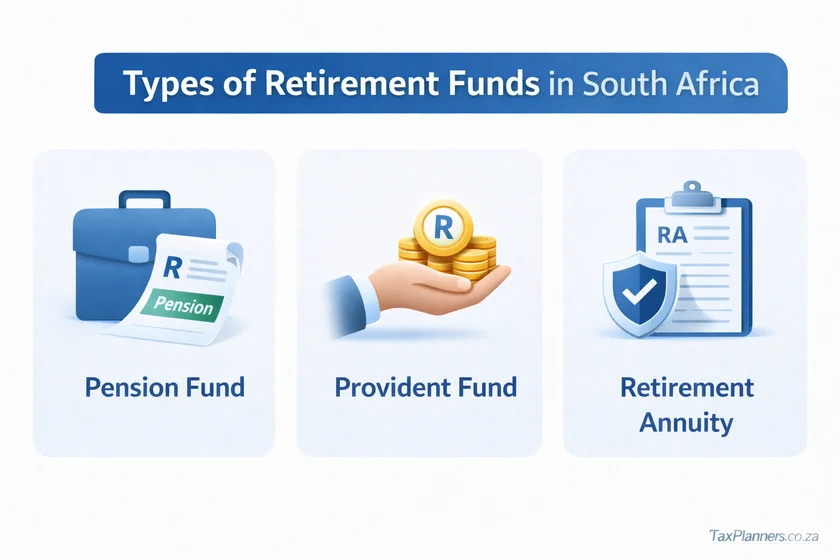
Pension Funds
Pension funds are employer-sponsored retirement savings vehicles where both you and your employer contribute toward your retirement. Key features include:
- Contributions are made through monthly salary deductions
- At retirement, you can take up to one-third as a lump sum
- The remaining two-thirds must be used to purchase an annuity (monthly pension)
- If the total value is less than R247,500, you can take the entire amount as a lump sum
- Subject to the two-pot retirement system from September 2024
Provident Funds
Provident funds are similar to pension funds but historically offered more flexibility at retirement. However, recent reforms have aligned their rules more closely with pension funds:
- Also employer-sponsored with salary deductions
- Members who were 55 or older on 1 March 2021 can still take their entire benefit as a lump sum at retirement
- Younger members are now subject to the one-third lump sum / two-thirds annuity rule
- Covered by the two-pot system for new contributions
Retirement Annuities (RAs)
Retirement annuities are private retirement savings products independent of your employer. They’re ideal for self-employed individuals or those wanting additional retirement savings:
- You contribute independently, not through an employer
- Cannot be accessed before age 55 (except for emigration after 3 years of non-residence)
- At retirement: one-third can be taken as a lump sum, two-thirds must buy an annuity
- Contributions are tax-deductible up to 27.5% of taxable income (capped at R350,000 annually)
- Investment growth is completely tax-free until retirement
Preservation Funds
When you change jobs, you can transfer your pension or provident fund into a preservation fund. These allow your retirement savings to continue growing tax-free while preserving them for retirement. You’re allowed one withdrawal before retirement, after which the funds are locked until you reach retirement age.
Tax Benefits of Retirement Fund Contributions in 2026
One of the most powerful incentives for saving toward retirement in South Africa is the generous tax deduction on contributions. Understanding how this works can save you thousands of rands in tax while securing your financial future.
The 27.5% Contribution Deduction Rule
Since 1 March 2016, South Africa has had a unified approach to retirement fund tax deductions. Whether you contribute to a pension fund, provident fund, or retirement annuity, you qualify for a tax deduction of up to 27.5% of your taxable income or remuneration (whichever is higher), subject to an annual cap of R350,000.
This means:
- If your taxable income is R400,000, you can deduct up to R110,000 (27.5% of R400,000)
- If your taxable income is R1,500,000, you can deduct up to R350,000 (27.5% would be R412,500, but the cap applies)
- Both your contributions AND your employer’s contributions count toward this limit
How Much Tax Do You Save?
The actual tax saving depends on your marginal tax rate. Let’s look at practical examples for 2026:
Example 1: Middle Income Earner
- Taxable income: R450,000 per year
- Retirement contribution: R60,000 per year (R5,000 per month)
- Marginal tax rate: 31%
- Tax saving: R60,000 × 31% = R18,600 per year
Example 2: Higher Income Earner
- Taxable income: R900,000 per year
- Maximum deductible contribution: R247,500 (27.5% of R900,000)
- Marginal tax rate: 41%
- Tax saving: R247,500 × 41% = R101,475 per year
Carryover of Excess Contributions
If your contributions exceed the 27.5% / R350,000 limit in any tax year, the excess amount isn’t lost. It carries forward to the next tax year and can be deducted then, subject to that year’s limits. When you eventually retire, any accumulated excess contributions that weren’t deducted reduce the taxable portion of your retirement lump sum.
Retirement Lump Sum Tax Tables for 2026
When you retire and take a lump sum from your retirement fund, SARS applies special concessionary tax rates that are generally more favorable than ordinary income tax rates. Understanding these tables helps you plan how much to take as a lump sum versus converting to a monthly pension.
Retirement Fund Lump Sum Benefit Tax Table (2026)
This table applies when you retire, are retrenched, or receive a death benefit. The rates remained unchanged for the 2026 tax year:
| Taxable Income (R) | Rate of Tax |
| R0 – R550,000 | 0% (Tax-free) |
| R550,001 – R770,000 | 18% of amount above R550,000 |
| R770,001 – R1,155,000 | R39,600 + 27% of amount above R770,000 |
| R1,155,001 and above | R143,550 + 36% of amount above R1,155,000 |
Withdrawal Benefit Tax Table (Early Withdrawals)
If you withdraw from your retirement fund before retirement (e.g., when resigning from your job), different and harsher tax rates apply. This discourages early access to retirement savings:
| Taxable Income (R) | Rate of Tax |
| R0 – R27,500 | 0% (Tax-free) |
| R27,501 – R726,000 | 18% of amount above R27,500 |
| R726,001 – R1,089,000 | R125,730 + 27% of amount above R726,000 |
| R1,089,001 and above | R223,740 + 36% of amount above R1,089,000 |
Important: Cumulative Taxation of Lump Sums
All retirement fund lump sums are taxed on a cumulative basis from 1 October 2007. This means SARS tracks every lump sum you receive and considers the total when calculating tax on subsequent withdrawals. The R550,000 tax-free threshold is a once-in-a-lifetime benefit.
For example: If you withdrew R200,000 when changing jobs (using R200,000 of your tax-free allowance), you only have R350,000 of tax-free benefit remaining for retirement. When you eventually retire and take a lump sum, only the first R350,000 will be tax-free, and the rest is taxed according to the retirement lump sum table.
Understanding the Two-Pot Retirement System (2024-2026)
The two-pot retirement system, implemented on 1 September 2024, represents the most significant change to South Africa’s retirement landscape in years. This system fundamentally changes how retirement contributions are structured and accessed, providing both flexibility for emergencies and stronger preservation for long-term retirement security.
How the Two-Pot System Works
Under the two-pot system, your retirement savings are divided into three components:
1. Vested Component (Your Existing Savings)
- Contains all retirement savings you had on 31 August 2024
- Existing withdrawal rules still apply to this component
- Can be accessed when you resign, retire, or change jobs (subject to fund rules)
- A seed capital amount (10% of your balance or R30,000, whichever is lower) was transferred from this pot to your savings pot on 1 September 2024
2. Savings Component (Emergency Access)
- Receives one-third (33.33%) of all new contributions from 1 September 2024 onwards
- Can be accessed once per tax year (1 March to 28 February) without resigning or leaving your job
- Minimum withdrawal: R2,000 (before fees and tax)
- No maximum withdrawal limit – you can access the full savings pot balance
- Withdrawals are taxed at your marginal income tax rate (not the concessionary retirement lump sum rates)
- SARS may deduct outstanding tax debt from your withdrawal before paying you
3. Retirement Component (Preservation for Retirement)
- Receives two-thirds (66.67%) of all new contributions from 1 September 2024 onwards
- Completely locked until retirement – cannot be accessed when changing jobs
- Must be used to purchase a pension/annuity at retirement
- Can only take one-third as a lump sum at retirement
- If total of retirement + vested components is less than R165,000 at retirement, you can take it all in cash
Tax Implications of Two-Pot Withdrawals
The tax treatment of two-pot withdrawals is crucial to understand:
Savings Pot Withdrawals:
- Taxed at your marginal tax rate (18% to 45% depending on your income)
- Tax is withheld by your retirement fund before payment
- You must declare the withdrawal on your annual tax return
- Does NOT qualify for the R550,000 tax-free retirement benefit
Example: If you earn R600,000 per year (36% marginal tax rate) and withdraw R50,000 from your savings pot, you’ll pay R18,000 in tax, receiving R32,000 (before admin fees).
Retirement Component at Retirement:
- The one-third lump sum is taxed using the favorable retirement lump sum tax table
- Qualifies for the R550,000 tax-free threshold (if not previously used)
- The two-thirds annuity income is taxed as regular income with age-related tax thresholds
Should You Withdraw from Your Savings Pot?
While the savings pot provides valuable emergency access, financial experts caution against frequent withdrawals. Consider this comparison:
Scenario: Two individuals, both age 40, contributing R1,000 monthly to retirement for 20 years with 10% annual growth:
- Person A: Never withdraws from savings pot → Accumulates R723,987 at age 60
- Person B: Withdraws 10% annually from savings pot → Accumulates only R230,175 at age 60
The long-term impact of regular withdrawals is devastating. Person B ends up with less than one-third of Person A’s retirement savings. This demonstrates why the savings pot should truly be reserved for genuine emergencies, not routine expenses.
Tax on Monthly Pension and Annuity Income
After retirement, the portion of your retirement savings converted to an annuity (monthly pension) is taxed as ordinary income. However, retirees benefit from higher tax thresholds and additional tax rebates that reduce their tax burden.
Age-Related Tax Thresholds for 2026
Your tax threshold determines how much income you can receive before paying any tax. For the 2026 tax year, the thresholds are:
- Under 65 years: R95,750 per year (R7,979 per month)
- Age 65 to 74 years: R148,217 per year (R12,351 per month)
- Age 75 and older: R165,689 per year (R13,807 per month)
These thresholds result from the primary, secondary, and tertiary tax rebates applied against calculated tax liability. If your total annual income (pension, investment income, part-time work) is below these thresholds, you pay no income tax.
Example: Tax on Pension Income
Example 1: Retiree Under 65
- Annual pension income: R180,000
- Tax before rebates: R180,000 falls in 18% bracket = R15,165
- Less primary rebate: R17,235
- Tax payable: R0 (rebate exceeds tax, so no tax owed)
Example 2: Retiree Age 68
- Annual pension income: R300,000
- Tax before rebates: R36,045
- Less primary rebate: R17,235
- Less secondary rebate (65+): R9,444
- Total rebates: R26,679
- Tax payable: R9,366 per year (R780 per month)
Common Issues with Pension Tax Deductions
Many pension providers do not deduct the correct amount of tax monthly. You might receive your full pension without any tax deducted, leading to an unexpected tax bill when filing your annual return. To avoid this:
- Check your monthly pension payslip for tax deductions
- Contact your pension provider to arrange correct tax deductions
- Set aside money monthly if no tax is being deducted
- File your tax return annually even if you’re retired
How to Calculate Your Retirement Tax Liability
Understanding how to calculate retirement tax helps you make informed decisions about how much to contribute, when to retire, and how to structure your retirement income. Here’s a comprehensive step-by-step approach.
Calculating Tax on Retirement Lump Sums
Step 1: Determine Your Gross Lump Sum
Start with the total lump sum you’re receiving from your retirement fund. This is your gross amount before any deductions.
Step 2: Subtract Non-Deductible Contributions
If you made contributions that didn’t qualify for tax deductions (excess contributions carried forward), subtract these from your gross lump sum. This reduces the taxable portion.
Step 3: Check Previous Lump Sum Withdrawals
Add all previous retirement lump sums received since 1 October 2007. This cumulative amount determines which tax bracket applies. You can check your lump sum history on SARS eFiling or contact SARS directly.
Step 4: Apply the Retirement Lump Sum Tax Table
Use the cumulative total to determine tax owed:
Example: You’re retiring with a R900,000 lump sum. You previously withdrew R150,000 when changing jobs five years ago.
- Cumulative total: R900,000 + R150,000 = R1,050,000
- This falls in the R770,001 – R1,155,000 bracket
- Tax calculation: R39,600 + (27% × [R1,050,000 – R770,000])
- Tax: R39,600 + (27% × R280,000) = R39,600 + R75,600 = R115,200
- Less tax already paid on previous R150,000 withdrawal: R0 (first R550,000 tax-free)
- Tax on current R900,000 lump sum: R115,200
- Net amount received: R900,000 – R115,200 = R784,800
Calculating Tax on Annual Pension Income
Your monthly pension is taxed as ordinary income using the standard PAYE tax tables. However, retirees benefit from age-related rebates that create higher tax thresholds.
The process:
- Calculate annual pension income
- Add any other income (investments, rental, part-time work)
- Apply standard income tax tables
- Subtract age-appropriate tax rebates
- Apply medical tax credits if applicable
Tax-Efficient Retirement Planning Strategies for 2026
Maximizing your retirement income while minimizing tax requires strategic planning throughout your working years and at retirement. Here are proven strategies to optimize your tax position.
During Your Working Years
1. Maximize Tax-Deductible Contributions
Contribute the maximum allowed 27.5% of taxable income (up to R350,000) annually. Every rand contributed reduces your current tax bill while building retirement wealth. If you earn R600,000 annually and contribute the maximum R165,000, you save approximately R59,400 in tax (at 36% marginal rate) while investing in your future.
2. Choose the Right Retirement Vehicle
- Employer pension/provident funds: Convenient through payroll, often with employer matching
- Retirement annuities: Flexible, independent of employer, cannot be accessed early (good for discipline)
- Combination approach: Use both for maximum flexibility and tax benefits
3. Avoid Early Withdrawals
Early withdrawals face harsh tax treatment (only R27,500 tax-free vs. R550,000 at retirement) and permanently reduce your retirement savings. If you change jobs, transfer your retirement fund to a preservation fund rather than cashing out. The long-term cost of early withdrawal is devastating due to lost compound growth and higher taxes.
4. Use the Two-Pot System Wisely
The savings pot should be your last resort, not your first. Before tapping into retirement savings, consider:
- Building a separate emergency fund (3-6 months’ expenses)
- Reducing expenses or increasing income
- Using other savings or investments first
Remember: Savings pot withdrawals are taxed at your marginal rate, which can be 36-45% for higher earners. This significantly reduces the value of your withdrawal.
At Retirement
1. Optimize Your Lump Sum vs. Annuity Split
Consider taking the maximum one-third as a lump sum if:
- You need to settle debt (especially high-interest debt)
- You have major one-time expenses (home repairs, medical procedures)
- Your lump sum falls within the R550,000 tax-free threshold
Consider taking less than one-third if:
- You want maximum monthly income security
- Your lump sum would be heavily taxed (over R770,000)
- You’re concerned about managing a large lump sum
2. Time Your Retirement Strategically
If possible, retire early in the tax year (March/April) to benefit from the full year’s tax thresholds and rebates. This can reduce tax on your final salary and early pension payments.
3. Consider Tax-Free Investments
After receiving your retirement lump sum, invest a portion in tax-free savings accounts (up to R36,000 annually, R500,000 lifetime limit). Returns from these investments (interest, dividends, capital gains) are completely tax-free, providing tax-efficient supplementary income.
4. Maintain Medical Aid Membership
Medical tax credits continue after retirement. For 2026, you receive R364 monthly for yourself and your first dependent, plus R246 monthly for additional dependents. These credits directly reduce your tax liability. Additionally, retirees can claim out-of-pocket medical expenses above certain thresholds.
Frequently Asked Questions About Retirement Tax in South Africa
Q: Can I contribute to multiple retirement funds and claim the full deduction on each?
No. The 27.5% / R350,000 annual limit applies to the TOTAL of all your retirement fund contributions combined. If you contribute to both a pension fund through your employer and a private retirement annuity, the sum of both contributions cannot exceed the limit for maximum tax deduction.
Q: What happens if I emigrate from South Africa? Can I access my retirement funds?
From 1 March 2021, you can only access your retirement annuity after ceasing to be a South African tax resident for three consecutive years. Pension and provident funds can be accessed earlier when you emigrate, but this triggers withdrawal tax (not the favorable retirement tax). Plan carefully and consult a tax advisor before emigrating.
Q: Are foreign pensions taxed in South Africa if I become a tax resident?
Yes. From 1 March 2026, South Africa is removing the exemption for foreign retirement benefits. If you’re a South African tax resident receiving a foreign pension or lump sum, it will be taxable in South Africa. Double taxation agreements may provide relief, but you should consult a tax professional to understand your specific situation.
Q: Do I need to file a tax return if I only receive pension income?
It depends on your total income. If your pension income is below the tax threshold for your age (R95,750 under 65, R148,217 for 65-74, R165,689 for 75+), and you have no other income, you may not need to file. However, it’s often wise to file anyway to claim refunds if too much tax was withheld, to comply with SARS requirements, and to maintain a clear tax record.
Q: Can I change my mind after withdrawing from my two-pot savings?
No. Once your retirement fund submits your withdrawal application to SARS, the decision is final and cannot be reversed. This is why it’s crucial to carefully consider whether you genuinely need to access your savings pot before submitting a withdrawal request.
Q: How does SARS know about my previous retirement fund withdrawals?
Retirement fund administrators must report all lump sum payments to SARS. SARS maintains a cumulative record of all your retirement lump sums since 1 October 2007. You can view your lump sum history on SARS eFiling under your tax profile, or request it from SARS directly.
Q: Can I defer taking my retirement lump sum?
It depends on your fund rules. Some funds allow you to defer taking a lump sum, which can be beneficial for tax planning. If you don’t need the lump sum immediately and your income is temporarily high, deferring to a lower-income year can reduce your tax liability. Check with your fund administrator about deferral options.
Q: Are living annuity withdrawals taxed differently from guaranteed annuities?
No, both are taxed as ordinary income. However, living annuities offer flexibility in withdrawal amounts (between 2.5% and 17.5% of capital annually), allowing you to manage your tax bracket. Guaranteed annuities provide fixed monthly income. Both are subject to the same income tax rates and age-related rebates.
When to Get Professional Tax and Retirement Planning Help
While this guide provides comprehensive information about retirement tax calculations, some situations warrant professional assistance from qualified tax practitioners and financial advisors.
Consider Professional Help When:
- Your retirement fund value exceeds R2 million
- You have multiple retirement funds and complex contribution histories
- You’re planning to emigrate or have foreign retirement income
- You have previous early withdrawals and are uncertain about cumulative tax calculations
- You’re considering business or property investments with retirement capital
- You need estate planning integrated with retirement planning
- You’re facing retirement within the next 2-3 years and need comprehensive planning
Types of Professionals to Consult
Registered Tax Practitioners:
- Specialized in tax law and SARS compliance
- Can handle complex tax calculations and disputes with SARS
- Assist with tax return filing and optimization
Certified Financial Planners (CFP):
- Provide holistic retirement planning beyond just tax
- Help structure retirement income for sustainability
- Advise on investment strategies for retirement capital
Conclusion: Take Control of Your Retirement Tax Planning
Understanding retirement tax in South Africa empowers you to make informed decisions that can save thousands of rands and secure a comfortable retirement. The key principles to remember for 2026 and beyond are:
- Maximize tax-deductible contributions throughout your working life (up to 27.5% of income, capped at R350,000)
- Avoid early withdrawals when possible – they trigger harsh taxes and derail retirement goals
- Use the two-pot savings component only for genuine emergencies, not routine expenses
- Understand cumulative taxation – your lifetime retirement lump sum history affects current tax
- Take advantage of favorable retirement lump sum tax rates (R550,000 tax-free once in a lifetime)
- Plan your lump sum vs. annuity split carefully based on your needs and tax position
- Benefit from age-related tax thresholds and rebates in retirement
- Use retirement tax calculators to estimate your liability before making decisions
- Seek professional advice for complex situations or large retirement funds
Retirement planning is a marathon, not a sprint. The decisions you make today about contributions, withdrawals, and tax planning will significantly impact your quality of life in retirement. With South Africa’s retirement landscape evolving through reforms like the two-pot system and potential future tax changes, staying informed and proactive is essential.
Use the retirement tax calculator tools available, review your contributions regularly, and adjust your strategy as your income and circumstances change. Most importantly, prioritize consistent contributions throughout your career – the tax benefits are immediate, but the compound growth over decades is truly transformational for your retirement security.
Remember that less than 6% of South Africans retire comfortably. Don’t leave your financial future to chance. Master the tax rules, maximize your benefits, and commit to building the retirement you deserve.