
After the Click:
Your Complete 2026 SARS
PAYE Tax Return Journey
Everything that happens from the moment you hit “Submit” — assessments, refunds, audits, penalties, and your rights as a South African taxpayer.
You’ve filed your tax return. Maybe you wrestled with eFiling for hours, or maybe SARS auto-assessed you before you even logged in. Either way, a question sits in the back of your mind: now what? This guide walks you through every stage of the post-submission journey — explained in plain language, updated for 2026’s tightened enforcement landscape.
What Is PAYE — and Why Does It Still Concern You After Submission?
PAYE — Pay As You Earn — is the mechanism through which your employer deducts tax from your salary every month and remits it directly to the South African Revenue Service. By the time you sit down to file your annual return, a substantial portion of what you owe may already have been paid. But “already paid” does not mean “already correct.”
The filing season you just navigated exists precisely to reconcile what was withheld throughout the year against what you actually owe. Deductions, medical credits, travel allowances, home office expenses, retirement annuity contributions — none of these are captured automatically in the PAYE calculation your employer uses. Your ITR12 return is where those adjustments are made, and the ITA34 that follows tells you the result.
For employers, PAYE is an ongoing monthly obligation. Every EMP201 declaration and payment that arrives at SARS by the 7th of the month — or the preceding business day when the 7th falls on a weekend or public holiday — feeds directly into the annual reconciliation process. The two are inseparable. Understanding both gives you a far clearer picture of where you stand.
when banking details
are correct
SARS to close an
audit case
lodge a notice of
objection
tax debt as at
Jan 2026
The Notice of Assessment — Your ITA34 Explained
The moment SARS has processed your return, they issue a formal document called the Notice of Assessment, or ITA34. This arrives via email, SMS, and is always accessible on your eFiling profile or SARS MobiApp. It is the single most important document you will receive after submission, and it deserves careful reading.
The ITA34 shows you three things: your total taxable income as SARS has calculated it, the tax they believe is due, and the final outcome — either an amount refundable to you, or an amount you must pay. A minus sign next to a figure means SARS owes you money. A positive figure means you owe SARS.
Your ITA34 contains your personal details and tax reference number at the top — verify these first. Below that, a summary shows income, deductions, and SARS-adjusted figures side by side with what you declared. Any lines where SARS has made changes will show their revised amounts. At the foot of the document, the payment due date (if you owe) or the refund confirmation is clearly stated.
There is also an important flag to check: the ITA34 includes a field labelled Audit: Yes or Audit: No. If it says Yes, your return has been selected for verification. This does not mean you have done anything wrong — it means SARS wants documentary backup before releasing any refund or closing your assessment. More on that in Section 5.
You can also access your Income Tax Statement of Account (ITSA) on eFiling. While the ITA34 shows the result of a specific year’s assessment, the ITSA gives you a running balance — particularly useful if you have had multiple assessments issued, or if you want to confirm the exact date a refund will hit your bank account.
If SARS issued you an auto-assessment — common for taxpayers with straightforward IRP5 income — and you agree with it, you do nothing. Log in, verify the figures match your reality, and if a refund is due, simply close the app and wait. If you disagree, file your own return before the deadline — this overrides the auto-assessment. Never blindly accept: an incorrect return you accepted can still be penalised later.
Receiving Your Refund — Timelines, Delays & What to Check
For many individual taxpayers, the entire annual filing exercise is motivated by one thing: getting money back. If PAYE deducted throughout the year exceeded your actual tax liability — because of medical credits, travel deductions, or retirement contributions — SARS must refund the difference.
When your return is straightforward and your banking details on file with SARS are current and verified, refunds are typically credited to your account within 72 hours of the ITA34 being issued. That is fast — and intentionally so. SARS has worked to automate this process for uncomplicated cases.
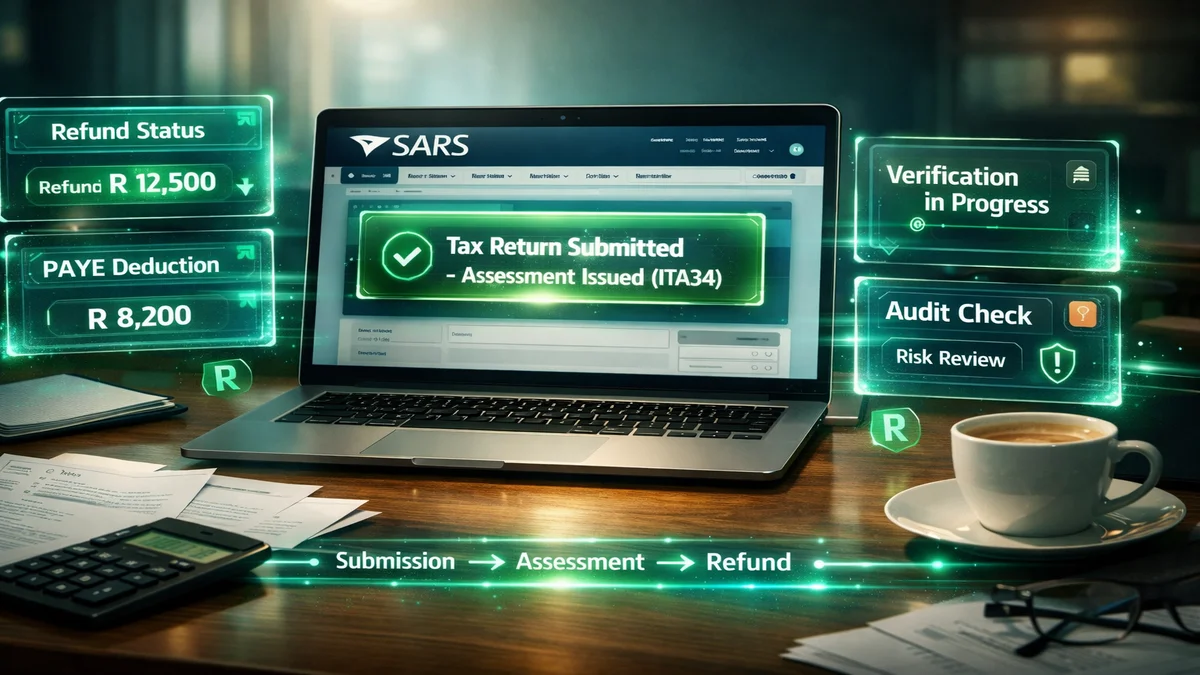
ITA34 Issued
SARS processes your return and issues the Notice of Assessment. Check eFiling or MobiApp. Verify the refund amount and confirm your banking details are correct.
Audit: No → Refund Released
If not selected for audit, and banking details are verified, SARS initiates the electronic transfer. Most standard refunds reflect within 2–3 business days of the ITA34 date.
Audit: Yes → Supporting Documents Requested
SARS sends a verification letter listing documents required (payslips, logbooks, medical receipts, lease agreements, etc.). Upload these via eFiling — not by email.
Audit Closure → Letter of Completion
Once all documents are submitted, SARS has 21 business days to conclude the audit and issue a Letter of Completion — plus a revised ITA34 if the refund amount has changed.
Final Refund Payment
After the Letter of Completion arrives, expect the refund within 7 business days. Complex multi-year audits may take up to 90 business days in total.
Common reasons your refund is delayed: outdated banking details, an outstanding return from a prior year, an unresolved tax debt (SARS will offset the refund against what you owe), or a fraud-risk flag triggered by large deductions. If a refund or debt is less than R100, SARS rolls it over to the next tax year rather than processing a payment.
To update banking details: log into eFiling, navigate to “Maintain SARS Registered Details,” and update your bank account information. Be aware that from 2025, SARS introduced a verification step where taxpayers must select from their already-verified banking details rather than manually entering new ones — a fraud-prevention measure.
SARS will never send you an email asking you to click a link to receive your refund, nor will they ask for a fee before releasing money. As filing season approaches, phishing attempts that mimic SARS communications are widespread. Report suspected scams to [email protected] immediately. SARS communicates refund status through eFiling and the MobiApp — not through WhatsApp groups or unofficial websites.
When You Owe SARS — Paying, Arranging & Project AmaBillions
If your ITA34 shows a positive balance — meaning you owe SARS — the payment due date is displayed directly on the notice under “Details.” This deadline is not optional, and 2026 is not the year to treat it as one. SARS’s enforcement landscape has fundamentally changed.
You can pay via eFiling, the SARS MobiApp, or through your bank’s EFT system using SARS’s account details. If you cannot pay in full, SARS allows payment arrangements — formally called Deferral of Payment agreements — which can be arranged through eFiling’s digital channels. Ignoring the debt entirely, however, can trigger consequences that escalate rapidly.
“South Africa’s total outstanding tax debt has climbed to R646-billion as at 31 January 2026 — and SARS has made collecting it a national priority.”
Project AmaBillions · SARS Enforcement Update, March 2026Project AmaBillions is SARS’s active enforcement campaign, funded with additional government resources and driven by AI-powered risk-selection tools. The initiative targets outstanding tax debts of all sizes — even small balances that once would have gone unnoticed are now being flagged and pursued. By 31 January 2026, SARS had already collected R79.4 billion in tax debt, though they were still R15 billion short of their internal targets — motivation that makes further enforcement even more certain.
Under this campaign, SARS has the legal authority to issue third-party appointment notices directly to your bank or employer, compelling them to deduct money from your account or salary without your direct involvement. They can also secure civil judgments, attach movable assets, and initiate broader legal proceedings. The best way to avoid any of this is immediate, transparent communication — either by paying or by formalising a repayment arrangement.
Enforcement Powers SARS Can Activate
- Third-party appointment notices to banks — deductions made directly from your account
- Employer instructions to deduct outstanding amounts from your salary
- Civil judgment proceedings through the courts
- Attachment of movable assets
- Interest accruing daily on outstanding balances from the due date
- Administrative penalties escalating monthly on outstanding returns
Audits & Verification — What SARS Is Looking For in 2026
Being selected for audit or verification is a routine part of SARS’s operations — it does not automatically imply wrongdoing. SARS uses automated risk-selection tools that flag returns based on anomalies: unusually large deductions relative to income, claims without corresponding third-party data, or returns that deviate significantly from prior years.
When selected, SARS will send a letter (accessible on eFiling) requesting specific supporting documents. These commonly include:
- IRP5 certificates and payslips matching your declared employment income
- Detailed travel logbook — must comply fully with SARS requirements (date, odometer, destination, purpose for every trip)
- Medical expense receipts and medical aid contribution certificates
- Rental income lease agreements and expense invoices
- Home office floor-plan and expense breakdown (if claiming home office deduction)
- Retirement annuity fund contribution certificates (RA tax certificates)
- IT3(b) investment income certificates from banks and brokers
- Any other supporting documents specified in SARS’s verification letter
All documents must be uploaded through eFiling — not emailed directly. SARS has 21 business days after receiving your complete document pack to issue a Letter of Completion and a revised ITA34. For cases involving multiple tax years or complex income structures, this can extend to 90 business days.
The critical lesson from thousands of failed audits: incomplete documents reset the clock. If you submit an incomplete set, SARS may request additional items, restarting the 21-day window. Submit everything simultaneously, clearly labelled, and in full.
You are legally required to retain all tax records for a minimum of 5 years from the date of submission. Companies must keep records for at least 7 years under the Companies Act, and close corporations must retain accounting records for 15 years. If you receive an audit notification, preserve everything until the matter is fully closed — regardless of these standard periods.
The 2026 Employer Filing Season — Stricter Than Ever
If you are an employer — whether running a small business or a large enterprise — the 2026 filing season carries a harder edge than any before it. SARS has made this transition very clear: the grace periods that once allowed time to correct missing employee information are gone.
The Employer Annual Declaration period runs from 1 April to 31 May 2026. During this window, every employer must submit their annual EMP501 reconciliation — matching monthly EMP201 payments against employee tax certificates (IRP5s) issued for the period March 2025 to February 2026.
| Obligation | Deadline / Period | Key Notes |
|---|---|---|
| Monthly EMP201 | 7th of each month (or preceding business day) | Covers PAYE, UIF (2% split), SDL (1% payroll). All submissions via eFiling or e@syFile. |
| IRP5 Certificates Issued to Employees | By ~29 April 2026 | Must be issued within 60 days of tax year end (28 Feb 2026). |
| EMP501 Annual Reconciliation | 1 April – 31 May 2026 | Full March 2025–February 2026 period. Mandatory Income Tax numbers now strictly enforced. |
| Mandatory Income Tax Numbers | From February 2026 onward | EMP501 submissions without valid Tax Reference Numbers for all employees will be rejected. |
| Late EMP501 Penalty | If submitted after 31 May 2026 | 1% of annual PAYE liability per month, escalating 1% monthly to a maximum of 10%. |
The mandatory Income Tax Reference Number requirement is the defining change of 2026. Previously, e@syFile would warn employers about missing employee tax numbers but still allow submission. That tolerance has ended. From the 2026 reconciliation period, any EMP501 without valid numbers for all employees whose earnings exceed the tax threshold (R95,750 per annum for individuals under 65) will be rejected outright, and administrative penalties follow.
Employers can register employees using the ITREG or BundleReg tools on eFiling or e@syFile, or by visiting a SARS Service Centre with an appointment. Industries with high seasonal, temporary, or contract worker volumes carry the greatest risk — these are often the workers least likely to have tax registration details readily available. Start now, not in April.
Employers with more than 50 employees must use e@syFile Employer (Thin Client version). The Flex version is being phased out. Those with 50 or fewer employees may submit directly via eFiling.
The 2026 Budget Speech introduced specific PAYE-related amendments — including updates to long service award tax treatment, compensation provisions related to death during employment, and a new source code for travel reimbursements linked to prior tax years. The updated BRS (Business Requirements Specification) for PAYE Employer Reconciliation has been released to version 24.0.2. Employers and payroll administrators should review this before submitting any EMP501 to ensure their payroll systems reflect the latest validation rules and source code changes.
Disagreeing with SARS — Objection, Appeal & Dispute
Receiving an ITA34 you disagree with does not mean you must simply accept SARS’s assessment. South African tax law gives you a structured right to challenge any assessment — but you must act within defined timeframes, and the process must be followed precisely.
Request for Remission (RFR)
For penalties and interest specifically. Submit an RFR1 form on eFiling with a clear explanation of the circumstances that prevented compliance. This must be done before you can lodge a full objection against a penalty.
Request for Reasons (RFRE)
Not sure why SARS adjusted your return? Request written reasons before objecting. Filing a valid RFRE automatically extends your objection window by the same period SARS takes to respond.
Notice of Objection (NOO)
You have 80 business days from the date of assessment to lodge a formal objection via eFiling (DISP01 form). The grounds you state here cannot be changed later — be thorough, attach all evidence, and specify exact amounts and source codes.
Notice of Appeal (NOA)
If SARS disallows or partially allows your objection, you may appeal within 30 business days. Disputes under R1 million go to the Tax Board; above R1 million to the Tax Court. Alternative Dispute Resolution (ADR) may be offered.
A critical practical point: SARS operates on a “pay now, argue later” basis. Even while your objection is pending, SARS expects payment of the assessed amount. To avoid judgment and asset attachment during a dispute, you must separately request a Suspension of Payment — this suspends your payment obligation until the dispute is resolved. SARS’s debt collection arm and audit arm do not automatically communicate, so this request must run simultaneously with your objection.
Note that objections cannot be lodged if three or more years have elapsed since the date of assessment — this is a hard statutory limit with very limited exceptions. Act within the original deadlines whenever possible.
Since April 2022, all PAYE disputes and penalty remission requests must be submitted electronically via eFiling. SARS no longer accepts manually filed PAYE disputes. The eFiling platform allows you to dispute up to 12 periods simultaneously on one form for PAYE and VAT. Employment Tax Incentive (ETI) objections, however, must be filed separately from PAYE/UIF/SDL disputes.
Penalties & Interest — The Numbers You Don’t Want to See
The SARS penalty framework is designed to make non-compliance more expensive than compliance. In 2026, with Project AmaBillions in full operation and AI-driven risk selection identifying even small irregularities, the chances of penalties going unnoticed are lower than ever.
| Non-Compliance | Penalty Rate | Maximum |
|---|---|---|
| Late EMP501 submission | 1% of annual PAYE liability per month | 10% (escalates 1% monthly) |
| Outstanding income tax return | Administrative penalty per outstanding return | Up to 200% of tax payable if fraud found |
| Underestimation of provisional tax | Penalty + interest on shortfall | Calculated per SARS prescribed rates |
| Late PAYE / EMP201 payment | 10% of late payment per period | Plus interest accruing daily |
| Missing employee Tax Reference Numbers in EMP501 | Administrative penalty (2026 onwards) | Submission rejected outright |
| Trusts with 2024 + 2025 returns outstanding | Administrative penalty from 1 March 2026 | Both years must be filed to halt escalation |
Interest on outstanding amounts accrues from the due date until the day of full settlement. Unlike penalties, interest cannot generally be waived through an RFR — it follows the debt. This is why even a small deferred liability can compound into a significant obligation within months.
For provisional taxpayers specifically: if your estimate of taxable income falls materially below your actual taxable income, an underestimation penalty may apply — even if you filed and paid on time. The solution is accurate estimation, ideally with a qualified tax practitioner reviewing your IRP6 before submission.
Critical Dates & Deadlines for the 2025/2026 Tax Year
Below is a consolidated reference of the most important SARS deadlines for the 2025/2026 period — covering individual returns, employer obligations, and provisional tax. Always confirm final dates via the Government Gazette or SARS’s official website, as public holidays can shift specific deadlines.
| Date | Obligation | Who |
|---|---|---|
| 6 March 2026 Passed | February EMP201 due (shifted from 7th — Saturday) | All employers |
| 1 March 2026 Active | Admin penalties begin for trusts with 2024 + 2025 returns outstanding | Trusts |
| ~29 April 2026 | IRP5 certificates due to employees (within 60 days of 28 Feb year-end) | All employers |
| 1 April – 31 May 2026 | Employer Annual Declaration (EMP501) window opens | All employers |
| 7th monthly | EMP201 (PAYE, UIF, SDL) due each month | All employers |
| 31 August 2026 | First provisional tax payment for 2026/2027 year (IRP6) | Provisional taxpayers |
| 30 September 2026 | Optional voluntary 3rd provisional tax top-up payment | Provisional taxpayers |
| Filing Season 2026 | Individual ITR12 returns — dates TBC via Government Gazette | Individual taxpayers |
The optional third provisional tax payment (due 30 September each year) is often underused. Making a voluntary top-up reduces interest on any shortfall between your IRP6 estimates and your actual final assessment. For taxpayers with variable income — freelancers, landlords, business owners — this is a powerful tool to smooth out end-of-year surprises. It does not generate a refund automatically but reduces the interest that accumulates if you underestimated.
SARS Digital Tools — eFiling, MobiApp & e@syFile
The era of visiting a SARS branch for routine compliance matters is largely behind us. Every significant interaction — filing, payment, checking your assessment, lodging objections, uploading audit documents — is available digitally. Knowing which platform to use saves significant time.
SARS eFiling (sarsefiling.co.za)
The primary portal for individuals and small employers. File ITR12, EMP201, EMP501, lodge disputes, upload supporting documents, access all correspondence including ITA34 notices, and make payments. Two-factor authentication is now mandatory for foreign taxpayers.
SARS MobiApp
Available on Apple App Store, Google Play, and Huawei App Gallery. Ideal for checking assessment status, viewing ITA34, making payments, and receiving push notifications. Auto-assessment acceptance or rejection is also handled here.
e@syFile™ Employer (Thin Client)
Required for employers with more than 50 employees. Used for bulk EMP501 reconciliations, IRP5 generation, and employee tax number verification. The Flex version is being phased out — ensure you’re on the Thin Client version for 2026.
SARS Online Query System (SOQS)
Available via the SARS website. Use this to retrieve a forgotten tax reference number, submit supporting material for queries, or track open cases — without needing a branch visit or call centre hold time.
Branch visits remain available for complex matters, but appointments are mandatory. Branch walk-ins are no longer accommodated. Make an appointment through the SARS website well in advance, especially during peak filing periods when slots fill quickly.
The SARS Contact Centre can be reached at 0800 00 SARS (7277). For account balance queries, the ITSA on eFiling is faster and more accurate than a call — agents have access to the same system information.