
Tax Brackets South Africa 2026/2027: Complete SARS Income Tax Guide
All 7 income tax brackets, rebates, thresholds and worked examples — updated for the March 2026 Budget.
South Africa has 7 progressive income tax brackets for 2026/2027, ranging from 18% on income up to R245,100 to 45% on income above R1,878,600. Taxpayers under 65 pay zero tax below R99,000 due to the primary rebate of R17,820. Brackets increased 3.4% from 1 March 2026 following the Budget Speech on 25 February 2026.
How Progressive Tax Works in South Africa
South Africa uses a progressive income tax system, which means the more you earn, the higher the rate applied — but only on the portion of income that falls within each bracket. You never pay the top rate on your entire salary.
Think of your income as being stacked in layers. The first layer (up to R245,100) is always taxed at 18%. The next layer (R245,101 to R383,100) is taxed at 26%. Each additional layer is taxed at a higher rate, right up to 45% for the portion above R1,878,600.
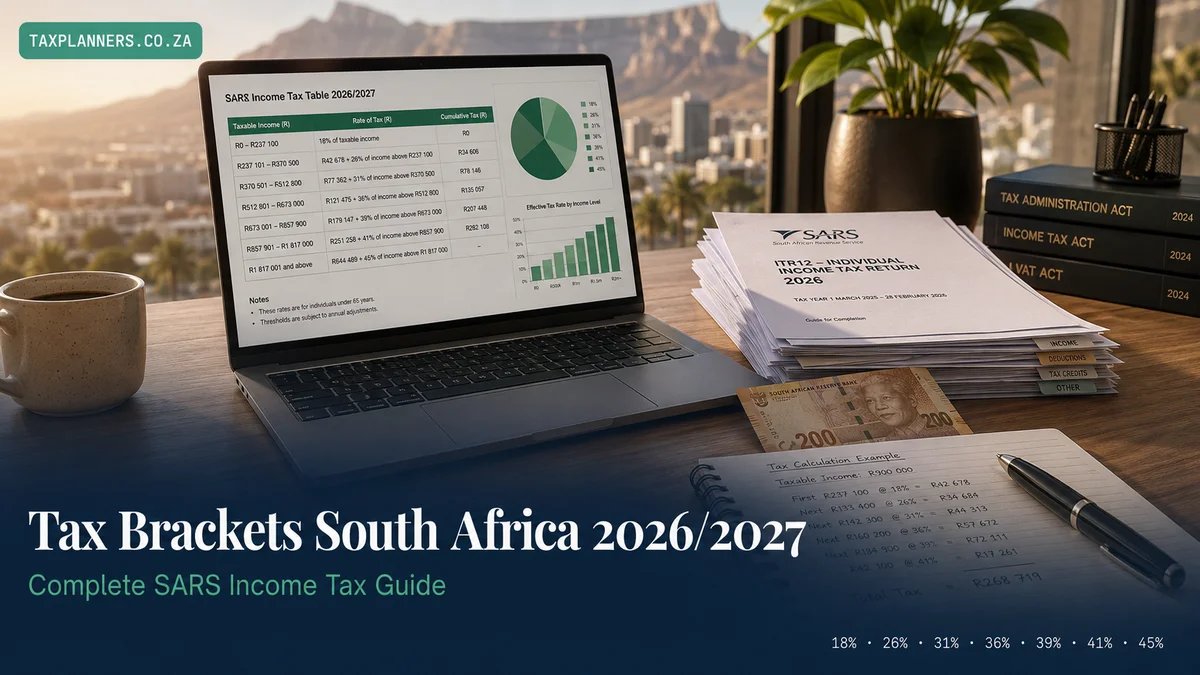
2026/2027 Tax Brackets South Africa — Full Table
These are the official SARS income tax brackets effective 1 March 2026, as announced in the 2026 Budget Speech. South Africa tax rates were increased by 3.4% from the previous year to partially offset inflation.
| # | Taxable Income (Annual) | Rate | Tax on This Bracket | Cumulative Tax at Top |
|---|---|---|---|---|
| 1 | R0 – R245,100 | 18% | 18% of income | R44,118 |
| 2 | R245,101 – R383,100 | 26% | R44,118 + 26% above R245,100 | R79,998 |
| 3 | R383,101 – R530,200 | 31% | R79,998 + 31% above R383,100 | R125,599 |
| 4 | R530,201 – R695,800 | 36% | R125,599 + 36% above R530,200 | R185,215 |
| 5 | R695,801 – R887,000 | 39% | R185,215 + 39% above R695,800 | R259,853 |
| 6 | R887,001 – R1,878,600 | 41% | R259,853 + 41% above R887,000 | R666,494 |
| 7 | Above R1,878,600 | 45% | R666,494 + 45% above R1,878,600 | — |
Source: SARS Budget Tax Guide 2026, effective 1 March 2026. All figures before rebates.
📈 Calculate Your Exact Income Tax →2025/2026 vs 2026/2027 Comparison
The 2026 Budget raised all brackets and rebates by 3.4% from 1 March 2026 — the first inflation-linked adjustment since 2023/2024. Here is how the first four brackets changed:
| Bracket | 2025/2026 Upper Limit | 2026/2027 Upper Limit | Increase |
|---|---|---|---|
| 18% bracket | R237,100 | R245,100 | +R8,000 |
| 26% bracket | R370,500 | R383,100 | +R12,600 |
| 31% bracket | R512,800 | R530,200 | +R17,400 |
| 36% bracket | R673,000 | R695,800 | +R22,800 |
| Primary rebate | R17,235 | R17,820 | +R585 |
Tax-Free Thresholds & Rebates 2026/2027
SARS provides rebates that are deducted directly from your tax liability — not from your income. The primary rebate effectively means no tax is paid below the tax-free threshold. The older you are, the higher your total rebate and the higher your tax-free income.
Tax-free threshold: R99,000
Total rebate: R27,264 | Threshold: R153,100
Total rebate: R30,409 | Threshold: R171,000
Medical Aid Tax Credit South Africa 2026/2027
In addition to the standard rebates, South African taxpayers who belong to a registered medical scheme receive a Medical Scheme Fees Tax Credit (MTC). This credit is deducted directly from your tax liability — it is not just a deduction from income, making it significantly more valuable.
R4,512 per year per person for the main member and one dependant. Increased from R364/month in 2025/2026 (3.3% increase).
R3,048 per year for each additional dependant beyond the first two. Increased from R246/month in 2025/2026.
A family of four with medical aid members saves R15,120 per year directly off their tax bill — not just from taxable income. This credit applies regardless of which tax bracket you are in.
How to Calculate Your Income Tax — 3 Worked Examples
These examples show the step-by-step calculation of South Africa income tax for three common income levels. All figures are for the 2026/2027 tax year (1 March 2026 – 28 February 2027), for an individual under 65 with no other deductions.
Marginal vs Effective Tax Rate Explained
Two of the most misunderstood terms in South African tax. Knowing the difference changes how you plan your salary, bonuses, and deductions.
| Annual Income | Marginal Rate | Effective Rate | Tax Saving Per R1,000 RA |
|---|---|---|---|
| R200,000 | 18% | 9.1% | R180 |
| R360,000 (R30K/month) | 26% | 15.6% | R260 |
| R450,000 | 31% | 18.4% | R310 |
| R600,000 | 36% | 24.1% | R360 |
| R800,000 | 39% | 26.0% | R390 |
| R1,000,000 | 41% | 30.1% | R410 |
How Retirement Annuity Deductions Reduce Your Tax Bracket
A retirement annuity (RA) is the most powerful legal tax-reduction tool available to South African individuals. RA contributions are deductible from your taxable income before tax is calculated, which can move you into a lower bracket entirely.
By making the maximum RA contribution, this taxpayer drops from the 36% bracket into the 31% bracket, saving approximately R29,300 per year in income tax — while also building retirement savings that grow tax-free inside the RA.
🏭 Calculate Your RA Tax Saving →PAYE — How Your Employer Deducts Tax
If you are employed, your employer deducts Pay As You Earn (PAYE) from your salary each month and pays it directly to SARS on your behalf. PAYE is based on the current south africa tax rates applied to your annual income. PAYE is calculated based on your annual income tax liability divided into monthly instalments.
| Monthly Gross Salary | Annual Income | Est. Monthly PAYE | Monthly Take-Home* |
|---|---|---|---|
| R10,000 | R120,000 | R284 | ~R9,616 |
| R20,000 | R240,000 | R2,288 | ~R17,512 |
| R30,000 | R360,000 | R4,681 | ~R25,019 |
| R50,000 | R600,000 | R11,268 | ~R38,232 |
| R80,000 | R960,000 | R22,918 | ~R56,582 |
*After PAYE and UIF (1%, capped at R177/month). No RA or other deductions assumed. Use our PAYE calculator for your exact figure.
Budget 2026 Tax Changes & Bracket Creep Explained
On 25 February 2026, the South African Minister of Finance delivered the annual Budget Speech, announcing the first inflation-linked adjustment to income tax brackets South Africa has seen since 2023/2024.
Tax brackets and rebates were increased by 3.4% from 1 March 2026. This is a partial inflation adjustment.
Most South African employees received salary increases of 5–6% in 2026. The gap between 6% and 3.4% is “bracket creep.”
Bracket creep is the silent tax increase that happens when your salary grows faster than the tax brackets. If you received a 6% raise but brackets only went up 3.4%, the extra 2.6% of your salary is effectively taxed at a higher rate than before — even though your real purchasing power barely changed.
Other 2026 Budget Tax Changes
| Item | 2025/2026 | 2026/2027 | Change |
|---|---|---|---|
| Primary rebate | R17,235 | R17,820 | +R585 |
| Medical credit (first 2) | R364/month | R376/month | +R12/month |
| Medical credit (additional) | R246/month | R254/month | +R8/month |
| VAT rate | 15% | 15.5% | +0.5% |
| CGT annual exclusion (individuals) | R40,000 | R40,000 | No change |
| RA deduction cap | R350,000 | R350,000 | No change |
Sources: National Treasury Budget Review 2026, SARS Budget Tax Guide 2026 (released 25 February 2026).
Frequently Asked Questions — Tax Brackets South Africa
Calculate Your Exact Tax — Free SARS Calculators
Use our free South African tax calculators to get your personalised PAYE, income tax, refund and retirement figures for 2026/2027.
📈 Income Tax Calculator 💼 PAYE Calculator 💵 Refund Calculator 🏭 Retirement Calculator