
VAT Registration South Africa 2026: R2.3M Threshold, How to Register & Complete SARS Guide
Everything you need to know about the new R2.3 million VAT threshold, who must register, how to apply on SARS eFiling, and what SMEs between R1M–R2.3M must do now.
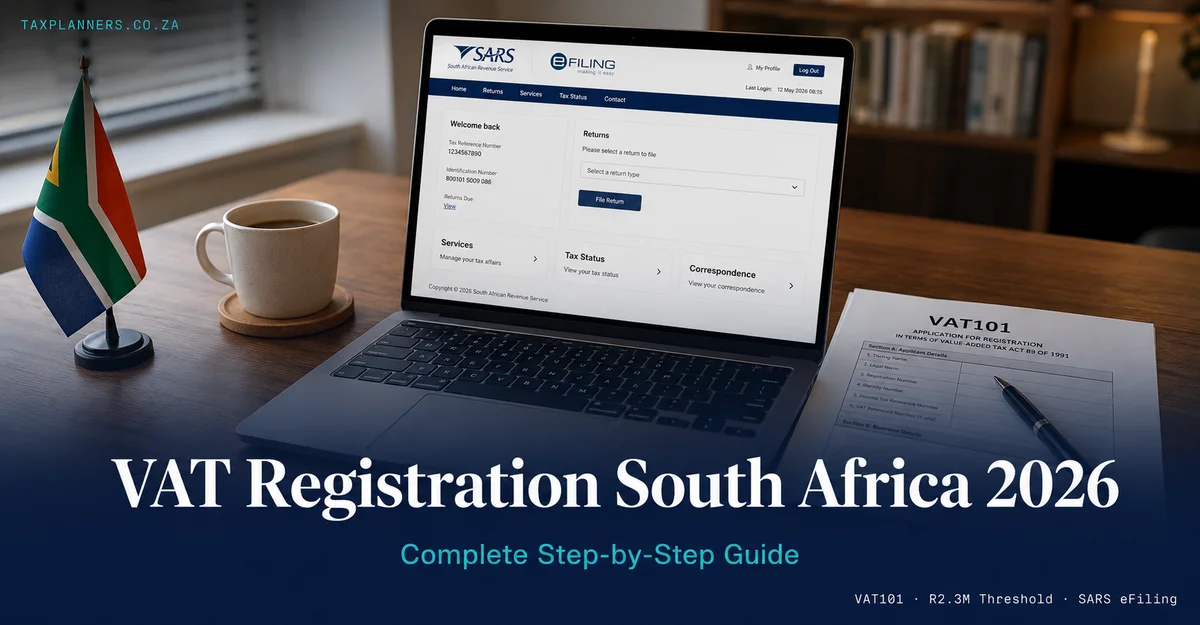
From 1 April 2026, you must register for VAT in South Africa once your taxable supplies exceed R2.3 million in any 12-month period — up from the previous R1 million threshold. Voluntary registration is available from R120,000 (up from R50,000). The VAT rate remains 15%. Register via the VAT101 form on SARS eFiling within 21 business days of exceeding the threshold. Businesses currently registered with turnover between R1M and R2.3M may now apply to deregister, but should check the tax consequences first.
What Is VAT and Who Must Register for It in South Africa?
Value-Added Tax is collected at every stage of the supply chain. As a VAT vendor, you charge customers 15% VAT on taxable supplies (output VAT), claim back 15% VAT on qualifying business purchases (input VAT), and remit the difference to SARS every two months via a VAT201 return.
VAT is governed by the Value Added Tax Act 89 of 1991 and administered by SARS. South Africa has applied a 15% standard VAT rate since 1 April 2018. A zero rate (0%) applies to certain supplies including exports, basic foodstuffs, fuel levy goods, and international transport services. Exempt supplies — such as residential rental income and financial services — are outside the VAT net entirely.
What Is the New VAT Threshold for 2026 and What Changed?
The R2.3 million threshold is the most significant change to South Africa’s VAT framework since 2009, when the compulsory threshold was last raised. The increase was introduced specifically to reduce the compliance burden on small and medium enterprises (SMEs), many of whom are not set up to manage the accounting, return filing, and administrative requirements that VAT registration demands.
Why R2.3 Million? The Rationale
The R2.3 million figure was not arbitrary. Treasury’s analysis found that a large proportion of registered VAT vendors generated turnover below this level yet accounted for a disproportionately small share of total VAT collections. By raising the threshold, SARS can concentrate audit and compliance resources on higher-risk, higher-revenue taxpayers, while freeing smaller businesses from quarterly return obligations.
SARS confirmed the threshold changes on the Budget 2026 FAQ page at sars.gov.za. The Taxation Laws Amendment Act gives these changes legal effect. Source: SARS Budget 2026 Frequently Asked Questions (sars.gov.za, effective 1 April 2026).
How Does the 2026 VAT Threshold Compare to the Previous Rules?
| Rule | Before 1 April 2026 | From 1 April 2026 | Change |
|---|---|---|---|
| Compulsory registration threshold | R1,000,000 | R2,300,000 | +130% |
| Voluntary registration threshold | R50,000 | R120,000 | +140% |
| Standard VAT rate | 15% | 15% | Unchanged |
| Registration form | VAT101 (eFiling) | VAT101 (eFiling) | Unchanged |
| Registration deadline | 21 business days | 21 business days | Unchanged |
| Deregistration form | VAT123e | VAT123e | Unchanged |
| Return period (most vendors) | Bi-monthly | Bi-monthly | Unchanged |
How Do You Register for VAT with SARS Step by Step?
-
Confirm you meet the threshold
Add up all your taxable supplies (standard-rated + zero-rated) for the past 12 months, or project the next 12 months if you are a new business. If the total exceeds R2.3 million (compulsory) or R120,000 (voluntary), you qualify to register. Exempt supplies such as residential rental income do not count.
-
Gather your supporting documents
You will need: proof of business address, bank confirmation letter, proof of taxable supplies (invoices or contracts), public officer resolution, and tax compliance certificates for the business and its public officer. See Section 5 for the full document checklist.
-
Log into SARS eFiling
Go to
efiling.sars.gov.zaand log in with your existing eFiling credentials. If you do not have an eFiling profile, register one first under “Register” on the eFiling homepage. Your business must already be registered with SARS for income tax or PAYE before applying for VAT. -
Complete the VAT101 form
Navigate to
Register New → VAT. Complete the VAT101 form with: your business legal name and registration number, nature of taxable supplies, banking details, expected annual turnover, the date from which you became liable (if compulsory), and the name and ID of the public officer. -
Upload supporting documents
Attach all required documents in PDF or JPEG format. Ensure your bank confirmation letter is dated within the last three months and is on the bank’s letterhead. SARS will reject the application if documents are outdated or do not clearly show the business name and account number.
-
Submit and track your application
Click Submit. Note your case reference number. SARS processes VAT registrations in 10–21 business days. You will receive your VAT registration number via eFiling notifications. Once registered, your first VAT return (VAT201) will become available on your eFiling profile for the relevant tax period.
For step-by-step guidance on navigating SARS eFiling in general, see our complete SARS eFiling Step-by-Step Guide 2026.
What Documents Do You Need to Register for VAT in South Africa?
| Document | Accepted Forms | Requirements |
|---|---|---|
| Proof of business address | Lease agreement, utility bill, municipal rates account | Must be in the business name, not older than 3 months |
| Bank confirmation letter | Letter on bank letterhead OR stamped bank statement | Shows business name, account number, branch code; not older than 3 months |
| Proof of taxable supplies | Customer invoices, signed contracts, letter of intent | Must show amounts consistent with claimed turnover; showing supply of taxable goods/services |
| Public officer resolution | Board resolution or company resolution | Signed by directors, appointing the public officer responsible for tax matters |
| Tax compliance status | Tax Compliance Status (TCS) PIN or certificate | For both the company and the appointed public officer — obtain via SARS eFiling |
- Proof of business address — lease, utility bill or municipal rates account (max 3 months old)
- Bank confirmation letter on bank letterhead OR stamped bank statement (max 3 months old)
- Customer invoices or signed contracts showing taxable supply amounts
- Board resolution appointing the public officer (signed by all directors)
- Tax Compliance Status PIN for company AND public officer (from SARS eFiling)
- Company registration documents (CK1 / CoR14.3 from CIPC) if SARS requests them
What Is Voluntary VAT Registration and When Does It Make Sense?
Benefits of Voluntary Registration
The main financial benefit is recovering input VAT on qualifying business expenses — purchases from other VAT-registered suppliers. If you buy R200,000 of equipment and materials per year, you can reclaim R26,087 in input VAT (15/115 of R200,000) that would otherwise be an unrecoverable cost. For capital-intensive businesses, this can be significant.
Corporate and government clients often prefer or require their suppliers to be VAT-registered. A VAT number signals that your business is established and formally registered. Without a VAT number, you cannot issue a valid tax invoice, which some procurement departments require before processing payment.
When Voluntary Registration Does NOT Make Sense
If your clients are mostly consumers (private individuals who cannot claim input VAT), registering for VAT makes you 15% more expensive than unregistered competitors unless you absorb the VAT into your pricing. This is common for service businesses in the B2C market. In those cases, the compliance burden of bi-monthly VAT returns outweighs the input VAT benefit.
| Business Type | Voluntary Registration? | Reason |
|---|---|---|
| Sells mainly to VAT-registered companies | ✓ Usually yes | Clients can claim input VAT; no price disadvantage |
| Sells mainly to government / parastatal | ✓ Usually yes | Government often requires tax invoices and VAT numbers |
| High capital spend on equipment / stock | ✓ Consider it | Recover significant input VAT on purchases |
| Sells mainly to consumers (B2C) | ✗ Usually no | 15% VAT raises your prices vs unregistered competitors |
| Low business expenses / inputs | ✗ Usually no | Little input VAT to recover; compliance cost outweighs benefit |
| Exempt supplies only (e.g. rental) | ✗ Not eligible | Exempt supplies do not qualify for VAT registration |
Can SMEs Deregister for VAT Below the New R2.3M Threshold?
The threshold increase to R2.3 million means that businesses currently registered with taxable supplies between R1 million and R2.3 million are no longer legally required to remain registered. This is potentially good news for administrative burden — but the decision to deregister should not be made without careful analysis.
The Section 8(2) Deemed Output Tax Risk
When you deregister for VAT, SARS treats you as if you have made a taxable supply of all business assets and trading stock on the date of deregistration. This “deemed supply” triggers output VAT on the open-market value of your assets and stock at that date — a potentially significant once-off VAT liability. For businesses with substantial fixed assets, vehicles, equipment or inventory, this can make deregistration expensive.
How to Deregister: VAT123e Form
To deregister, submit the VAT123e form on SARS eFiling under Returns → VAT → VAT123e. State your reason for deregistration (turnover below R2.3 million threshold) and the proposed deregistration date. SARS will review your application and, if approved, issue a deregistration confirmation. You must continue to file VAT returns and pay any VAT due until your deregistration date is confirmed by SARS.
| Factor | Deregister | Stay Registered |
|---|---|---|
| Clients are mainly consumers (B2C) | ✓ Benefit | ✗ Price disadvantage |
| Clients are VAT-registered businesses | ✗ Clients lose input VAT | ✓ No change for clients |
| High asset / stock value at deregistration | ✗ Large deemed output tax | ✓ No deemed tax cost |
| Low business expenses / little input VAT | ✓ Little benefit lost | ✗ Compliance cost high vs benefit |
| Plans to grow above R2.3M soon | ✗ Must re-register later | ✓ No disruption |
What Are the Penalties for Late or Non-Registration for VAT?
The consequences of late VAT registration are severe precisely because VAT is a tax you are supposed to collect on SARS’s behalf. If you exceeded the R2.3 million threshold but failed to register within 21 business days, you effectively owe SARS VAT on all taxable supplies made since the date you should have registered — whether or not you charged your customers VAT.
| Penalty Type | Rate / Amount | Basis |
|---|---|---|
| Backdated VAT liability | 15% on all taxable supplies | From the date you should have registered |
| Understatement penalty | 10% (standard) | On the VAT shortfall — higher if SARS deems it intentional |
| Prescribed interest | 10.25% per annum | On outstanding VAT and penalty from due date |
| Administrative penalty | R250 – R16,000 per month | Fixed monthly penalty for non-compliance, based on taxable income |
The fastest way to avoid penalties is to monitor your rolling 12-month turnover monthly. If you are approaching R2.3 million, submit your VAT101 before you exceed the threshold. Use our Income Tax Calculator to track your taxable income and turnover position throughout the year.
How Does VAT Work After You Register with SARS?
Output VAT vs Input VAT
Output VAT is the 15% you charge on your taxable supplies — you collect this on behalf of SARS. Input VAT is the 15% VAT you pay on purchases from other registered VAT vendors. Your VAT payment to SARS is: Output VAT minus Input VAT = Net VAT payable. If input VAT exceeds output VAT in a period, SARS owes you a refund — claimed on the VAT201 return.
What Must a Valid Tax Invoice Include?
For supplies above R5,000 (inc. VAT), a full tax invoice must include: your business name and VAT number, the customer’s name and address, invoice date and a unique sequential invoice number, description of goods or services, quantity, unit price, VAT amount, and total amount inclusive of VAT. For supplies of R5,000 or less, an abridged tax invoice is acceptable and can omit certain fields.
- Charge 15% VAT on all standard-rated taxable supplies
- Issue a valid tax invoice for every taxable supply
- Keep records of all VAT invoices received and issued for 5 years
- Submit VAT201 return on SARS eFiling every 2 months
- Pay net VAT by the 25th of the month after your tax period
- Claim input VAT only on supplies from other registered VAT vendors
- Notify SARS within 21 days if your business ceases taxable supplies
For guidance on your annual income tax return and how VAT interacts with your company’s taxable income, see our SARS Tax Season 2026 guide.
Frequently Asked Questions About VAT Registration in South Africa
Need Help With Your VAT Registration or Tax Compliance?
Use our free South African tax tools and guides to manage your VAT obligations, calculate your tax position, and stay compliant with SARS.