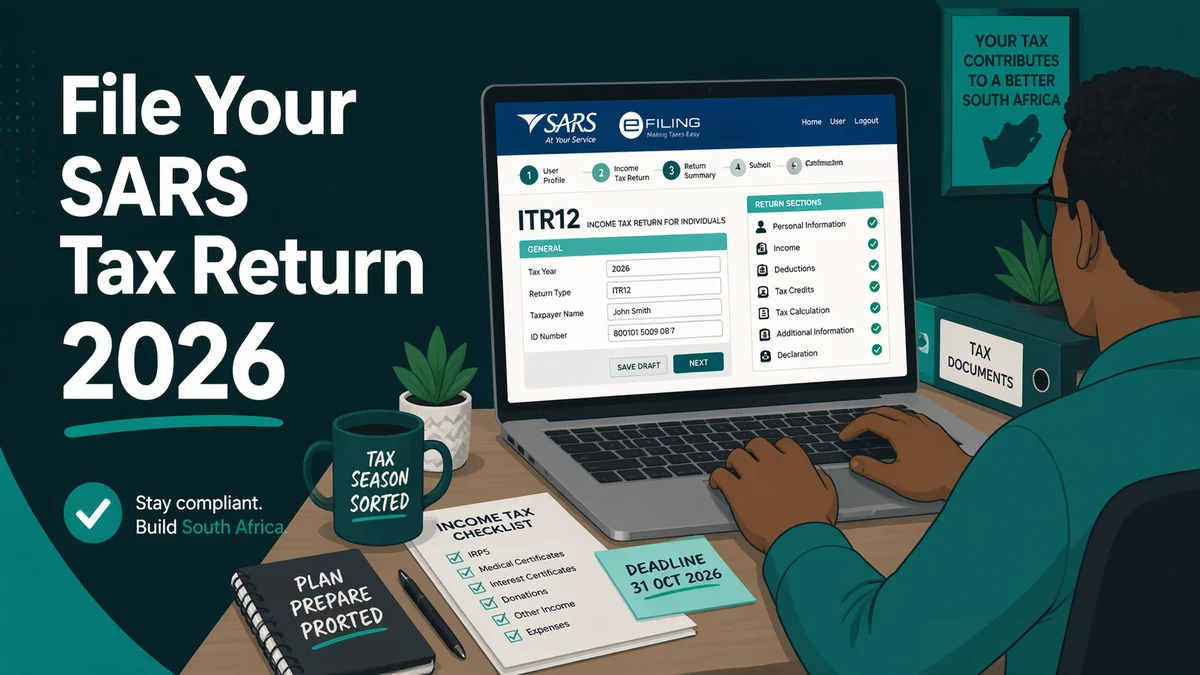
How to File Your SARS Tax Return in 2026 — Complete Step-by-Step Guide
Everything you need to know about filing your ITR12 return with SARS in 2026 — who must file, what documents you need, how to file on eFiling, and how to claim your refund.
Updated: April 2026
TaxPlanners.co.za — 2026/2027 SARS Tax Season
Quick Answer: How do I file my SARS tax return in 2026?
File your SARS ITR12 tax return on eFiling (www.sars.gov.za) or the SARS MobiApp. You will need your IRP5, medical aid certificate, and RA certificate. Filing season typically opens in July 2026. Non-provisional taxpayers must file by October 2026. Provisional taxpayers have until January 2027.
Who Must File a SARS Tax Return in 2026?
Not every South African taxpayer is required to file an ITR12 return. You must file if any of the following apply:
| You Must File If | Reason |
|---|
| Annual income exceeds R99,000 (under 65) | Above the tax threshold for 2026/2027 |
| Annual income exceeds R153,250 (65–74) | Above the tax threshold for 2026/2027 |
| Annual income exceeds R171,300 (75+) | Above the tax threshold for 2026/2027 |
| You have rental income | Not taxed at source — must be declared |
| You have freelance or commission income | Not fully taxed at source |
| You have foreign income | Must be declared regardless of amount |
| You have capital gains above R40,000 | CGT annual exclusion — excess must be declared |
| SARS requests you to file | Mandatory even if below threshold |
Note: Even if you received an auto assessment from SARS, you still need to review it and either accept it or edit and file your own return. Read our guide on
SARS auto assessments for full details.
Documents You Need to File Your Tax Return
Gather these documents before you start filing to make the process smooth and accurate:
Essential documents checklist
- IRP5 / IT3(a) certificate from every employer you worked for during the year
- Medical aid tax certificate showing total annual contributions and member count
- Retirement annuity (RA) contribution certificate from your RA administrator
- Bank interest certificate (IT3b) from your bank
- South African ID document or passport
- Your SARS tax reference number
- Verified bank account details for refund payment
- Travel logbook — if claiming a travel allowance deduction
- Home office calculation — if claiming home office expenses
- Capital gains records — if you sold property, shares or other assets
- Foreign income documents — if you earned income outside South Africa
- Section 18A receipts — if claiming charitable donation deductions
How to Register on SARS eFiling
If you are filing for the first time, you need to register on eFiling before you can submit your return:
Step 1 — Go to eFiling
Visit www.sars.gov.za and click on “eFiling” or download the SARS MobiApp from the App Store or Google Play.
Step 2 — Click Register
Click “Register” and select “Individual”. Enter your ID number, date of birth, and personal details exactly as they appear on your ID document.
Step 3 — Verify your identity
SARS will verify your identity using information they already have. You may need to visit a SARS branch with your ID if online verification fails.
Step 4 — Set up your profile
Complete your eFiling profile — add your contact details, banking details, and tax reference number. Verify your banking details for refund payments.
Step 5 — Activate your account
SARS will send an activation email or SMS. Click the link to activate your eFiling account. You are now ready to file your return.
Step-by-Step: How to File Your ITR12 on eFiling 2026
Step 1 — Log into eFiling
Go to www.sars.gov.za → eFiling → enter your username and password. If you forgot your password, use the “Forgot Password” option.
Step 2 — Navigate to your ITR12
Click Returns → Income Tax → ITR12 → Select the tax year (2025/2026) → Click “Request Return”. Your pre-populated return will open with data SARS already has.
Step 3 — Verify pre-populated data
Check all pre-populated fields against your actual documents — IRP5 income, PAYE deducted, medical aid contributions, and RA contributions. Correct any discrepancies immediately.
Step 4 — Add additional income
Declare all additional income not pre-populated — rental income, freelance income, foreign income, capital gains, and any other taxable receipts.
Step 5 — Add deductions and credits
Add all allowable deductions — RA contributions, travel allowance (with logbook km), home office expenses, and any additional medical expenses above the tax credit.
Step 6 — Review your tax calculation
eFiling will automatically calculate your tax, rebates, and medical credits. Use our
income tax calculator to verify the result independently.
Step 7 — Submit your return
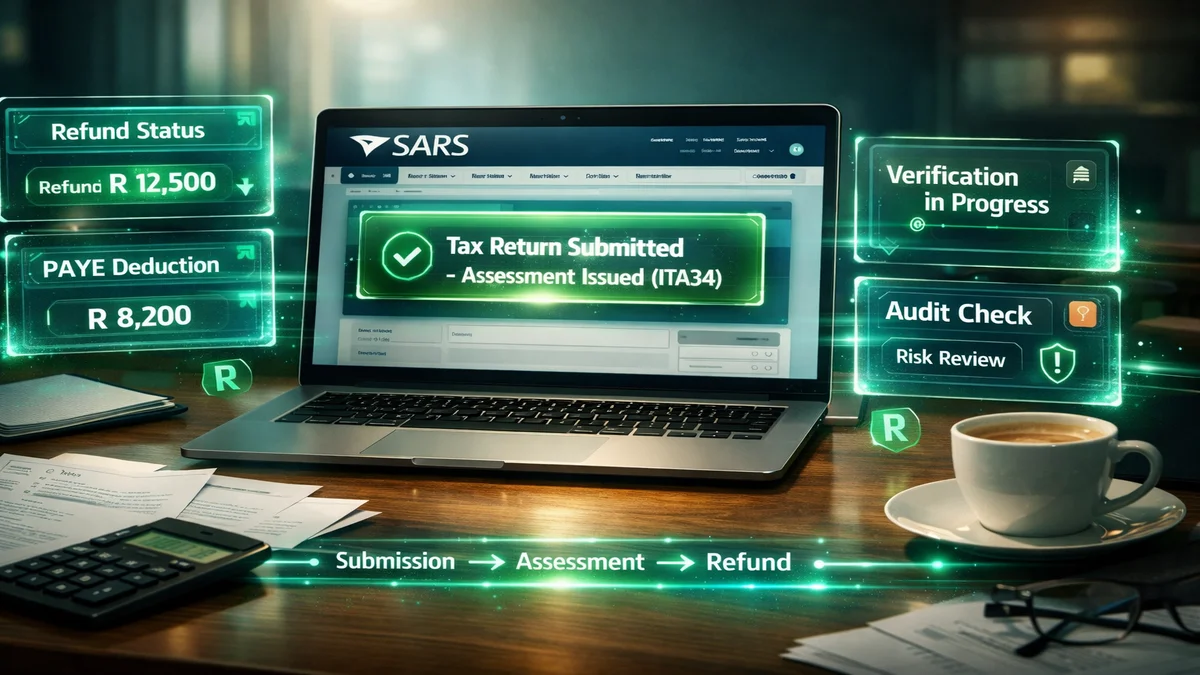
Once satisfied, click “Submit”. eFiling will confirm submission and issue your assessment (ITA34). Save this document — it is your official tax assessment for the year.
Step 8 — Pay or wait for refund
If you owe tax — pay via eFiling before the deadline. If you are due a refund — SARS will pay it to your verified bank account within 21 business days of assessment.
2026 SARS Filing Deadlines
| Taxpayer Type | Filing Deadline | Notes |
|---|
| Non-provisional taxpayers (eFiling) | October 2026 | Employees with one employer and simple tax affairs |
| Non-provisional taxpayers (branch) | September 2026 | Filing at SARS branch — earlier deadline |
| Provisional taxpayers (eFiling) | January 2027 | Self-employed, directors, investors |
| Trusts | January 2027 | Trust ITR12T returns |
| Deceased estates | As per executor | Contact SARS for specific guidance |
Warning: These are typical deadlines based on prior years. SARS confirms exact 2026 dates when filing season opens in July 2026. Always verify on www.sars.gov.za before filing.
Common Deductions to Claim on Your 2026 Tax Return
Pension Fund / RA
Up to 27.5% of taxable income or remuneration (max R430,000/year). Reduces taxable income directly — one of the most powerful tax-saving tools available.
Medical Aid Tax Credits
R364/month (self) + R364 (first dependant) + R246 (each additional). Plus additional medical expense deduction for amounts above 7.5% of taxable income if over 65 or disabled.
Travel Allowance
Business km × SARS rate per km. Requires a detailed logbook — without it SARS will disallow the claim. Use the SARS rate table for your vehicle’s value.
Home Office
Proportional home expenses if your employer permits remote work and you have a dedicated workspace. Calculate as: (home office m² ÷ total home m²) × qualifying expenses.
Section 18A Donations
Donations to approved PBOs — deductible up to 10% of taxable income. Requires a valid Section 18A receipt from the organisation.
Wear and Tear
Depreciation on assets used for income-producing purposes. Applies to sole proprietors and freelancers — not employees unless specifically permitted by employer.
Use our PAYE calculator to see how these deductions reduce your monthly tax before filing your annual return.
Late Filing Penalties — 2026
Filing your return late results in automatic administrative penalties from SARS. These are charged monthly until the return is filed:
| Taxable Income | Monthly Penalty |
|---|
| R0 – R250,000 | R250/month |
| R250,001 – R500,000 | R500/month |
| R500,001 – R1,000,000 | R1,000/month |
| R1,000,001 – R5,000,000 | R2,000/month |
| R5,000,001 – R10,000,000 | R4,000/month |
| Above R10,000,000 | R16,000/month |
Good news: If you file all outstanding returns, SARS will typically reduce administrative penalties by up to 100% for first-time non-compliance. File as soon as possible to minimise penalties — do not wait.
How to Get Your SARS Refund Faster
If you are due a refund, follow these steps to ensure it is paid as quickly as possible:
Step 1 — Verify banking details before filing
Log into eFiling → My Profile → Banking Details. Ensure your account is correct, in your own name, and verified. Unverified banking details are the most common cause of delayed refunds.
Step 2 — File early in the season
File in July when the season opens — before SARS gets busy. Early filers generally receive refunds faster as there is less verification backlog.
Step 3 — Settle all outstanding SARS debts first
Outstanding tax debts from any tax type will be offset against your refund. Settle or arrange payment plans before filing to avoid your refund being absorbed.
Step 4 — Submit verification documents promptly
If SARS selects your return for verification, upload all requested documents via eFiling within the 21-day window. Late submission delays your refund further.
For a detailed guide on refund issues, see our article on why you may not have received your SARS refund. Use our SARS refund calculator to estimate your refund amount before filing.
What If SARS Has Already Auto-Assessed You?
If SARS has issued you an auto assessment, you do not need to file a separate return — but you must still review it. Your options are:
| Scenario | Action |
|---|
| Auto assessment is correct | Accept it on eFiling — no further action needed |
| Auto assessment has errors or missing deductions | Edit and resubmit your own ITR12 return |
| You have additional income not in auto assessment | Must edit — not declaring income risks additional assessment |
| You did not receive an auto assessment | File your ITR12 manually on eFiling before the deadline |
Read our complete guide on SARS auto assessments to understand the full process and common errors to check for.
Ready to file your SARS tax return for 2026? Use our free income tax calculator to know your numbers before you start.
Calculate Your Tax First →
Frequently Asked Questions — Filing Your SARS Tax Return 2026
When does SARS filing season open in 2026? +
SARS typically opens the individual income tax filing season in July each year. Auto assessment notifications are sent out first, followed by the opening of eFiling for manual ITR12 submissions. SARS confirms the exact dates closer to July 2026 — check www.sars.gov.za for official announcements.
Do I need to file a tax return if I only have one employer? +
If your only income is a salary from one employer and your PAYE was correctly deducted, SARS may issue you an auto assessment instead of requiring you to file. If your income exceeds the tax threshold (R99,000/year under 65) and SARS does not auto-assess you, you must file an ITR12 manually. When in doubt, file — it is better to file unnecessarily than to miss a required filing.
How long does SARS take to process my return and pay a refund? +
SARS has 21 business days to issue an assessment after you file, and a further 21 business days to pay a refund after assessment. In practice, straightforward returns filed early in the season are often processed within 7–10 business days. Complex returns or those selected for verification take longer — sometimes 6–8 weeks.
Can I file my SARS tax return on my phone? +
Yes. Download the SARS MobiApp from the App Store (iOS) or Google Play (Android). The MobiApp allows you to file your ITR12, accept auto assessments, upload supporting documents, and check your refund status. It is free and available to all registered eFiling users.
What happens if I file my tax return late? +
SARS imposes automatic administrative penalties for late filing — ranging from R250 to R16,000 per month depending on your taxable income. These accumulate monthly until you file. However, SARS typically reduces or waives these penalties if you file voluntarily and it is your first instance of non-compliance. File as soon as possible to minimise penalties.
How do I claim a home office deduction on my tax return? +
To claim a home office deduction on your ITR12: your employer must confirm in writing that you are permitted to work from home, you must have a dedicated workspace used regularly and exclusively for work, and you calculate the deduction as (home office m² ÷ total home m²) × qualifying annual expenses (rent/bond interest, rates, electricity, repairs). Enter this amount in the “Other deductions” section of your ITR12.
What is provisional tax and do I need to file it? +
Provisional tax applies to taxpayers who earn income not subject to PAYE — such as freelancers, directors, and investors. If you are a provisional taxpayer, you must submit two provisional tax returns (IRP6) per year — one in August and one in February — in addition to your annual ITR12. Use our
provisional tax calculator to estimate your payments.
How do I declare rental income on my SARS tax return? +
Declare rental income in the “Local Business, Trade and Professional Income” or “Local Rental Income” section of your ITR12. You may deduct allowable expenses against the rental income — including bond interest, rates and taxes, insurance, agent fees, repairs and maintenance, and wear and tear on appliances. Net rental income (income minus expenses) is added to your taxable income for the year.
Can I file on behalf of someone who has passed away? +
Yes. The executor of a deceased estate is responsible for filing the deceased’s final ITR12 return for the period up to the date of death. The executor must register the deceased estate with SARS and file using the estate’s tax reference number. SARS must be notified of the taxpayer’s death by submitting a death certificate and Letters of Executorship.
What is the difference between filing and submitting a tax return? +
In South African tax context, “filing” and “submitting” a tax return mean the same thing — completing your ITR12 and sending it to SARS via eFiling, the MobiApp, or at a SARS branch. Once submitted, SARS issues an assessment (ITA34). If you receive an auto assessment and simply accept it, that also counts as your return being filed for that year.
Last Updated: April 2026 | Disclaimer: This article was updated in April 2026 and is provided for informational purposes only. It does not constitute financial or tax advice. Filing deadlines and SARS processes are based on information current at time of writing — always verify current deadlines on www.sars.gov.za. Consult a registered tax practitioner for personalised advice.