
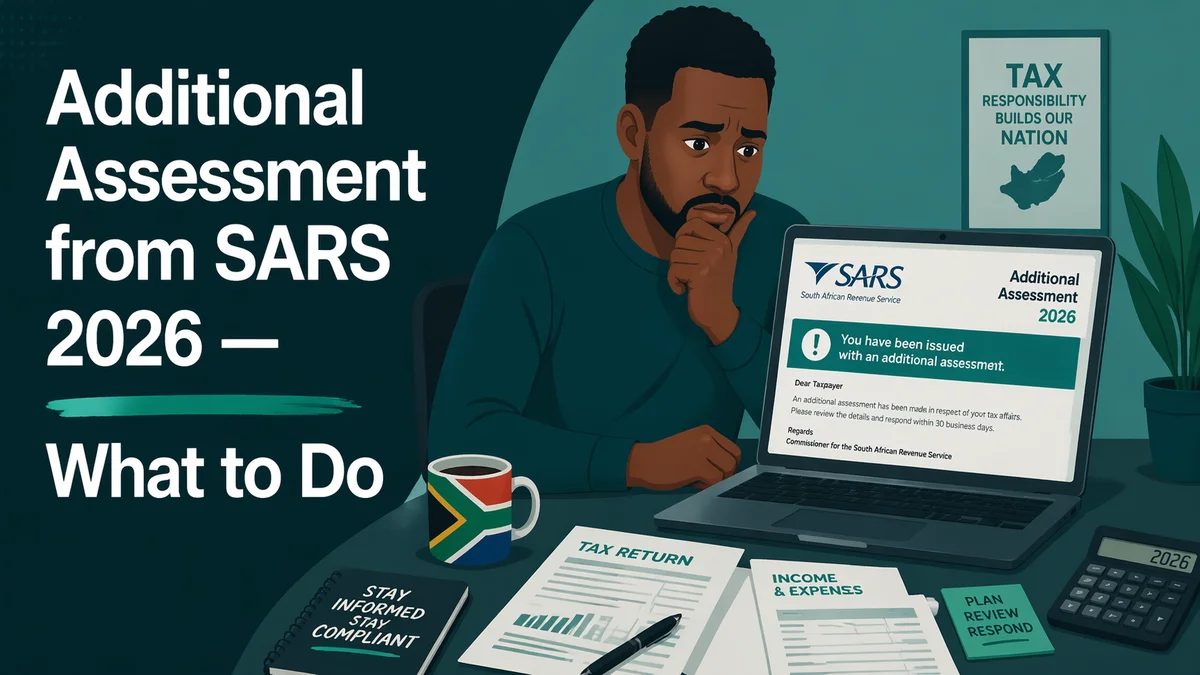
Additional Assessment from SARS — What It Means & What to Do in 2026
Received an additional assessment from SARS? This guide explains exactly what it means, why SARS issues them, how penalties and interest work, and your rights to object or appeal.
A SARS additional assessment is a revised tax assessment issued after your original ITR12 assessment — increasing your tax liability. SARS issues it when they discover income you did not declare, disallow deductions they consider invalid, or correct errors on your return. You have 30 business days to pay or lodge an objection.
Table of Contents
- What is an Additional Assessment?
- Why Does SARS Issue Additional Assessments?
- Types of SARS Assessments
- Penalties and Interest on Additional Assessments
- What to Do When You Receive One
- How to Object to a SARS Assessment
- How to Appeal if Your Objection Fails
- Should You Pay or Object?
- How to Prevent Additional Assessments
- Frequently Asked Questions
What is a SARS Additional Assessment?
A SARS additional assessment (also called a revised assessment) is issued when SARS recalculates your tax liability after your original assessment has already been issued. The result is always an increase in tax owed — either reducing your refund, eliminating it entirely, or creating a new tax debt.
Additional assessments are issued under Section 92 of the Tax Administration Act (TAA). SARS has 3 years from the date of the original assessment to issue an additional assessment for non-fraudulent cases. For fraud or intentional tax evasion, there is no time limit.
Receiving an additional assessment does not mean you have done something criminal. Many are the result of administrative discrepancies — such as a mismatch between your return and third-party data SARS receives from employers, banks, or retirement funds.
Why Does SARS Issue Additional Assessments?
The most common reasons SARS issues an additional assessment are:
| Reason | Example |
|---|---|
| Undeclared income | Rental income, freelance work, foreign income not declared on ITR12 |
| Disallowed deductions | Home office claim rejected — employee not permitted to work from home |
| IRP5 mismatch | Third-party IRP5 data from employer differs from what you declared |
| Medical aid credits error | Medical aid credits claimed exceed what the fund reported to SARS |
| Travel allowance adjustment | Logbook not accepted — business km reduced by SARS |
| Retirement fund mismatch | RA contributions claimed exceed what the fund reported |
| Foreign income not declared | Foreign employment income or foreign dividends omitted |
| Auto-assessment correction | SARS auto-assessment contained an error that is now corrected |
Types of SARS Assessments — Know the Difference
| Assessment Type | What It Means | Your Action |
|---|---|---|
| Original Assessment | First assessment issued after you file your ITR12 | Accept or object within 30 days |
| Additional Assessment | Revised assessment increasing your tax — issued under Section 92 | Pay or object within 30 business days |
| Reduced Assessment | Assessment reducing your tax — usually after successful objection | Accept — refund may be issued |
| Jeopardy Assessment | Emergency assessment where SARS believes tax is at risk | Urgent response required — get a tax practitioner |
| Auto-Assessment | SARS files on your behalf using third-party data | Accept or edit and resubmit within filing season |
Penalties and Interest on Additional Assessments
When SARS issues an additional assessment, they typically also impose penalties and interest on the additional tax owed:
Understatement penalty
A percentage penalty on the additional tax owed — ranging from 0% to 200% depending on the taxpayer’s behaviour. Honest mistakes attract lower penalties than intentional evasion.
Interest (Section 89quat)
Interest is charged at the prescribed rate on underpaid tax from the date payment was due. For 2026, this rate is linked to the repo rate. Interest cannot be waived.
Admin penalties
Fixed penalties for late or non-filing — ranging from R250 to R16,000/month depending on taxable income. These are separate from understatement penalties.
Penalty remission
Understatement penalties CAN be reduced or remitted if you can demonstrate reasonable grounds. Apply using the RCR01 form — interest cannot be remitted.
| Taxpayer Behaviour | Penalty % |
|---|---|
| Substantial understatement (no intent) | 25% |
| Reasonable care not taken | 50% |
| No reasonable grounds for tax position | 75% |
| Impermissible avoidance arrangement | 100% |
| Gross negligence | 125% |
| Intentional tax evasion | 150% – 200% |
What to Do When You Receive a SARS Additional Assessment
How to Object to a SARS Additional Assessment
If you disagree with a SARS additional assessment, you have the right to object under Section 104 of the Tax Administration Act. The process is:
How to Appeal if Your Objection is Disallowed
If SARS disallows your objection, you can escalate to the following:
| Forum | For Disputes Of | Process |
|---|---|---|
| Alternative Dispute Resolution (ADR) | Any amount | Facilitated mediation between you and SARS — faster and less costly than court |
| Tax Board | Under R1,000,000 | Informal tribunal — you can represent yourself |
| Tax Court | R1,000,000 and above | Formal court proceedings — legal representation recommended |
| High Court | Point of law only | Appeal from Tax Court on legal questions — not factual disputes |
Should You Pay or Object?
This is the most important decision when you receive an additional assessment. Here is a simple framework:
| Scenario | Recommended Action |
|---|---|
| SARS is correct and you have the funds | Pay immediately — stop interest accumulating |
| SARS is correct but you cannot afford to pay | Contact SARS to arrange a payment plan — prevents enforcement action |
| SARS is wrong on a clear factual error | Object immediately with supporting documents |
| SARS disallowed a deduction you legitimately claimed | Object with full documentation — strong case for success |
| Large amount with complex dispute | Engage a registered tax practitioner before deciding |
| Small amount — cost of objection exceeds tax owed | Consider paying rather than spending time and money on objection |
How to Prevent Additional Assessments in Future
Declare all income
Include all income sources on your ITR12 — rental income, freelance work, foreign income, investment returns, and any other receipts. SARS receives third-party data from banks, employers and fund administrators.
Keep a logbook
If claiming a travel allowance, maintain a detailed logbook recording every business trip — date, destination, purpose, and km. SARS disallows travel claims without a logbook.
Keep all supporting documents
Retain all tax documents for at least 5 years — IRP5s, medical aid certificates, RA certificates, home office calculations, bank statements and invoices.
Use accurate calculators
Use our income tax calculator to verify your tax position before filing — catching errors before SARS does saves time and penalties.
If you received an additional assessment after a SARS auto-assessment, read our guide on SARS auto-assessments to understand how to review and correct them before they become additional assessments.
Want to verify your tax position before filing to avoid additional assessments from SARS?
Calculate Your Income Tax Now →