
How to Calculate PAYE Net Salary in South Africa — 2026/2027 SARS Guide
Step-by-step guide to calculating your PAYE, UIF and net take-home salary using official SARS 2026/2027 tax tables — with a free interactive calculator.
PAYE is calculated by annualising your monthly salary, applying the SARS 2026/2027 tax brackets (18%–45%), subtracting your age-based rebate (R17,820–R29,824) and medical aid tax credits, then dividing by 12. UIF of 1% is deducted separately. The result is your net take-home pay.
Table of Contents
What is PAYE in South Africa?
PAYE stands for Pay As You Earn. It is the system SARS uses to collect income tax from employees on a monthly basis. Your employer deducts PAYE from your gross salary before paying you and remits it to SARS by the 7th of the following month.
PAYE applies to all employees earning above the annual tax threshold. For 2026/2027, this threshold is R99,000 per year (R8,250/month) for individuals under 65. If your income is below this, no PAYE is deducted.
Understanding how PAYE is calculated helps you verify your payslip, plan your finances, and identify if you are entitled to a SARS tax refund at year end.
Step-by-Step PAYE Calculation — 2026/2027
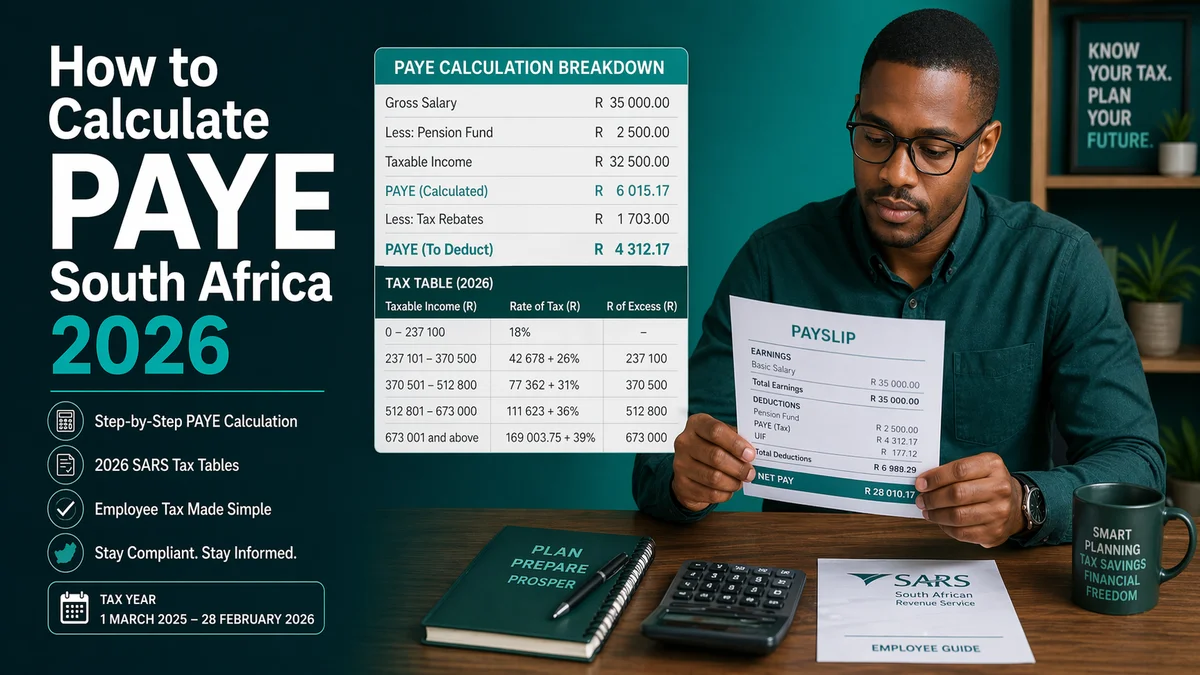
SARS uses the following formula to calculate monthly PAYE:
PAYE Net Salary Calculator — South Africa 2026/2027
Enter your details below to calculate your exact monthly PAYE, UIF and net take-home pay:
2026/2027 SARS Income Tax Brackets
South Africa uses a progressive tax system. The rates below apply to annual taxable income:
| Taxable Income (Annual) | Rate | Base Tax |
|---|---|---|
| R0 – R245,100 | 18% | R0 |
| R245,101 – R383,100 | 26% | R44,118 |
| R383,101 – R530,200 | 31% | R79,998 |
| R530,201 – R695,800 | 36% | R125,599 |
| R695,801 – R887,000 | 39% | R185,215 |
| R887,001 – R1,878,600 | 41% | R259,783 |
| R1,878,601 and above | 45% | R666,339 |
Use our PAYE calculator to apply these brackets to your specific salary.
Tax Rebates and Tax Thresholds 2026/2027
| Rebate | Amount (Annual) | Who Qualifies |
|---|---|---|
| Primary Rebate | R17,820 | All taxpayers |
| Secondary Rebate | R9,765 | Age 65 – 74 |
| Tertiary Rebate | R3,249 | Age 75 and older |
| Age Group | Annual Threshold | Monthly Equivalent |
|---|---|---|
| Under 65 | R99,000 | R8,250/month |
| 65 – 74 | R153,250 | R12,771/month |
| 75 and older | R171,300 | R14,275/month |
Deductions That Reduce Your PAYE
Pension Fund / RA
Up to 27.5% of remuneration or taxable income (whichever is greater), capped at R430,000/year. Reduces taxable income directly.
Medical Aid Tax Credits
R376/month (self) + R376 (first dependant) + R254 (each additional). Credits directly reduce tax payable — not taxable income.
Travel Allowance
80% of travel allowance is included in taxable income for PAYE. Actual deduction is claimed on your annual ITR12 return.
Home Office
If approved by employer, proportional home office costs reduce taxable income. Claimed on annual ITR12 — not via payroll.
UIF — Unemployment Insurance Fund
UIF is a separate deduction from PAYE. Both employee and employer each contribute 1% of the employee’s gross monthly salary. Key rules for 2026/2027:
| UIF Detail | Value |
|---|---|
| Employee contribution rate | 1% of gross salary |
| Employer contribution rate | 1% of gross salary |
| Monthly salary cap | R17,712/month |
| Maximum monthly deduction (employee) | R177.12/month |
| Maximum annual deduction (employee) | R2,125.44/year |
UIF does NOT reduce your taxable income — it is a separate statutory contribution and is not considered when calculating PAYE.
Worked Example — R30,000 Gross Monthly Salary
Let us walk through a complete PAYE calculation for an employee under 65, earning R30,000/month, with no pension contribution and 2 medical aid members:
Employee: Under 65 | Salary: R30,000/month | Medical: 2 members | No RA
| Gross annual salary | R360,000 |
| Less RA/pension deduction | R0 |
| Taxable income (annual) | R360,000 |
| Gross tax (26% bracket): R44,118 + 26% × (R360,000 − R245,100) | R44,118 + R29,874 = R73,992 |
| Less primary rebate | − R17,820 |
| Tax after rebate | R56,757 |
| Less medical aid credits (2 members × R376 × 12) | − R9,024 |
| Annual net PAYE | R48,021 |
| Monthly PAYE (÷ 12) | R4,002/month |
| UIF (1% of R30,000) | R300/month |
| Monthly take-home pay | R25,698/month |
IRP5 and Annual PAYE Reconciliation
At the end of each tax year (February), your employer issues an IRP5 certificate showing total remuneration and all PAYE deducted. SARS uses this to pre-populate your ITR12 return.
If your employer deducted more PAYE than your actual tax liability — due to medical credits, RA deductions, or other allowances — SARS will issue a tax refund. If too little was deducted — such as when you have additional income — you will owe SARS.
Always check your IRP5 against your payslips to ensure accuracy. Errors on your IRP5 must be corrected by your employer before you can file. Read more about SARS auto-assessments to understand how SARS processes your return automatically.
Ready to file your SARS tax return and claim any PAYE refund you are owed?
File Your SARS Tax Return Now →