
Retirement Fund Lump Sum Tax South Africa 2026/2027
Complete guide to SARS tax on retirement fund lump sum benefits — withdrawal tax, retirement tax tables, Two-Pot system, tax directives, and how to calculate exactly how much tax you will pay.
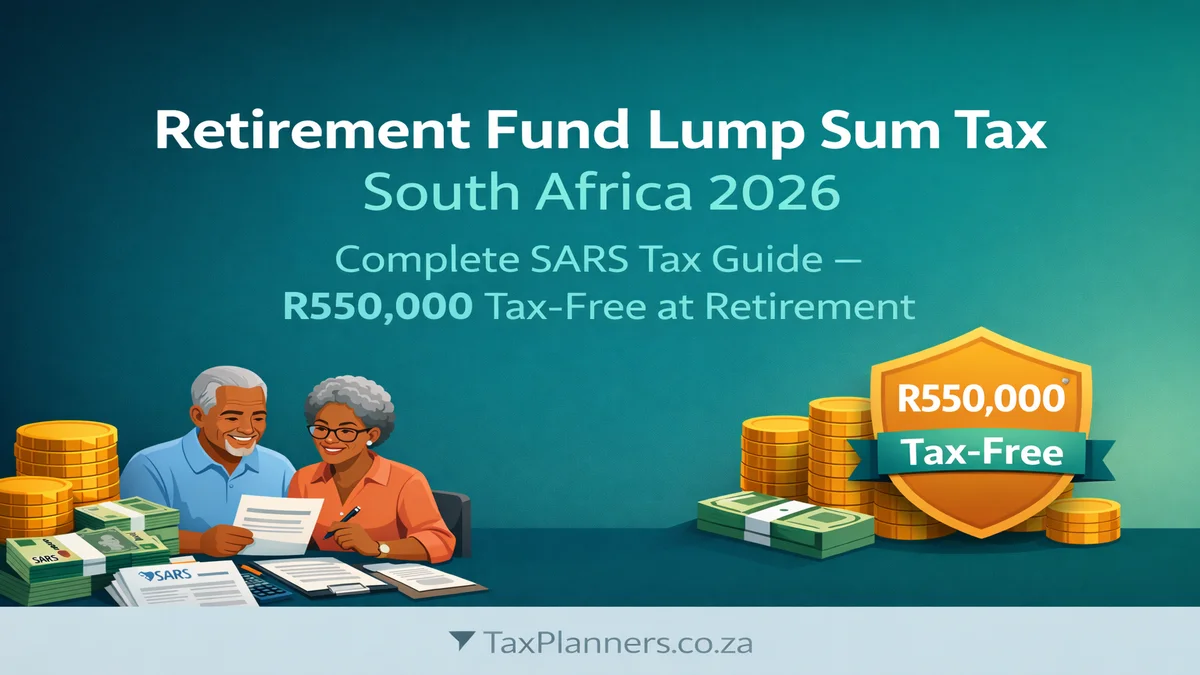
When you receive a lump sum from a retirement fund in South Africa, SARS taxes it using special lump sum tax tables — not your normal income tax rates. At retirement, the first R550,000 is tax-free (since 1 March 2023, confirmed unchanged for 2026/2027). For early withdrawal before retirement, only the first R27,500 is tax-free. All previous lump sums received since October 2007 are combined when calculating your current tax — this is called aggregation.
📋 Table of Contents
Receiving a lump sum from your retirement fund is one of the most significant financial events of your life — and one of the most tax-sensitive. Whether you are retiring, withdrawing early, or accessing funds through the Two-Pot system, SARS has specific rules that determine exactly how much tax you will pay on your lump sum benefit.
This guide explains the complete tax treatment of lump sum benefits paid by retirement funds in South Africa for the 2026/2027 tax year — including the SARS tax tables, how aggregation affects your tax, what a tax directive is, and practical strategies to legally minimise your lump sum tax.
Types of Retirement Fund Lump Sum Benefits South Africa
SARS recognises two main categories of retirement fund lump sum benefits, each taxed differently. Understanding which type applies to you is the first step in calculating your tax liability.
Received on retirement, death, or retrenchment. More favourable tax rates. First R550,000 tax-free.
Received when leaving a fund before retirement age. Less favourable rates. Only R27,500 tax-free.
Paid on retrenchment or ill-health dismissal. Same favourable tax table as retirement benefits. First R550,000 tax-free.
New from 1 September 2024. Savings component accessed once per tax year. Taxed at your marginal income tax rate.
Which Funds Are Covered?
The lump sum tax rules apply to benefits paid from: pension funds, pension preservation funds, provident funds, provident preservation funds, retirement annuity funds (RAs), and living annuities (under certain conditions). Benefits from foreign retirement funds are taxed under different rules — from 1 March 2026, foreign retirement benefits are now fully taxable in South Africa following the deletion of Section 10(1)(gC)(ii) of the Income Tax Act. See our complete guide to foreign retirement fund taxation 2026 for details.
Retirement Lump Sum Tax Table 2026/2027 — SARS Rates
When you retire from a fund (or receive a severance benefit), SARS applies the following tax table. This table applies to the aggregate of all retirement lump sums received since October 2007. SARS has confirmed no changes for the 2027 tax year.
| Taxable Lump Sum (Aggregate Since Oct 2007) | Tax Rate | Tax Payable |
|---|---|---|
| R0 — R550,000 | 0% | R0 (Tax-Free) |
| R550,001 — R770,000 | 18% | 18% of amount above R550,000 |
| R770,001 — R1,155,000 | 27% | R39,600 + 27% above R770,000 |
| R1,155,001 and above | 36% | R143,550 + 36% above R1,155,000 |
The R550,000 tax-free threshold applies to the lifetime aggregate of all retirement lump sums received since October 2007 — not per fund or per year. Once you have used up your R550,000 tax-free amount through previous lump sums, future retirement lump sums will be taxed from the first rand.
Withdrawal Lump Sum Tax Table 2026/2027 — SARS Rates
If you withdraw from a fund before retirement (for example, when changing jobs and cashing out instead of transferring), a far less favourable tax table applies. These withdrawal tax rates are calculated on the aggregate of all withdrawal lump sums received since March 2009. SARS has confirmed no changes for the 2027 tax year.
| Taxable Withdrawal Lump Sum (Aggregate Since Mar 2009) | Tax Rate | Tax Payable |
|---|---|---|
| R0 — R27,500 | 0% | R0 (Tax-Free) |
| R27,501 — R726,000 | 18% | 18% of amount above R27,500 |
| R726,001 — R1,089,000 | 27% | R125,730 + 27% above R726,000 |
| R1,089,001 and above | 36% | R223,740 + 36% above R1,089,000 |
Early withdrawal is almost always the worst financial decision. Not only do you pay more tax (only R27,500 tax-free vs R550,000 at retirement), but you also deplete your lifetime retirement tax-free allowance, reduce your savings, and lose the power of compound growth. Always consider a preservation fund transfer first.
Lump Sum Tax Calculator South Africa 2026/2027
🧮 Retirement Fund Lump Sum Tax Calculator — 2026/2027
Estimate your SARS tax on any retirement fund lump sum. Includes aggregation.
How Aggregation Works — Previous Lump Sums & Your Tax
One of the most important and misunderstood aspects of retirement fund lump sum taxation is aggregation. SARS does not calculate tax on each lump sum in isolation — it looks at the total of all lump sums you have ever received and applies the tax table to the running total.
Aggregation Example — Retirement Benefit
Thabo received a R300,000 withdrawal from a pension fund in 2018 when he changed jobs. He is now retiring and receiving a R600,000 retirement lump sum. His tax is calculated as follows:
| Step | Calculation | Amount |
|---|---|---|
| Previous withdrawal (2018) | R300,000 — first R27,500 tax-free at time | R300,000 |
| Current retirement lump sum | R600,000 new lump sum | R600,000 |
| Total aggregate | R300,000 + R600,000 | R900,000 |
| Tax on R900,000 (retirement table) | R39,600 + 27% × (R900,000 – R770,000) | R74,700 |
| Less: Tax already “used” on first R300,000 | Tax on R300,000 at retirement table = R0 (under R550,000) | R0 |
| Tax payable on current R600,000 | R74,700 – R0 | R74,700 |
Thabo’s previous withdrawal of R300,000 has used up R300,000 of his R550,000 tax-free retirement allowance. Instead of having R550,000 tax-free at retirement, he only has R250,000 remaining. This is why early withdrawal is so costly — it permanently depletes your lifetime tax-free allowance.
Two-Pot Retirement System & Lump Sum Tax Treatment
From 1 September 2024, South Africa introduced the Two-Pot Retirement System, which fundamentally changed how retirement fund members can access their savings. It is critical to understand how the Two-Pot system interacts with lump sum tax. For a full guide, see our Two-Pot Retirement System guide.
| Factor | Retirement Component | Savings Component | Vested Component |
|---|---|---|---|
| What it is | Two-thirds of contributions from Sep 2024 | One-third of contributions from Sep 2024 | All savings before Sep 2024 |
| Can you access early? | No | Yes (once per tax year, min R2,000) | Old rules apply |
| How is it taxed? | Retirement lump sum table at retirement | Marginal income tax rate | Depends on benefit type |
| Tax-free threshold | R550,000 lifetime | None — fully taxable at marginal rate | Depends on benefit type |
| Affects R550k threshold? | No | No — taxed separately | Yes — uses up threshold |
Withdrawals from the Savings Component are taxed at your marginal income tax rate — not the favourable lump sum tax rates. If you are in the 41% or 45% tax bracket, you could lose nearly half your savings component withdrawal to tax. Access the savings component only in a genuine financial emergency.
Tax Directive — What It Is and How to Get One
Before your retirement fund pays out any lump sum benefit, the fund administrator must obtain a Tax Directive from SARS. A tax directive is SARS’s official instruction to the fund on exactly how much tax to withhold from your lump sum payment.
Your pension fund, provident fund, or RA administrator submits a tax directive application to SARS via eFiling or the SARS interface. You cannot apply for a directive yourself — only the fund administrator can.
SARS checks your tax records for all previous lump sums received since October 2007 (retirement benefits) or March 2009 (withdrawal benefits). This is how aggregation is applied — SARS has a complete record of your lump sum history.
SARS issues a directive stating the exact amount of employees’ tax (PAYE) to be withheld from your lump sum. This is an estimate — your final tax liability is confirmed when you file your annual ITR12 return.
The fund deducts the tax amount per the directive and pays you the net lump sum. If too much tax was withheld, you will receive a refund when you file your tax return. If too little, you will owe SARS the difference.
Tax Directive Form Types
Form A&D applies to pension and provident fund benefits on retirement or death. Form B covers events before retirement. Form C applies to retirement annuity funds. Form E covers lump sums paid after retirement by an insurer, including living annuity commutations.
Early Withdrawal vs Retirement — Tax Comparison
To understand the tax difference between withdrawing early and preserving your fund until retirement, consider this direct comparison for a R500,000 lump sum (assuming no previous lump sums):
| Factor | ✅ Retire at Retirement Age | ❌ Withdraw Early (Job Change) |
|---|---|---|
| Lump Sum Amount | R500,000 | R500,000 |
| Tax-Free Amount | R500,000 (under R550k threshold) | R27,500 only |
| Taxable Amount | R0 | R472,500 |
| Tax Payable | R0 | R85,050 |
| Amount Received | R500,000 | R414,950 |
| Tax Saved by Preserving | R85,050 | — |
| Effective Tax Rate | 0% | 17% |
When changing jobs, always transfer your pension fund to a preservation fund or your new employer’s fund rather than withdrawing cash. This preserves your R550,000 tax-free retirement allowance, keeps your savings growing tax-deferred, and avoids the punishing early withdrawal tax rates.
How to Legally Reduce Your Retirement Fund Lump Sum Tax
While you cannot avoid lump sum tax entirely, there are several legal strategies to minimise the tax you pay on your retirement fund benefits in South Africa.
The single most effective strategy is to never make early withdrawals from retirement funds. Every rand withdrawn before retirement uses up part of your R550,000 lifetime tax-free retirement allowance and is taxed at the far less favourable withdrawal rates. Transfer between funds via a tax-free Section 14 transfer instead.
If your retirement fund contributions were not fully deductible in prior years (due to the annual deduction limit), SARS allows you to use these excess contributions to reduce your taxable lump sum at retirement. Keep records of all non-deductible contributions — they can significantly reduce your lump sum tax. This deduction is only available at retirement, not on early withdrawal.
For pension fund and retirement annuity members, you can only take a maximum of one-third of your fund as a lump sum at retirement — the remaining two-thirds must purchase an annuity. However, if your total retirement interest is below R247,500, you may take the full amount as a lump sum. Strategically managing the lump sum vs annuity split can optimise your overall tax position.
If you have other income in the year you retire, taking your retirement lump sum in a low-income year can reduce the impact of any tax payable above the R550,000 threshold. The lump sum tax rates are applied cumulatively and interact with your marginal income tax in certain circumstances.
FAQ — Tax Treatment of Lump Sum Benefits South Africa
Most searched SARS questions about retirement fund lump sum tax — tap any question for the full answer.
🧮 Calculate Your Retirement Tax Now
Use our free South African tax calculators — retirement lump sum, income tax, provisional tax and more.