🧾 SARS Tax Tools · Updated May 2026
VAT Calculator South Africa 2026: Add, Remove & Calculate VAT Instantly
Free online VAT calculator for South Africa. Add or remove 15% VAT in seconds — plus the complete 2026 guide to VAT rates, registration thresholds, and zero-rated goods.
📅 Updated May 2026
⏱ 9 min read
✍ Tax Planners Team
🇿🇦 South Africa
⚡ Quick Answer — VAT Calculator South Africa 2026
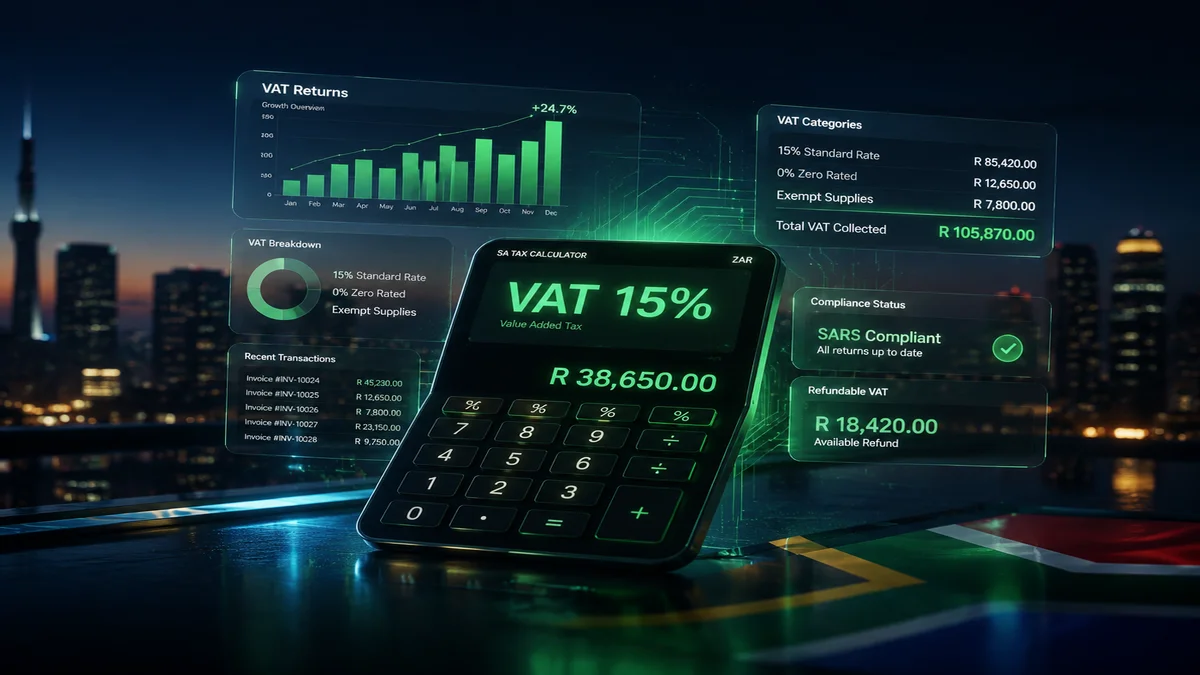
South Africa’s VAT rate is 15% in 2026 (unchanged). To add VAT: multiply your amount by 1.15. To remove VAT: divide the VAT-inclusive price by 1.15. The compulsory VAT registration threshold increased from R1 million to R2.3 million from 1 April 2026. Use the calculator below for instant results.
01 · Current Rate
South Africa VAT Rate 2026
15%
Standard VAT Rate — Unchanged in 2026
The proposed increase to 15.5% (May 2025) and then 16% (April 2026) was reversed by government. South Africa’s VAT rate remains 15% — in place since 1 April 2018.
Value-Added Tax (VAT) is an indirect tax levied by SARS on the consumption of goods and services in South Africa. It is charged at each stage of the supply chain, but the final cost is borne by the end consumer. Registered VAT vendors collect VAT on behalf of SARS and can claim back the VAT they paid on their own business inputs.
South Africa has three VAT categories: standard-rated (15%), which applies to most goods and services; zero-rated (0%), which applies to basic food items and exports; and exempt, which applies to certain financial and educational services where no VAT is charged or claimed.
✅ 2026 Confirmation
The Budget 2026 speech (25 February 2026) confirmed VAT remains at
15%. No increase will take effect in the 2026/27 tax year.
02 · Online Tool
How to Use Our Free South Africa Tax Calculator
Tax Planners provides free online tax calculators built specifically for South African taxpayers and businesses. Whether you need to calculate your PAYE income tax, check a tax refund estimate, or work out retirement tax contributions, our tools give you instant, accurate results based on current SARS rates.
🧮
Free South Africa Tax Calculators — 2026
PAYE income tax, capital gains, retirement, refund & more — all updated for the 2026/27 tax year. No sign-up required.
Use Free Tax Calculators →
How to Calculate VAT: Step-by-Step
For quick VAT calculations, the manual method takes seconds once you know the formula. Here is exactly how South African businesses and individuals calculate VAT at the current 15% rate:
01
Adding VAT to a price (Ex-VAT → Inc-VAT)
Multiply your ex-VAT amount by 1.15.
Example: R2,000 × 1.15 = R2,300 (VAT included). The VAT portion is R300.
02
Removing VAT from a price (Inc-VAT → Ex-VAT)
Divide your VAT-inclusive amount by 1.15.
Example: R2,300 ÷ 1.15 = R2,000 (ex-VAT). The VAT portion is R300.
03
Finding just the VAT amount from an inclusive price
Multiply the inclusive price by 15 ÷ 115 (or 0.130435).
Example: R2,300 × 15÷115 = R300 VAT.
04
Zero-rated goods — apply 0% VAT
For zero-rated items like brown bread, milk, or eggs — no VAT is added. The ex-VAT and inc-VAT prices are identical. See the full zero-rated list in Section 5 below.
03 · Manual Formula
VAT Formula: How to Calculate VAT Manually in South Africa
Understanding the VAT formula means you can calculate VAT on any amount without a calculator app. There are two scenarios — adding VAT to an ex-VAT price, and removing VAT from a VAT-inclusive price.
Quick Reference VAT Table
| Ex-VAT Amount | VAT (15%) | Inc-VAT Total |
|---|
| R 100 | R 15.00 | R 115.00 |
| R 250 | R 37.50 | R 287.50 |
| R 500 | R 75.00 | R 575.00 |
| R 1,000 | R 150.00 | R 1,150.00 |
| R 2,500 | R 375.00 | R 2,875.00 |
| R 5,000 | R 750.00 | R 5,750.00 |
| R 10,000 | R 1,500.00 | R 11,500.00 |
| R 50,000 | R 7,500.00 | R 57,500.00 |
04 · Inc vs Excl
VAT Inclusive vs VAT Exclusive — What Is the Difference?
This is one of the most common sources of confusion when calculating VAT in South Africa. Understanding the difference prevents costly invoicing errors.
⚠️ Common Mistake
Never calculate 15% of an already VAT-inclusive price to find the VAT — you will get the wrong answer. The correct way to extract VAT from an inclusive price is:
Price × 15 ÷ 115. For R1,150: 1,150 × 15 ÷ 115 =
R150.
05 · Zero-Rated vs Exempt
Zero-Rated vs VAT-Exempt Goods in South Africa
Not all goods and services are subject to 15% VAT in South Africa. Some are zero-rated (0% VAT) and others are exempt (no VAT at all). The distinction matters significantly for VAT vendors claiming input tax.
| Category | VAT Rate | Examples | Input VAT Claimable? |
|---|
| Standard-rated |
15% |
Most goods & services, clothing, electronics, restaurants |
✅ Yes |
| Zero-rated |
0% |
Brown bread, maize meal, milk, eggs, fruit & veg, rice, dried beans, lentils, edible oils, pilchards, exports |
✅ Yes |
| Exempt |
Exempt |
Residential rental, financial services, life insurance, passenger transport (taxis, trains), educational services |
❌ No |
ℹ️ Key Difference
Zero-rated vendors
can claim back input VAT on their costs. Exempt suppliers
cannot claim input VAT. This makes zero-rated status more favourable for vendors in the supply chain.
06 · 2026 Update
VAT Registration Threshold South Africa 2026 — Major Update
Budget 2026 brought a significant change that affects thousands of South African small businesses. The VAT registration thresholds have been substantially increased from 1 April 2026.
🆕 New Thresholds Effective 1 April 2026
Compulsory Registration
R1,000,000
R2,300,000
per 12-month period
Voluntary Registration
R50,000
R120,000
per 12-month period
If your taxable supplies in any consecutive 12-month period exceed R2.3 million, you are legally required to register for VAT with SARS within 21 business days. Failure to do so results in penalties and backdated VAT liability. If you also operate a company, see our company income tax calculator for your corporate tax obligations.
Businesses between R120,000 and R2.3 million may voluntarily register for VAT. Voluntary registration allows you to claim back the VAT you paid on business purchases — this can significantly improve cash flow for growing businesses.
✅ What This Means for Small Businesses
If your turnover is under R2.3 million, you are no longer legally required to charge VAT — even if you were previously registered. However, voluntary deregistration requires application to SARS and approval.
07 · Small Business
VAT for Small Business Owners in South Africa
For small business owners and sole proprietors, understanding VAT is essential for pricing, invoicing, and cash flow management. Here is what you need to know.
VAT Returns: When and How to Submit
Most VAT vendors submit returns bi-monthly (every two months). The return and payment are due by the last business day of the month following the end of your VAT period. eFiling users receive an additional 7 days after the standard deadline. Late submission attracts a penalty of 10% of the VAT due, plus interest at the SARS prescribed rate. For a full guide on the submission process, read our article on submitting your tax return to SARS.
Output VAT vs Input VAT
Output VAT is the VAT you charge your customers on sales. Input VAT is the VAT you paid to your suppliers on business purchases. You submit the difference to SARS. If your input VAT exceeds your output VAT in a period, SARS owes you a refund. Use our tax refund calculator to estimate what you may be owed.
💡 Cash Flow Tip
VAT collected from customers is not your income — it is money held in trust for SARS. Keep your VAT in a separate account to avoid spending it before the return deadline.
VAT Invoices: What Must Be Included
A valid VAT invoice must include: your VAT registration number, the customer’s VAT number (for B2B), invoice date, description of goods or services, the VAT amount shown separately, and both the ex-VAT and VAT-inclusive totals. Invoices over R5,000 require full details; those below R5,000 may use an abridged tax invoice.
08 · Mistakes to Avoid
Common VAT Mistakes South Africans Make
01
Calculating VAT as 15% of an Inclusive Price
Taking 15% of R115 gives R17.25 — not R15. Always divide by 1.15 to extract VAT from an inclusive price, or use the 15÷115 fraction method.
02
Charging VAT Without Being Registered
Only registered VAT vendors may charge VAT. Collecting VAT while unregistered is a criminal offence — SARS can impose a 100% penalty on any VAT incorrectly charged.
03
Missing the VAT Return Deadline
Late VAT returns attract a 10% penalty plus interest. Mark your bi-monthly deadlines in advance and set up auto-payment on eFiling to avoid this easily avoidable cost. If SARS issues an
additional assessment for late or incorrect returns, you have the right to object within 30 business days.
04
Claiming Input VAT Without a Valid Tax Invoice
SARS requires a valid VAT invoice to support every input VAT claim. Without the correct documentation, your claim will be disallowed during an audit.
05
Applying VAT to Zero-Rated or Exempt Supplies
Charging 15% VAT on zero-rated items like brown bread, vegetables, or exports is incorrect. Overcharging VAT must be corrected and paid back to customers.
FAQ
Frequently Asked Questions — VAT South Africa 2026
What is the VAT rate in South Africa in 2026?
The standard VAT rate in South Africa remains 15% in 2026. A proposed increase to 15.5% and then 16% was reversed by government. The 15% rate has been in place since 1 April 2018.
How do I calculate VAT in South Africa?
To add 15% VAT: multiply the amount by 1.15 (e.g. R100 × 1.15 = R115). To remove VAT from a VAT-inclusive price: divide the amount by 1.15 (e.g. R115 ÷ 1.15 = R100). To find the VAT portion only: multiply the inclusive price by 15 ÷ 115.
What is the VAT registration threshold in South Africa for 2026?
From 1 April 2026, the compulsory VAT registration threshold increased from R1 million to R2.3 million. The voluntary registration threshold increased from R50,000 to R120,000. If your taxable supplies exceed R2.3 million in any 12-month period, you must register for VAT.
What is the difference between VAT inclusive and VAT exclusive?
VAT exclusive (ex-VAT) means the price does NOT include VAT — you still need to add 15%. VAT inclusive means the 15% VAT is already included in the price. Example: R100 ex-VAT becomes R115 VAT inclusive. When removing VAT from R115, the ex-VAT price is R100.
Which goods are zero-rated for VAT in South Africa?
Zero-rated goods in South Africa include: brown bread, maize meal, milk, eggs, fruit and vegetables, dried beans, rice, edible oils, pilchards, lentils, and municipal services like water. Exported goods are also zero-rated. These are taxed at 0% VAT instead of 15%.
What is the difference between zero-rated and VAT-exempt in South Africa?
Zero-rated supplies are taxed at 0% VAT — vendors can still claim input VAT on costs related to these supplies. VAT-exempt supplies have no VAT charged and vendors cannot claim input VAT on related costs. Examples of exempt supplies include residential rental, financial services, and educational services.
Do I need to register for VAT as a small business in South Africa?
From 1 April 2026, you must register for VAT if your taxable supplies exceed R2.3 million in any consecutive 12-month period. You may voluntarily register if your supplies exceed R120,000. Voluntary registration allows you to claim back input VAT on business expenses.
When must I submit my VAT return to SARS?
Most VAT vendors submit returns bi-monthly (every 2 months). The return and payment are due by the last business day of the month following the end of the VAT period. eFiling submissions receive an additional 7 days after the standard deadline.
Can I claim VAT back on business expenses?
Yes — registered VAT vendors can claim back the VAT (input tax) paid on goods and services purchased for business purposes. This is offset against the VAT collected from customers (output tax). If your input tax exceeds your output tax, SARS will refund the difference. If you sold business assets, you may also need to calculate
capital gains tax separately.
What happens if I charge VAT without being registered?
Charging VAT without being registered is a criminal offence under the VAT Act. SARS can impose a 100% penalty on the VAT incorrectly charged. Only registered VAT vendors are legally permitted to charge VAT on invoices.
Need Help with Your Tax Return?
Our team of South African tax professionals can handle your SARS filing, VAT registration, and tax planning — accurately and on time.
File Your Tax Return →