
Medical Aid Tax Credit 2026/2027: Complete South Africa Guide
Section 6A & 6B explained with current rand amounts, worked examples for individuals and families, and step-by-step ITR12 claim instructions.
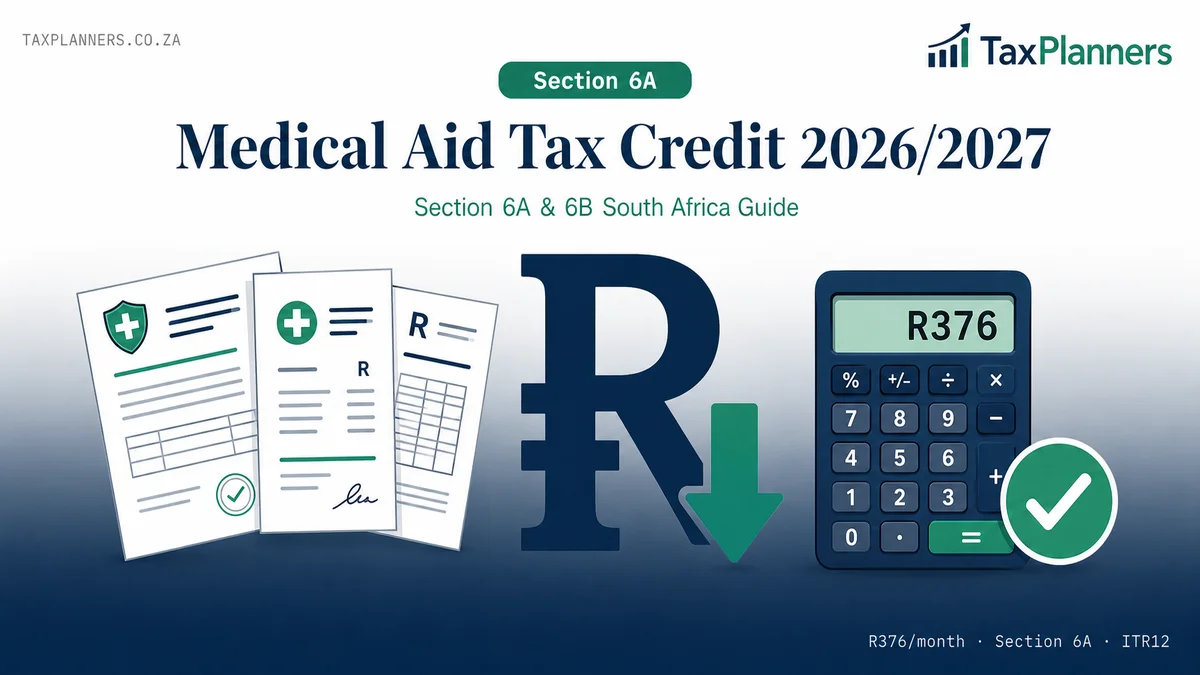
The medical aid tax credit (Section 6A) for 2026/2027 is R376 per month for the main member and first dependant, and R254 per month for each additional dependant. This is a direct tax credit — not a deduction — meaning it reduces your SARS tax bill rand-for-rand regardless of your income level. A family of four on medical aid saves up to R15,120 per year in tax through this credit alone. The credit is applied automatically on your ITR12 assessment based on your IRP5 medical aid data.
What Is the Medical Aid Tax Credit?
The medical aid tax credit is a benefit provided under Section 6A of the South African Income Tax Act. It allows taxpayers who pay medical aid contributions to reduce their annual SARS tax liability by a fixed rand amount per month for each person covered on the medical aid scheme.
The credit applies to the main member and all registered dependants. Unlike many other tax provisions, the medical aid tax credit is not means-tested — it is available to all qualifying taxpayers at the same rand value, regardless of income level. There is no upper income limit, and no minimum income required.
The credit was introduced in 2012 to replace the previous system of allowing medical aid contributions as a partial income tax deduction. The switch to a flat credit system was designed to give lower-income taxpayers a proportionally larger benefit, since a flat credit is worth more relative to the tax they pay.
Medical Aid Tax Credit vs Deduction: The Key Difference
Many South African taxpayers use the terms “tax credit” and “tax deduction” interchangeably, but they work very differently. Understanding this distinction matters for accurate tax planning:
Tax Credit (Section 6A)
How it works: Subtracts a fixed rand amount directly from your tax bill after all calculations.
- R376/month benefit is identical whether you earn R200,000 or R2,000,000
- Proportionally more valuable to lower-income earners
- Applied after tax is calculated — reduces final SARS liability
- Not affected by your marginal tax rate
Tax Deduction (old system)
How it worked: Reduced your taxable income, so the benefit depended on your tax bracket.
- A high earner (45% bracket) saved more than a low earner (18% bracket)
- Favoured higher-income taxpayers disproportionately
- Applied before tax is calculated — reduced the income being taxed
- Abolished in 2012 and replaced with the flat credit system
Practical example: A monthly medical aid credit of R376 saves every qualifying taxpayer exactly R376 per month in tax — R4,512 per year per covered member. Under the old deduction system, a taxpayer in the 45% bracket would have saved far more from the same contribution than a taxpayer in the 18% bracket. The credit system is more equitable.
Medical Aid Tax Credit 2026/2027: Rate Table & Who Qualifies
The 2026/2027 medical aid tax credit rates increased by 3.4% from the previous tax year, in line with the March 2026 Budget adjustments. The rates apply from 1 March 2026 to 28 February 2027:
| Beneficiary | Monthly Credit | Annual Credit | 2025/26 Rate | Increase |
|---|---|---|---|---|
| Main member | R376 | R4,512 | R364 | +R12/month |
| First dependant | R376 | R4,512 | R364 | +R12/month |
| 2nd dependant | R254 | R3,048 | R246 | +R8/month |
| 3rd dependant | R254 | R3,048 | R246 | +R8/month |
| Each additional | R254 | R3,048 | R246 | +R8/month |
Who qualifies: Any South African resident taxpayer who pays registered medical scheme contributions for themselves or their dependants. This includes salaried employees (where the employer pays), self-employed individuals, freelancers, and pensioners. The scheme must be registered under the Medical Schemes Act.
Use the TaxPlanners income tax calculator to see exactly how your medical aid tax credit reduces your total tax bill alongside your other deductions and rebates.
Section 6B: Additional Medical Expenses Tax Credit
In addition to the Section 6A medical aid tax credit for contributions, SARS provides a second credit under Section 6B for qualifying out-of-pocket medical expenses that were not covered by your medical aid scheme.
| Taxpayer Category | Section 6B Formula | Qualifying Expenses |
|---|---|---|
| Under 65, no disability | 25% of [qualifying expenses + uncovered costs − 4 × annual Section 6A credit] | Out-of-pocket medical costs exceeding 4x the annual Section 6A credit |
| Age 65 and over | 33.3% of all qualifying medical expenses paid | All qualifying out-of-pocket medical expenses |
| Person with disability | 33.3% of all qualifying medical expenses paid | All qualifying expenses including disability-related costs |
What qualifies as a Section 6B expense: Doctor, specialist, dentist, and optometrist fees not reimbursed by medical aid; prescribed medicines (with a valid script); hospital costs not covered; and any other expenses for a person with a disability as defined by SARS. All expenses must be supported by receipts and paid in the same tax year you are claiming.
Worked Examples: Medical Aid Tax Credit for Individual, Couple & Family
The following examples use 2026/2027 rates and assume 12 months of medical aid coverage throughout the full tax year:
Single Individual
Couple (Main + Spouse)
Family of Four
Use the TaxPlanners PAYE calculator or our tax refund calculator to check your full tax position including medical aid credits alongside your income tax and rebates.
How to Claim the Medical Aid Tax Credit on Your ITR12
SARS automatically calculates your Section 6A medical aid tax credit based on the data on your IRP5 from your employer or medical scheme. However, you still need to confirm the medical section on your ITR12 and capture any Section 6B expenses manually:
Log in to SARS eFiling and open your ITR12
Go to sars.gov.za, log in to eFiling, and open your ITR12 return for the 2026/2027 tax year. If SARS has issued an auto assessment, click Edit Return to access the full ITR12 form. Check that your return has the Medical Expenses section enabled — select “Yes” when asked if you have medical expenses or medical aid contributions.
Verify your IRP5 medical aid data is pre-populated
Your employer-paid and employee-paid medical aid contributions appear on your IRP5 under Code 4005 (employer contributions) and Code 4474 (employee contributions). On your ITR12, these figures should be pre-populated from your IRP5. Verify the total contribution amount matches your annual medical aid statements.
Capture number of months and dependants covered
In the Medical Expenses section of your ITR12, enter the number of months you were covered (1–12), the number of dependants covered, and the total contributions paid for the year. SARS uses these figures to calculate your Section 6A credit at R376/month for the first two members and R254/month for additional members.
Capture Section 6B out-of-pocket expenses (if applicable)
If you have qualifying medical expenses not covered by your scheme, enter the total amount in the “Medical expenses not covered by medical aid” field. Keep all receipts for doctor, dentist, specialist, pharmacy, and hospital visits — SARS may request supporting documents. For taxpayers under 65, only the portion exceeding 4 times your annual Section 6A credit will generate an additional credit.
Review your tax calculation summary
Once all fields are captured, click Calculate on eFiling. Your ITR12 summary will show your gross tax, less primary/secondary/tertiary rebates, less Section 6A medical aid tax credit, and any Section 6B credit. The final figure is your net tax payable or refund due. Use our 2026/27 tax brackets guide to verify the gross tax calculation is correct before submitting.
Common Medical Aid Tax Credit Mistakes to Avoid
Confusing credit with deduction
Many taxpayers believe medical aid contributions reduce their taxable income. They do not. The Section 6A credit reduces your tax bill directly after all income calculations are done.
Not claiming dependants
Some taxpayers only claim the credit for themselves and forget to include registered dependants (spouse, children). Each covered dependant generates an additional monthly credit.
Claiming gap cover contributions
Gap cover is not a registered medical scheme. Including gap cover premiums in your Section 6A medical aid tax credit claim is incorrect and may trigger a SARS verification query.
Missing Section 6B expenses
Taxpayers aged 65+ or with a disability often miss claiming qualifying out-of-pocket expenses under Section 6B, which gives them 33.3% credit on all such costs — with no minimum threshold.
Using wrong tax year rates
Using 2025/26 rates (R364/R246) instead of the 2026/27 rates (R376/R254) results in an understated credit claim and a higher-than-necessary tax payment to SARS.
Not checking auto assessment figures
SARS auto assessments pre-populate medical credit data from your IRP5, but errors occur — particularly if your employer submitted incorrect codes or if you changed medical schemes mid-year.
Frequently Asked Questions — Medical Aid Tax Credit
Calculate Your Medical Aid Tax Credit
Use the TaxPlanners income tax calculator to see your exact Section 6A credit alongside your full 2026/2027 tax calculation — including rebates, PAYE, and your refund or liability.
Open Tax Calculator