

Crypto Tax South Africa 2026:
Complete SARS Guide
How SARS taxes cryptocurrency in South Africa — CGT vs income tax, what the new CARF rules mean for you, and how to declare crypto on your ITR12 tax return.
Yes, SARS taxes cryptocurrency. Crypto assets are treated as intangible assets — not currency. Investors pay Capital Gains Tax (CGT) when they sell or swap crypto; active traders pay income tax on the full profit. From 1 March 2026, the new CARF framework means South African crypto exchanges automatically report your transaction data to SARS. Annual CGT exclusion is R50,000 in 2026. All crypto income must be declared on your ITR12 return.
- What Is Crypto Tax in South Africa?
- How Does SARS Tax Cryptocurrency?
- Which Crypto Events Trigger Tax?
- What Is CARF & How It Affects You
- CGT vs Income Tax — Which Applies?
- How to Calculate Your Crypto Tax
- How to Declare Crypto on eFiling
- What Records Must You Keep?
- 2026 Crypto Tax Rates
- Are You Ready to File?
- Common Mistakes to Avoid
- Frequently Asked Questions
What Is Crypto Tax in South Africa?
Yes. SARS confirmed in 2018 that normal income tax and CGT laws apply to crypto assets. Crypto is treated as an intangible asset — not as foreign currency or shares. Every South African taxpayer who holds, trades, or earns cryptocurrency must declare it on their annual ITR12 tax return, regardless of which exchange they use or whether the exchange is based in South Africa.
South Africa was one of the first countries in the world to formally clarify cryptocurrency taxation. SARS issued guidance in April 2018 stating that crypto assets are subject to the same tax framework as other assets — meaning the Income Tax Act and the Eighth Schedule (Capital Gains Tax) apply fully to crypto transactions.
The key point: SARS does not treat cryptocurrency as a currency, a share, or a foreign asset in the traditional sense. Instead, crypto is classified as an intangible asset. This classification determines which tax rules apply and how your gains and income are calculated.
Cryptocurrency includes Bitcoin (BTC), Ethereum (ETH), Ripple (XRP), Solana (SOL), stablecoins (USDT, USDC), NFTs, and any other digital asset — regardless of whether it is traded on a South African or foreign exchange.
SARS has been clear: not declaring crypto income or gains is not an option. With the introduction of the Crypto Asset Reporting Framework (CARF) from 1 March 2026, crypto exchanges now report transaction data directly to SARS — making undisclosed crypto activity significantly easier to detect.
Use the TaxPlanners CGT calculator to estimate how much tax you may owe on crypto profits before you file.
How Does SARS Tax Cryptocurrency?
SARS applies one of two taxes depending on your activity: Capital Gains Tax (CGT) for investors who hold crypto as a long-term asset, and income tax for traders who trade crypto as a business or receive crypto as payment, mining rewards, or staking income. The same crypto portfolio can have both CGT and income tax components — for example, a gain from selling Bitcoin held for 2 years (CGT) plus staking rewards received during the year (income tax).
Understanding how is crypto taxed in South Africa depends on two categories of activity, and the tax treatment is fundamentally different for each:
1. Capital Gains Tax (CGT) — For Investors
If you buy crypto as an investment and sell or dispose of it at a later date, any profit is a capital gain. Capital gains are not fully taxed — only 40% of the gain (the inclusion rate for individuals) is included in your taxable income. The first R50,000 of net capital gains per tax year is excluded (the annual exclusion, increased to R50,000 in Budget 2026 from R40,000).
2. Income Tax — For Traders and Earners
If you trade crypto frequently as a business or primary income source, SARS treats your profits as revenue — fully taxable as income, at your marginal tax rate (up to 45%). There is no annual exclusion for income tax. Crypto earned through mining, staking, airdrops, or payment for services is also treated as income at the ZAR value when received.
| Activity | Tax Type | Annual Exclusion | Inclusion Rate |
|---|---|---|---|
| Selling crypto (long-term investor) | CGT | R50,000 | 40% |
| Swapping crypto-to-crypto | CGT | R50,000 | 40% |
| Using crypto to pay for goods | CGT | R50,000 | 40% |
| Frequent / professional trading | Income Tax | None | 100% |
| Mining rewards received | Income Tax | None | 100% |
| Staking rewards received | Income Tax | None | 100% |
| Airdrops received | Income Tax | None | 100% |
| Crypto received as payment for work | Income Tax | None | 100% |
Which Crypto Events Trigger Tax in South Africa?
The following events trigger a taxable event: selling crypto for ZAR, swapping one crypto for another (e.g. BTC to ETH), using crypto to pay for goods or services, receiving mining rewards, receiving staking rewards, receiving airdrops, and receiving crypto as payment for work. Events that do NOT trigger tax: buying crypto with ZAR, transferring crypto between your own wallets, and simply holding crypto without disposing of it.
| Transaction | Taxable? | Tax Type |
|---|---|---|
| Selling Bitcoin for ZAR | Yes | CGT (investor) / Income (trader) |
| Swapping BTC for ETH on an exchange | Yes | CGT — treated as disposal of BTC |
| Using crypto to buy a product or service | Yes | CGT on the gain at time of spending |
| Receiving mining rewards | Yes | Income tax at ZAR value when received |
| Receiving staking rewards | Yes | Income tax at ZAR value when received |
| Receiving an airdrop | Yes | Income tax at ZAR value when received |
| Receiving crypto as salary or payment | Yes | Income tax — same as cash salary |
| Buying crypto with ZAR | No | Not taxable — establishes base cost |
| Transferring between your own wallets | No | Not a disposal — no tax event |
| Holding crypto without selling | No | Unrealised gains are not taxed |
| Gifting crypto to a spouse | Depends | Donation tax may apply; CGT triggered |
| Crypto lending / DeFi protocols | Depends | Complex — consult a tax practitioner |
What Is CARF and How Does It Affect South African Crypto Users?
From 1 March 2026, SARS implemented the Crypto Asset Reporting Framework (CARF) — an international standard requiring all licensed crypto service providers in South Africa to collect taxpayer identification details and report full transaction histories to SARS annually. This means SARS receives your crypto data automatically, similar to how your employer reports your IRP5. SARS can now cross-reference this data against your ITR12 return.
Which Platforms Are Affected?
CARF applies to all crypto asset service providers (CASPs) licensed by the Financial Sector Conduct Authority (FSCA) in South Africa. This includes major South African exchanges such as Luno, VALR, AltCoinTrader, and Binance South Africa, as well as international platforms with South African users. If you use an overseas exchange that is not FSCA-licensed, SARS can still obtain data through international tax information exchange agreements.
What Does SARS Do with This Data?
SARS will use CARF data to identify taxpayers who have crypto activity but have not declared it on their ITR12, to verify that declared figures match reported transaction data, and to pursue enforcement action where undeclared crypto income or gains are identified. SARS has publicly stated that cryptocurrency is an area of active compliance focus.
If you have undeclared crypto income from previous years, SARS has a Voluntary Disclosure Programme (VDP) that allows taxpayers to come forward and regularise their affairs with reduced penalties. Consult a registered tax practitioner before making a VDP application.
CGT vs Income Tax — Which Applies to Your Crypto?
SARS uses a set of factors to determine whether your crypto activity is an investment (CGT) or a trading business (income tax). The key factors are: how frequently you trade, how long you hold before selling, whether crypto is your primary income source, and whether your intent when buying was to hold long-term or to profit from short-term price movements. There is no hard rule — SARS looks at the full picture.
| Factor | Points to CGT (Investor) | Points to Income Tax (Trader) |
|---|---|---|
| Trading frequency | Occasional — a few times per year | Daily, weekly, or very active |
| Holding period | Months to years before selling | Hours, days, or weeks |
| Intent when buying | Long-term store of value / HODL | Profit from short-term price movement |
| Primary income source | Crypto is a side asset — you have other income | Crypto trading is your primary income |
| Use of leverage / margin | No — spot buying only | Yes — using leverage, futures, options |
| Systematic approach | No — buy and hold | Yes — structured trading strategy |
It is also possible to have both CGT and income tax in the same tax year. For example: you might hold a Bitcoin position for 3 years and sell it (CGT), while also earning Ethereum staking rewards throughout the year (income tax). Each type of activity is declared separately on the ITR12.
How to Calculate Your Crypto Tax (Step by Step)
For CGT: Proceeds (ZAR value when you sold) minus Base Cost (ZAR you paid to buy, including fees) equals your capital gain. Subtract the R50,000 annual exclusion. Multiply the remaining gain by 40% (inclusion rate). Add that figure to your other taxable income and apply your marginal tax rate (18%–45%). For income tax on crypto earnings: the full ZAR value at receipt is added to your taxable income directly.
CGT Calculation Example — Bitcoin Investor
Income Tax Calculation Example — Staking Rewards
Use the TaxPlanners Capital Gains Tax calculator to run your own crypto CGT estimate. For income tax estimates use the income tax calculator.
How to Declare Crypto on SARS eFiling (ITR12 Guide)
Log into SARS eFiling and open your ITR12 return. Answer Yes to the crypto assets disclosure question — this unlocks the crypto sections. Declare capital gains in Schedule C (Capital Gains section) with the date, proceeds, and base cost for each disposal. Declare mining, staking, and other crypto income under Local Business Income or Other Income. Submit before the October 2026 deadline for non-provisional taxpayers.
Download your transaction history. Export your full transaction history from every crypto exchange you used during the 2025/26 tax year (1 March 2025 to 28 February 2026). Include buys, sells, swaps, and any rewards received. Convert all amounts to ZAR using the exchange rate on each transaction date.
Calculate your gains and income. For each disposal: Proceeds minus Base Cost equals Capital Gain or Loss. Sum all gains and losses. For income events (staking, mining, airdrops), record the ZAR value at the time of receipt.
Log into SARS eFiling. Go to www.sars.gov.za, click eFiling, and log in. See our SARS eFiling guide if you need help registering or logging in.
Open your ITR12 return. Go to Returns → Returns History → ITR12 for the current tax year. Click Edit. When asked if you hold or transacted in crypto assets, answer Yes.
Complete Schedule C (Capital Gains). For each crypto disposal, enter: description (e.g. “Bitcoin”), date of disposal, proceeds in ZAR, and base cost in ZAR. The system calculates the gain automatically. Confirm the R50,000 annual exclusion is applied.
Declare crypto income. Under Local Business Income (if you trade as a business or mine) or Other Income (staking rewards, airdrops), enter the total ZAR value of crypto received as income during the year.
Submit your return. Review all figures, then click Submit. SARS issues an ITA34 assessment. For a full walkthrough of the ITR12 filing process, see the TaxPlanners guide to filing your SARS tax return. Keep all your supporting records for at least 5 years — SARS can request them at any time.
What Crypto Records Must You Keep for SARS?
SARS requires you to keep records of every crypto transaction for at least 5 years. For each transaction you need: the date, the type of transaction (buy/sell/swap/reward), the amount of crypto involved, the ZAR value at the time of the transaction, and the exchange or wallet used. Download and archive your transaction history from every exchange you use — do not rely on the exchange to keep this data indefinitely.
The South African tax system operates on a self-assessment basis — you declare your own income and gains. SARS can audit any return for up to 5 years after submission (15 years in cases of fraud). Your responsibility is to maintain records that support every figure on your ITR12.
Required Records per Transaction
- Date and time of the transaction
- Type of transaction (buy, sell, swap, mining reward, staking reward, airdrop, gift)
- Amount of crypto involved (how many units of which coin)
- ZAR value at the time of the transaction — use a reputable source (exchange rate on the SA exchange where you traded, or CoinGecko/CoinMarketCap historical data in ZAR)
- Transaction fees paid (in crypto or ZAR)
- Wallet addresses involved (for transfers)
- Exchange or platform used
- Running total of holdings in each coin (to track your base cost accurately)
Practical Record-Keeping Tips
Export your full transaction CSV from every exchange you use at the end of each tax year (28 February). Do not wait until you prepare your tax return — exchanges may close, restrict access, or change their export formats. Store exports securely in cloud storage (Google Drive, Dropbox) and a local backup.
If you use multiple exchanges or wallets, consider using a crypto tax software tool that aggregates transaction histories from multiple sources and automatically calculates your gains and income in ZAR. This significantly reduces the manual calculation burden.
What Are the 2026 Crypto Tax Rates in South Africa?
For CGT: only 40% of your net capital gain (after the R50,000 annual exclusion) is included in taxable income, then taxed at your marginal rate of 18%–45%. The maximum effective CGT rate for individuals is therefore 18% (45% × 40%). For income tax on crypto trading or earnings: the full amount is taxed at your marginal rate, up to 45%.
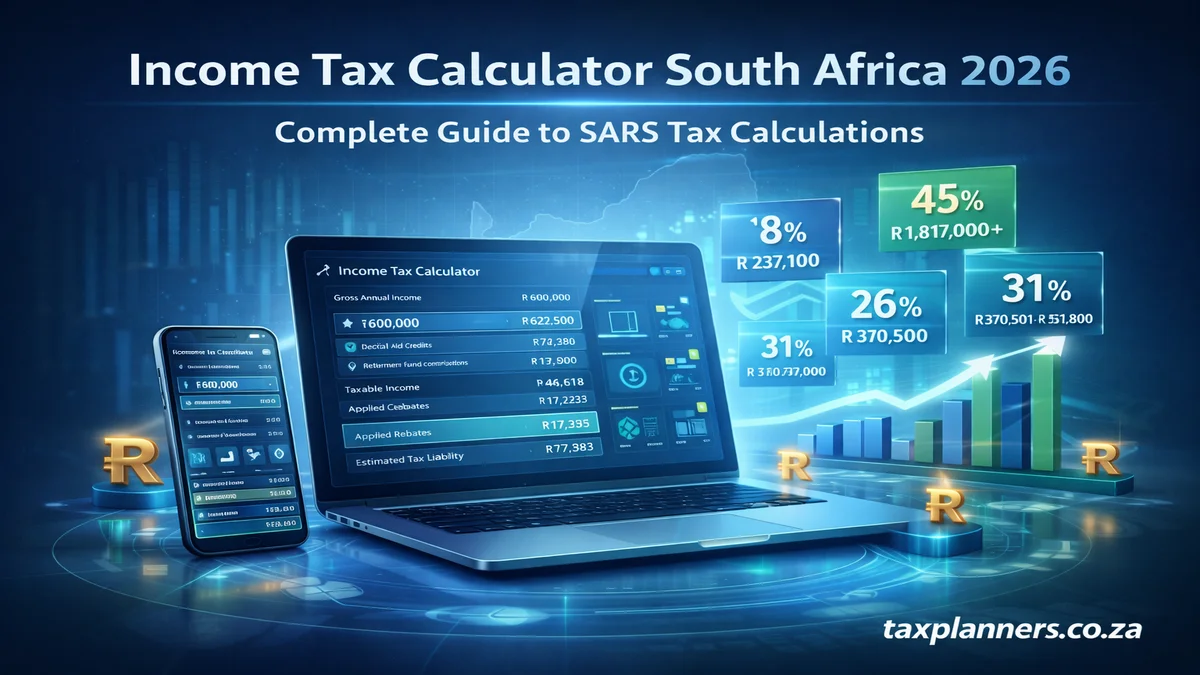
| Taxable Income (2026/27) | Marginal Rate | Max Effective CGT Rate |
|---|---|---|
| R1 – R237,100 | 18% | 7.2% |
| R237,101 – R370,500 | 26% | 10.4% |
| R370,501 – R512,800 | 31% | 12.4% |
| R512,801 – R673,000 | 36% | 14.4% |
| R673,001 – R857,900 | 39% | 15.6% |
| R857,901 – R1,817,000 | 41% | 16.4% |
| Above R1,817,000 | 45% | 18.0% |
Are You Ready to File? Crypto Tax Checklist 2026
Before the 2026 filing season opens in July: download all exchange transaction histories, convert all amounts to ZAR, calculate your capital gains and any crypto income received, ensure you are registered on SARS eFiling, and have your tax reference number ready for all exchanges under CARF. When filing your ITR12, answer Yes to the crypto question, complete Schedule C for CGT, and declare any crypto income separately.
Use this checklist before you file your 2026 ITR12 return:
- Downloaded full transaction CSV from every crypto exchange used in 2025/26
- Exported transaction history from hardware wallets and DeFi platforms
- All transaction amounts converted to ZAR at rates on transaction dates
- Capital gains calculated for all disposals (sells, swaps, spending)
- All crypto income totalled (staking, mining, airdrops, payment)
- Exchange fees documented and added to base cost or deducted as expenses
- SARS eFiling account registered, activated, and login tested
- Tax reference number provided to all exchanges (required under CARF)
- ITR12 crypto disclosure question answered Yes
- Schedule C (CGT) completed with all disposals
- Crypto income declared under appropriate income section
- All transaction records archived and backed up for 5 years
Use the SARS refund calculator to estimate whether SARS owes you money before you file, and the income tax calculator to check your total liability including crypto income.
What Crypto Tax Mistakes Do South Africans Commonly Make?
The most common mistakes are: not declaring crypto-to-crypto swaps, treating staking rewards as untaxed income, failing to disclose foreign exchange transactions, using incorrect ZAR conversion rates, and not registering a tax reference number with exchanges under CARF. Each of these can result in underpayment of tax, interest charges, and penalties of up to 200% of the tax owed.
Not Declaring Crypto-to-Crypto Swaps
Swapping Bitcoin for Ethereum or any other crypto is treated by SARS as a disposal of the first coin. Many taxpayers only declare when they convert to ZAR, missing all intermediate swaps — which can represent significant taxable gains. With CARF, SARS now receives complete swap data from exchanges.
Fix: Track every swap transaction separately. Record the ZAR value of the coin you disposed of at the moment of the swap — this is your proceeds for CGT purposes.
Treating Staking and Mining Rewards as CGT
A common error is to declare staking rewards only when selling the staked coins — and only as a capital gain. SARS treats staking rewards as income at the moment of receipt (not at the moment of later sale). Waiting until you sell understates your income and shifts the tax year incorrectly.
Fix: Record staking and mining rewards at their ZAR value on the date received. Declare this as Other Income in your ITR12 for the year they were received. Keep a log of each reward payout with the date and ZAR value.
Ignoring Foreign Exchange Transactions
Many South Africans use international exchanges (Coinbase, Kraken, Bybit) and assume SARS cannot see these transactions. Under CARF and OECD exchange agreements, SARS increasingly has access to international exchange data. The risk of being caught is higher than ever.
Fix: Declare all transactions on all exchanges — domestic and foreign. If you have undeclared foreign exchange activity, consider the SARS Voluntary Disclosure Programme to regularise your tax affairs before SARS initiates an audit.
Using Incorrect ZAR Conversion Rates
SARS requires all amounts to be declared in ZAR. Some taxpayers use the USD price of Bitcoin multiplied by a daily average exchange rate, which may differ from the actual ZAR rate on a South African exchange. SARS may dispute conversion rates that differ significantly from published SARB or major exchange rates.
Fix: Use the actual ZAR transaction price from the South African exchange you used (Luno, VALR) where possible. If trading on a foreign exchange, use the SARB daily exchange rate for that date to convert USD to ZAR. Document your rate source for every transaction.
Not Registering Your Tax Number with Exchanges
Under CARF (from 1 March 2026), South African exchanges are legally required to collect your tax reference number and ID. Some taxpayers refuse to provide this, thinking it protects their privacy. In reality, the exchange is still required to report the account to SARS — but with incomplete data, flagging the account as non-compliant.
Fix: Provide your South African tax reference number and ID to all exchanges you use. If you are not registered for tax, register at a SARS branch or via eFiling. Being on the SARS system with declared income is far better than being flagged as non-compliant.
Frequently Asked Questions — Crypto Tax South Africa
This guide is provided for general information purposes only and reflects SARS guidance and tax legislation as understood at June 2026. Tax laws and SARS interpretations change. This content does not constitute tax advice — for advice specific to your situation, consult a registered South African tax practitioner. Always verify current rates, deadlines, and rules at www.sars.gov.za/individuals/crypto-assets/.
Calculate Your Crypto Tax Before You File
Use the TaxPlanners calculators to estimate your CGT or income tax on crypto profits before the 2026 filing season opens.
📈 Calculate My Crypto CGT →Income Tax Calculator → | SARS eFiling Registration Guide → | Full CGT Guide →
✎ TaxPlanners.co.za · Published June 2026 · Not tax advice — verify at sars.gov.za