
Turnover Tax South Africa 2026: Complete SARS Guide
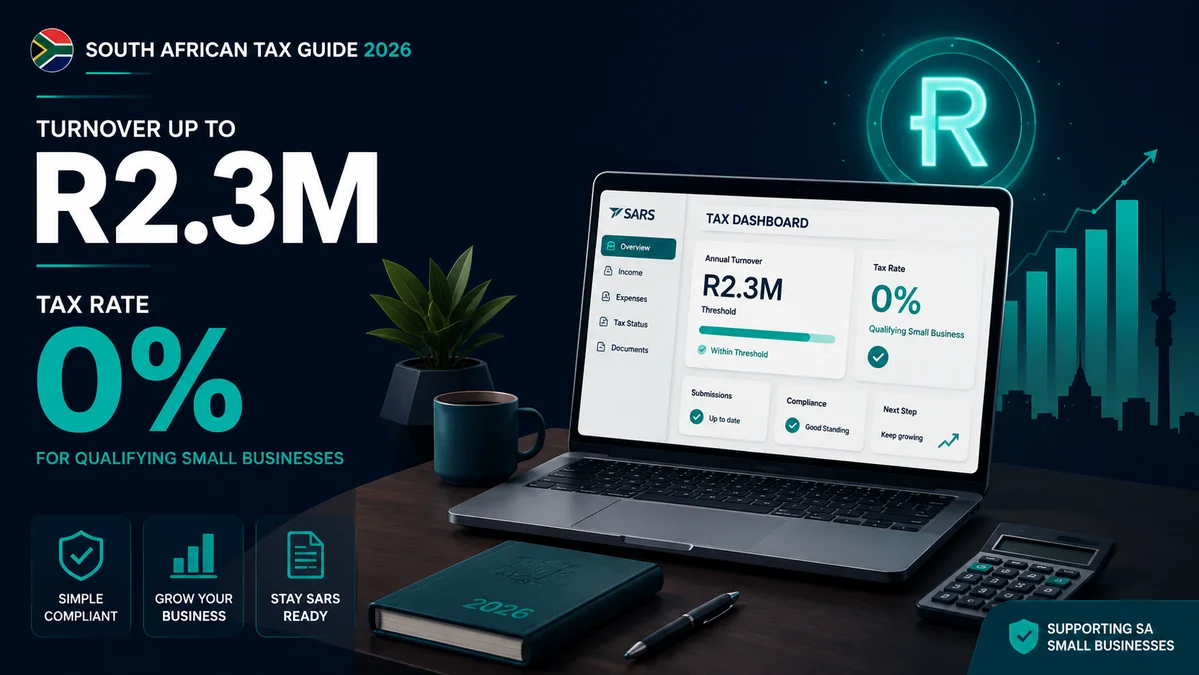
The Budget 2026 threshold increase means more small businesses now qualify. Here is everything you need to know about rates, registration and calculation.
This guide is compiled from SARS official publications, Budget 2026 documentation, and the SARS Turnover Tax page (last updated 10 April 2026). All rates and thresholds are sourced directly from sars.gov.za.
What Is Turnover Tax in South Africa?
Turnover Tax was introduced by SARS to reduce the administrative burden on very small businesses. Rather than filing multiple returns, tracking deductible expenses and paying provisional tax (advance income tax payments due twice yearly) twice a year, a registered micro business pays a single low-rate tax on its total income received.
The system is calculated on turnover — the total amount your business receives — not on profit. This makes bookkeeping far simpler because you do not need to track every expense or understand complex deduction rules.
What does Turnover Tax replace? For registered micro businesses, Turnover Tax takes the place of:
- Income Tax (company or personal, on business income)
- Provisional Tax (the twice-yearly advance payments to SARS before your final return)
- Capital Gains Tax (CGT) — replaced for micro businesses, with one exception for asset disposals
- Dividends Withholding Tax — up to R200,000 dividends per year are exempt; dividends above R200,000 remain subject to 20% DWT
- VAT — for businesses below the R1 million VAT threshold
A micro business registered for Turnover Tax may still elect to remain in the VAT system if it wishes, or if its supplies exceed the R1 million VAT registration threshold.
Who Qualifies for Turnover Tax in 2026?
The following types of businesses may apply to register for Turnover Tax:
- Sole proprietors (individuals running their own business)
- Partnerships
- Close corporations (CCs)
- Private companies (Pty Ltd)
- Co-operatives
What counts as qualifying turnover? Your qualifying turnover is the total amount your business receives from trading — but with two important exclusions:
- All receipts of a capital nature (proceeds from selling business assets such as equipment or vehicles)
- Certain government grants that are exempt from income tax under the Income Tax Act
This means if your trading income is R2.1 million but you also sold a company vehicle for R400,000, your qualifying turnover is still R2.1 million — well under the R2.3 million limit. You would still qualify.
Who Does NOT Qualify for Turnover Tax?
Even if your turnover is below R2.3 million, SARS excludes certain types of businesses from the Turnover Tax system:
- Personal service providers — where one person provides services, more than 80% of income comes from one client, and that person would be an employee if not operating through a company
- Labour brokers — businesses that supply workers to other employers
- Professional service providers — including attorneys, accountants, architects, engineers, doctors, dentists, and similar regulated professions
- Businesses where any owner holds an interest in another business that is not a micro business
- Businesses that earn investment income (interest or royalties) exceeding a certain threshold
If you are unsure whether your business qualifies, use the SARS Turnover Tax quick test — a short decision tree that confirms eligibility based on your specific circumstances.
What Are the Turnover Tax Rates for 2026/27?
| Annual Turnover | Rate | Tax on Band | Cumulative Tax |
|---|---|---|---|
| R0 – R600,000 | 0% 2026/27 | R0 | R0 |
| R600,001 – R950,000 | 1% on amount above R600,000 | Max R3,500 | Up to R3,500 |
| R950,001 – R1,400,000 | R3,500 + 2% on amount above R950,000 | Max R9,000 | Up to R12,500 |
| R1,400,001 – R2,300,000 | R12,500 + 3% on amount above R1,400,000 | Max R27,000 | Up to R39,500 |
Source: SARS Turnover Tax — year of assessment ending 1 March 2026 to 28 February 2027.
The maximum possible tax at the R2.3 million threshold is R39,500 — an effective rate of just 1.72% on total turnover. This compares very favourably to the 27% corporate tax rate or progressive individual income tax rates, especially for profitable businesses with low expenses.
How Is Turnover Tax Calculated? — Worked Examples
Qualifying turnover vs taxable turnover — the key distinction:
When you sell a business asset (equipment, a vehicle, etc.), the proceeds are excluded from your qualifying turnover when checking whether you meet the R2.3 million eligibility threshold. However, 50% of those proceeds are included in your taxable turnover when calculating the actual tax you owe. This prevents large capital gains from being routed through the low-rate turnover tax system.
Turnover: R450,000
Turnover: R800,000
Turnover: R1,800,000
Is Turnover Tax Better Than Normal Tax in South Africa?
| Feature | Turnover Tax | Normal Company Tax | SBC Tax (Small Business Corp) |
|---|---|---|---|
| Tax base | Total turnover (receipts) | Taxable profit (revenue minus expenses) | Taxable profit |
| Tax rate | 0–3% | 27% | 0–27% graduated |
| Expense deductions | None | Full deductions | Full deductions |
| Provisional tax | Replaced (two TT02 payments) | Required (IRP6 twice yearly) | Required |
| CGT | Replaced (50% included in turnover) | Applies at 21.6% inclusion rate | Applies |
| Record keeping | Minimal — receipts only | Full income and expense records | Full records required |
| eFiling return submission | eBooking appointment needed | Fully on eFiling | Fully on eFiling |
| Best for | Low-cost, high-margin businesses | High-expense businesses | Companies with significant profits |
Should you register for Turnover Tax?
✅ Choose Turnover Tax if:
- Your profit margin is above 15%
- Your operating costs are low
- You want minimal bookkeeping
- You have no large deductible expenses
- Simplicity is more valuable than optimisation
✗ Stick with Normal Tax if:
- Your business has high operating costs
- You run on thin profit margins (under 5%)
- You have significant capital equipment depreciation
- You expect to exceed R2.3M soon
- You prefer eFiling for all returns
Before switching, run the numbers for your specific business. For a free comparison, use the Turnover Tax Calculator at Accounter.co.za which compares turnover tax against estimated normal tax based on your profit margin. Alternatively, consult a registered tax practitioner — for many small businesses the decision is not obvious.
How Do You Register for Turnover Tax in 2026?
-
1Do the SARS Quick TestGo to the SARS Turnover Tax quick test and answer a series of yes/no questions about your business type and turnover. This confirms in minutes whether you qualify before you invest time in registration.
-
2Register via SOQS (Recommended — Fully Digital)Visit tools.sars.gov.za/sarsonlinequery/turnovertax. As of November 2025, turnover tax registration is integrated into SARS’s Online Query System — it is secure, fast and fully digital. Have your tax reference number and ID ready.
-
3Alternative: Submit Form TT01 at a SARS BranchIf you prefer in-person registration, download the TT01 Application for Turnover Tax form, complete it, and book a SARS eBooking appointment. The SOQS route is faster and avoids branch queues.
-
4Register by 28 FebruaryYour registration must be submitted by the last business day of February to take effect for the tax year starting 1 March. Miss this deadline and you must wait until the following year. For 2027/28, register by 26 February 2027.
How Do You Submit Returns and Pay Turnover Tax?
| Return / Payment | When | Purpose |
|---|---|---|
| TT02 (1st interim) | Last business day of August | Estimated turnover for first half of year |
| TT02 (2nd interim) | Last business day of February | Estimated turnover for full year |
| TT03 (Annual return) | July – January (following year) | Actual turnover — final assessment and top-up payment |
How to submit the TT03 annual return:
- Book an appointment via the SARS eBooking system
- Alternatively, email SARS with your completed TT03 form and supporting documents
- The TT03 return cannot be submitted directly via eFiling — this is a known limitation of the turnover tax system
How to make payments: Use the TT02 Payment Advice as your reference when paying. Payments can be made via internet banking or at any commercial bank. Always quote the Beneficiary ID and Payment Reference Number shown on your TT02. Keep your TT02 as your own record — do not submit it to SARS.
What Records Must You Keep for Turnover Tax?
SARS provides two free recordkeeping workbook downloads to help:
- Recordkeeping workbook — Individuals and partnerships
- Recordkeeping workbook — CCs, companies and co-operatives
Even though detailed expense records are not required, it is still good business practice to track your costs. This helps you monitor profitability, identify when turnover tax may no longer be the best option, and manage cash flow for your TT02 interim payments.
All records must be retained for a minimum of 5 years from the date of submission of the relevant return — the same as for all other SARS tax types. For more on record-keeping best practice, see our guide on SARS eFiling and tax compliance.
When Should You Deregister from Turnover Tax?
Compulsory deregistration triggers:
- Your qualifying turnover exceeds R2.3 million in a tax year — notify SARS within 21 days
- Your business type changes to one that is excluded (e.g. you become a personal service provider)
- You acquire an interest in another business that is not a micro business
Voluntary deregistration reasons:
- Your business is growing and you expect to exceed R2.3 million within the next year
- You have taken on significant deductible expenses (staff, premises, equipment) making normal tax more efficient
- You want full eFiling capability for all your tax returns
- You want to claim input VAT on business purchases
To deregister, notify SARS in writing via the eBooking system or SOQS. The deregistration takes effect at the end of the current tax year (28 February). From 1 March, your business transitions to the normal income tax system — you will need to register for provisional tax and ensure your financial records are ready to support a full income and expense return.