
SARS IRP6 Deadline and Penalties Explained — 2026/2027
Everything you need to know about IRP6 deadlines, the 20% underestimate penalty, 10% late payment penalty, interest charges — and exactly how to avoid each one.
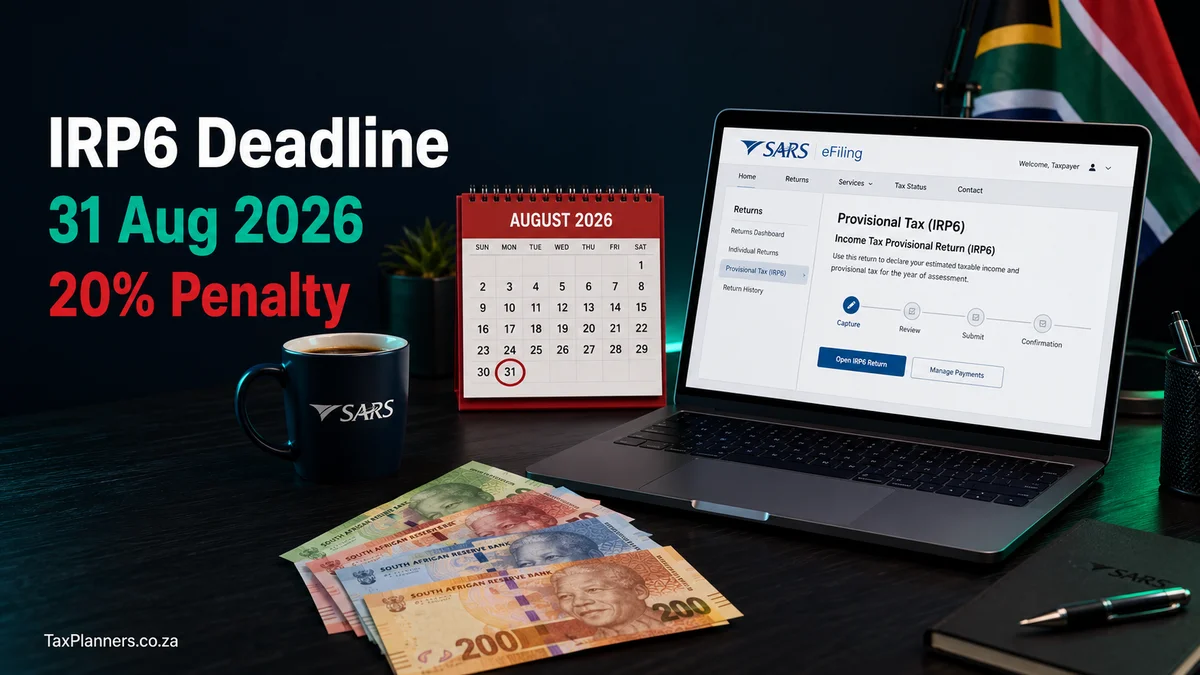
The IRP6 (provisional tax return) has two mandatory deadlines per year. For 2026/2027: first payment due 31 August 2026 (50% of estimated annual tax), second payment due 28 February 2027 (balance). Miss a deadline and SARS charges a 10% penalty plus interest. Underestimate by more than 10% — and SARS adds a further 20% penalty on the shortfall.
📋 Table of Contents
What is the IRP6?
The IRP6 is the provisional tax return form that provisional taxpayers must submit to SARS twice a year (with an optional third submission). On each IRP6, you estimate your taxable income for the full tax year and calculate the provisional tax payable. The IRP6 can only be filed via SARS eFiling — there is no paper version.
Provisional taxpayers include freelancers, sole proprietors, rental income earners, individuals with investment income above R30,000 not subject to PAYE, and all companies and close corporations. If you receive income that your employer does not fully deduct PAYE on, you are almost certainly a provisional taxpayer and must file IRP6 returns.
Getting the IRP6 right — accurate estimate, on time, with correct figures — is what prevents SARS penalties. This guide explains every penalty, when it applies, and how to stay clear of each one.
IRP6 Deadlines 2026/2027
The 2027 tax year runs from 1 March 2026 to 28 February 2027. There are three IRP6 submission and payment dates:
EFT payments via internet banking can take 1–2 banking days to reach SARS. Pay at least 2 business days before the deadline. If payment arrives after the due date, SARS treats it as late — even if you initiated it on time. Always use the correct IRP6 payment reference number from eFiling.
Company IRP6 Deadlines
Companies, close corporations and trusts have different IRP6 deadlines based on their financial year end — not the standard March–February cycle. A company with a February year end follows the same dates as individuals. A company with a June year end, for example, has its first IRP6 due 6 months into its financial year (December) and its second IRP6 due at year end (June). Always calculate your company’s deadlines from its own financial year start date.
Types of IRP6 Penalties
SARS can impose three separate financial consequences for IRP6 errors or late payments. They are independent of each other — all three can apply at the same time:
The 20% Underestimate Penalty
This is the most significant IRP6 penalty. SARS imposes it when your provisional tax estimate was too low. Two conditions must both be met before the penalty applies:
| Condition | Threshold | What It Means |
|---|---|---|
| Condition 1 | Estimate < 90% of actual taxable income | Your estimate was less than 90 cents for every rand of actual income earned |
| Condition 2 | Estimate < Basic amount | Your estimate was also less than the basic amount (last assessed income + 8% per year) |
Both conditions must be satisfied simultaneously for the 20% penalty to apply. If your estimate is below 90% of actual income but above the basic amount, no 20% penalty applies. If your estimate is above 90% of actual income, no 20% penalty applies regardless of the basic amount.
The penalty is calculated on the difference between the tax you should have paid (based on actual income) and the tax you actually paid via provisional tax. Example: if you owed R100,000 in provisional tax but only paid R50,000, and both penalty conditions are met, SARS imposes 20% × R50,000 = R10,000 penalty. This is in addition to the R50,000 shortfall and any interest.
The 10% Late Payment Penalty
A 10% penalty applies on any provisional tax amount that is not paid by the due date. This penalty applies regardless of whether the IRP6 return was filed on time — late payment is a separate issue from late filing.
The 10% is calculated on the unpaid amount as at the due date. If you paid R60,000 of a R100,000 liability by the due date, the 10% applies only to the R40,000 outstanding. Partial payments reduce the penalty base. SARS does not grant extensions on provisional tax due dates — there is no provision to request more time.
Even if you cannot pay the full amount, always file the IRP6 by the due date. Failing to file entirely can trigger additional administrative penalties under the Tax Administration Act (Section 210), separate from the late payment penalty. Filing on time with partial payment limits your exposure to 10% on the unpaid balance — not filing at all opens you to much broader penalties.
Interest on Underpayment
In addition to penalties, SARS charges interest on any provisional tax shortfall. Interest is prescribed by the National Credit Act and is currently calculated at the repo rate plus 3.5%, updated periodically. This interest runs from the due date of the payment until the date SARS receives full payment or raises a final assessment.
Interest cannot be waived by SARS — unlike penalties, which SARS has discretion to remit in exceptional circumstances. Making a voluntary third payment by 30 September 2027 stops further interest from accruing on any second-payment shortfall, before SARS raises your final assessment.
The Basic Amount — Your Safe Harbour
The basic amount is the taxable income shown on your most recent SARS income tax assessment, increased by 8% for each year that has passed since that assessment date. Using the basic amount as your IRP6 estimate is the safest approach when you are unsure of your actual income for the year.
| Time Since Last Assessment | Basic Amount Increase | Example (Last Assessed R300,000) |
|---|---|---|
| Less than 1 year | None — use as-is | R300,000 |
| 1 year | +8% | R324,000 |
| 2 years | +16.64% (compounded) | R349,920 |
| 3 years | +25.97% (compounded) | R377,914 |
When you use the basic amount as your IRP6 estimate and your actual income turns out to be higher, SARS will not impose the 20% underestimate penalty — even if your payment falls well below 90% of your actual tax. You will still owe the shortfall plus interest, but the additional 20% penalty is waived entirely.
If your taxable income exceeds R1 million, the 90% safe harbour tightens. SARS requires your estimate to be at least 80% of actual taxable income to avoid the underestimate penalty (instead of 90% for lower earners). The basic amount method still protects you regardless of income level.
Penalty Scenarios — Worked Examples
| Item | Amount |
|---|---|
| Actual taxable income (after year end) | R500,000 |
| IRP6 estimate submitted | R300,000 (60% of actual) |
| Basic amount | R380,000 |
| Estimate below 90% of actual? | Yes (60% < 90%) |
| Estimate below basic amount? | Yes (R300,000 < R380,000) |
| Actual tax on R500,000 | R98,417 (after primary rebate) |
| Tax paid on R300,000 estimate | R40,572 |
| Shortfall | R57,845 |
| 20% underestimate penalty | R11,569 |
| Interest on shortfall (prescribed rate, ~3 months) | ~R1,300 |
| Total additional cost | ~R12,869 |
| Item | Amount |
|---|---|
| Actual taxable income | R500,000 |
| IRP6 estimate (basic amount) | R380,000 |
| Estimate below 90% of actual? | Yes (76% < 90%) |
| Estimate below basic amount? | No — estimate equals basic amount |
| Tax paid on R380,000 basic amount estimate | R61,372 |
| 20% underestimate penalty | R0 — waived because basic amount used |
| Shortfall (actual vs paid) | R37,045 |
| Interest on shortfall (prescribed rate, ~3 months) | ~R830 |
| Total additional cost | ~R830 (interest only — no penalty) |
How to Avoid IRP6 Penalties — Checklist
| Penalty | How to Avoid It |
|---|---|
| 20% underestimate penalty | Estimate at least 90% of actual income (or 80% if income > R1M) — OR use the basic amount method |
| 10% late payment penalty | File the IRP6 AND ensure payment reaches SARS by 31 August 2026 (first) and 28 February 2027 (second) |
| Interest charges | Pay the full estimated liability by each due date. Make voluntary third payment by 30 September 2027 if you underpaid the second |
| Administrative penalties (non-filing) | Always file the IRP6 by the due date even if you cannot pay the full amount |
SARS can remit (cancel) penalties under Section 215 of the Tax Administration Act if there are exceptional circumstances — such as a natural disaster, serious illness, death of a close family member, or circumstances entirely beyond the taxpayer’s control. You must apply in writing with supporting documentation. Interest cannot be waived under any circumstances.
FAQ — IRP6 Deadlines and Penalties
⚡ Calculate Your Provisional Tax Now
Use our free provisional tax guide and calculator to estimate your IRP6 payments for 2026/2027.