
What Supporting Documents Does SARS Require? Complete Checklist
A practical checklist of common supporting documents SARS may request for your ITR12, a verification or an audit — IRP5, medical aid certificates, travel logbooks, investment certificates, rental records and business documents explained.
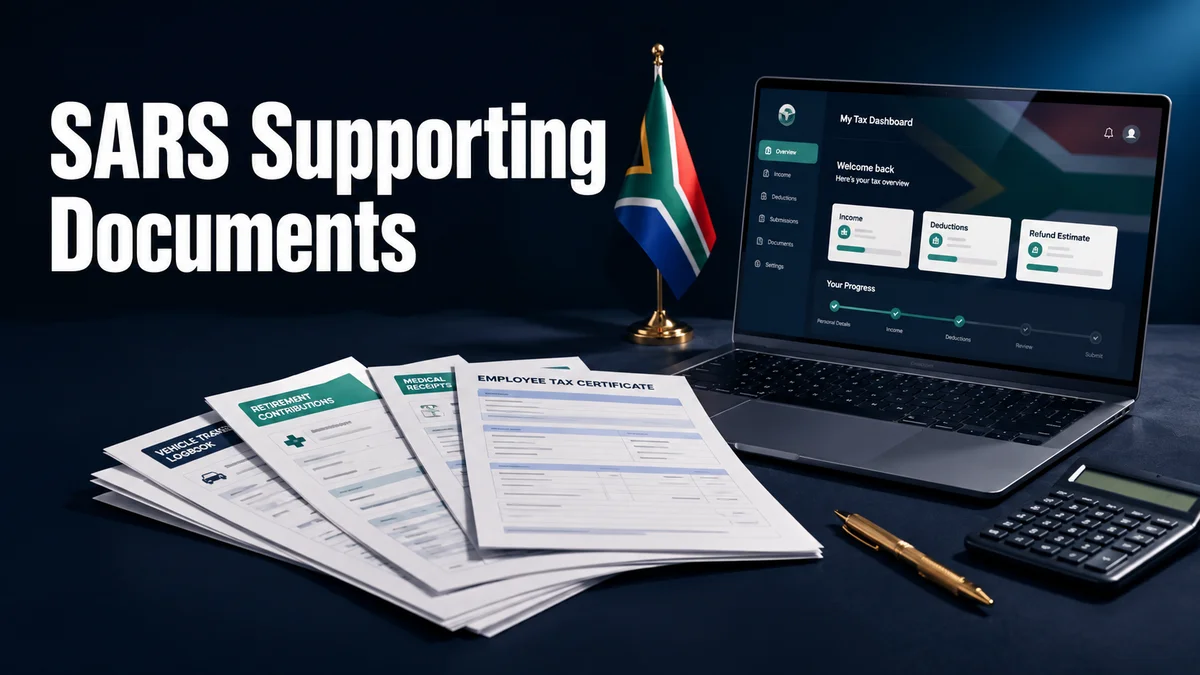
You should retain adequate records supporting the income, deductions, credits and other information declared on your ITR12. Common documents include your IRP5 from your employer, IT3(b) for investment income, medical scheme fees certificate, retirement fund contribution certificates, a travel logbook where a business-travel deduction is claimed, and rental or business records where applicable. You do not generally upload these when filing — SARS may request specific documents during verification or audit.
Why SARS Requests Supporting Documents
You should retain adequate records supporting the income, deductions, credits and other information declared on your ITR12. SARS does not verify documents at the time you file, but after submission SARS uses a risk-based system to select returns for verification or audit. If your return is selected, SARS issues a formal request specifying which documents are needed and the deadline by which you must submit them.
After SARS receives all required supporting material, it generally aims to conclude a standard verification within 21 business days, although it may request additional information and more complex cases can take longer. The most common reason SARS requests documents is to verify income or deductions that appear unusual, differ significantly from prior years, or fall into higher-risk categories.
Official source: SARS — Being Audited or Selected for Verification
Employment Income Documents
If you are an employee, these are the primary documents used to support employment income and deductions on your ITR12:
-
IRP5 / IT3(a) — Employee Tax CertificateIRP5 and IT3(a) employee tax certificates report remuneration and related payroll information submitted to SARS. The certificate type and codes used depend on whether employees’ tax was deducted and the nature of the payment. This information is normally pre-populated on your ITR12 in eFiling. Review it carefully before filing. If a certificate is missing or incorrect, contact your employer or payroll department and follow the current SARS process rather than submitting information you know is incomplete or inaccurate.
-
Travel LogbookA complete and acceptable logbook is generally required to claim a deduction for business travel against a travel allowance. Without a qualifying logbook, the business-travel deduction may be denied. Separately, for PAYE withholding purposes, employers generally include 80% of a fixed travel allowance in remuneration, which may be reduced to 20% where the employer is satisfied that at least 80% of the vehicle’s use during the tax year will be for business purposes. Your logbook must record date, starting odometer, ending odometer, destination and business purpose for every business trip.
-
Company Car LogbookIf your employer provides a company vehicle, keep a logbook recording total kilometres driven and business kilometres. This supports the determination of the private-use portion of the fringe benefit included in your taxable income. Consult your employer or tax practitioner for the applicable calculation method.
Official source: SARS — Travel e-Log Book
Deduction Documents
Deductions reduce taxable income or tax payable. Whether a particular deduction is available depends on the taxpayer’s circumstances and the applicable legislation. Retain proof of every deduction claimed on your ITR12:
-
Medical Scheme Fees Tax Credit CertificateIssued by your medical scheme, confirming monthly contributions and number of dependants covered. For the 2027 year of assessment, the monthly medical scheme fees tax credit is R376 for the taxpayer, R376 for the first dependant and R254 for each additional dependant, subject to the taxpayer qualifying for the credit under the applicable rules. Verify current amounts in the official SARS employer tax guide before relying on these figures.
-
Out-of-Pocket Medical ExpensesReceipts and invoices for qualifying medical expenses not recovered from your scheme — including doctors, dentists, optometrists, specialist consultations and qualifying medicines. Keep every receipt. SARS requires these to verify any additional medical expense deduction or credit claimed on your ITR12. Whether the additional deduction applies depends on your age and other individual circumstances.
-
Retirement Fund Contribution CertificatesIssued by your pension fund, provident fund or retirement annuity (RA) fund administrator confirming contributions made during the tax year. For the 2027 year of assessment, qualifying contributions to pension, provident and retirement annuity funds are generally deductible subject to the statutory calculation, including the 27.5% limitation and the annual cap of R430,000. The applicable limit is not simply 27.5% of taxable income in every case, and excess contributions may be carried forward under the applicable rules. Retain certificates from all qualifying funds — the limitation applies across qualifying retirement-fund contributions, not only to RA contributions.
-
Home Office Expense RecordsA home-office deduction is not available merely because an employee sometimes works from home. The relevant area generally needs to be regularly and exclusively used for trade or employment, specifically equipped for that purpose, and the taxpayer must satisfy the applicable duties-performed requirements. Keep floor-area calculations, invoices, proof of payment and any relevant employer confirmation. The permitted expenses depend on the taxpayer’s circumstances and current legislation — not every cost associated with the home is necessarily deductible. Consult the SARS home-office guidance for the current qualifying conditions.
-
Section 18A Donation ReceiptA deduction may be available for a bona fide donation to an organisation approved to issue section 18A receipts, provided the taxpayer holds compliant supporting documentation. Not every donation to a Public Benefit Organisation qualifies. The deduction is subject to the applicable statutory limit and current SARS requirements. Retain the official section 18A receipt showing the organisation’s PBO approval number, your name, amount donated and date. See our guide on PBO status for more detail on qualifying organisations.
Official sources: SARS Employer Tax Guide 2027 · SARS Home Office Expenses · SARS Section 18A
Investment Income & Capital Gains Documents
-
IT3(b) — Investment Income CertificateIssued by banks, unit trust companies and investment platforms reporting interest and other investment income credited to you during the tax year. Your bank typically issues this annually. You may need certificates from every institution where you hold a savings account, fixed deposit or unit trust investment. SARS uses IT3(b) data to pre-populate the investment-income sections of your ITR12.
-
IT3(c) — Capital Gains CertificateIssued by stockbrokers, unit trust administrators and investment platforms showing capital gains or losses realised during the tax year from the disposal of assets. Required to support the capital gains section of your ITR12. Includes cost price, proceeds and net gain or loss per asset class.
-
Property Purchase & Sale RecordsKeep purchase and sale agreements, transfer documentation, professional-fee invoices and records of qualifying acquisition, disposal and improvement expenditure. Whether a particular cost forms part of the base cost of a property depends on the Eighth Schedule to the Income Tax Act and the facts of the transaction. Retain these records throughout ownership and for the applicable retention period after the disposal is reported to SARS.
-
Cryptocurrency Transaction RecordsCrypto transactions may have income-tax or capital-gains consequences depending on the taxpayer’s intention, pattern of activity and the facts of each transaction. Keep complete records of acquisitions, disposals, exchanges, fees, wallet transfers and rand values at relevant dates. Transfers between wallets controlled by the same taxpayer should be documented so they can be distinguished from disposals to another party. Reports generated by exchanges can assist, but taxpayers should retain enough underlying records to substantiate every relevant transaction. See our crypto tax guide for further detail.
Rental Income Documents
If you earn rental income, declare it on your ITR12. Subject to the general deduction requirements, expenses incurred in producing rental income may include rates and taxes, bond interest (not capital repayments), qualifying insurance premiums, advertising, agency fees, repairs and certain levies. Private expenditure, capital improvements and expenses not incurred in producing rental income are generally not immediately deductible. Expenses may need apportionment where a property is used partly privately.
| Document | What It Supports | Notes |
|---|---|---|
| Signed lease agreement | Rental income amount and period | Confirm actual receipts against bank statements |
| Bank statements (rental deposits) | Actual income received | Reconcile with lease amounts |
| Bond / mortgage statements | Interest portion (may be deductible) | Capital repayments are not deductible |
| Municipal rates invoices | Rates and taxes expense | Apportion if partly private use |
| Maintenance and repair invoices | Deductible repairs | Distinguish from capital improvements |
| Insurance premium statements | Qualifying building insurance | Contents and bond insurance may require separate assessment |
| Estate agent fee invoices | Cost of earning rental income | Commission and management fees |
| Levy statements (sectional title) | Ordinary body corporate levies | Special or capital levies may require different treatment |
Only repairs and maintenance to restore property to its original condition are generally deductible as rental expenses in the year incurred. Capital improvements — structural additions, significant upgrades or alterations that improve the property beyond its original state — are not immediately deductible but may affect the property’s base cost for capital gains purposes. Keep all invoices and identify each item correctly.
Official source: SARS — Tax on Rental Income
Business & Self-Employment Documents
Sole proprietors and freelancers declare business income on their ITR12. Retain adequate records to support every item of income and every expense claimed:
-
Invoices Issued to ClientsAll invoices issued during the year showing gross income earned. These should reconcile with the income declared on your ITR12. Maintain a sequential invoice register and supporting contracts where applicable.
-
Business Expense Invoices and ReceiptsKeep invoices, receipts, contracts, proof of payment and business records that establish the amount, nature and business purpose of each expense claimed. Where a VAT-registered taxpayer also claims input VAT, the documentation must satisfy the applicable VAT invoice requirements — but an expense is not automatically non-deductible for income-tax purposes merely because the supplier is not VAT-registered.
-
Business Bank StatementsTwelve months of business bank statements reconciling income received and expenses paid. SARS uses these to cross-check declared income against actual deposits. If business and personal accounts are combined, be prepared to explain the basis of any apportionment.
-
Asset Purchase Invoices (Wear-and-Tear Allowances)If you claimed a wear-and-tear allowance under section 11(e) for business assets such as computers or office equipment, retain the original purchase invoice showing cost, purchase date and supplier. Keep these for the full period over which the allowance is claimed and for the applicable record-keeping period thereafter.
SARS Verification Requests
After you file your ITR12, SARS may issue a verification request for specific documents. This is not necessarily an audit. SARS will specify the submission deadline in the request letter — submit the requested material by the date stated in that letter. After SARS receives all required supporting documents, it generally aims to conclude a standard verification within 21 business days, although it may request additional information and more complex cases can take longer.
SARS specifies exactly which documents it wants and the deadline for submission. Only submit what is requested. Note the date stated in the letter and treat it as your filing deadline — not a general 21-business-day rule.
Open the relevant return, verification case or SARS correspondence item in eFiling and use the available supporting-document upload function. Follow the instructions displayed in the SARS letter and on the applicable work page. Check the upload screen for accepted file formats and size limits, as these can differ by submission channel.
Missing the deadline can result in SARS raising an estimated assessment that disallows deductions. If you need more time, request an extension via eFiling or by contacting SARS before the deadline stated in the letter.
After uploading, save the confirmation reference number generated by SARS. This serves as your proof of timely submission if a dispute arises.
Official source: SARS — Relevant Material and Supporting Documents · SARS — Being Audited or Selected for Verification
How Long Must You Keep Records?
A person who has submitted a return generally needs to retain supporting records for five years from the date of submission. Longer retention may be required where a return remains outstanding, an audit or investigation is ongoing, an assessment is disputed, or another legal retention rule applies. Records relevant to an unresolved audit, investigation or dispute should not be destroyed merely because five years have elapsed.
| Document Type | General Retention Period | Notes |
|---|---|---|
| IRP5, IT3(b), IT3(c) | Generally five years from date the related return was submitted | Request copies from employer or institution if lost |
| Medical scheme certificate | Generally five years from submission date | Download annual certificate from scheme portal |
| Retirement fund certificates | Generally five years from submission date | Retain for each fund contributed to |
| Travel logbook | Generally five years from submission date | Physical or digital logbook both acceptable |
| Rental income records | Generally five years from date the related return was submitted | Keep lease, invoices and bank statements |
| Business invoices and receipts | Generally five years from submission date | Covers both income invoices and expense receipts |
| Property purchase and sale documents | Retain throughout ownership; then generally five years after the disposal is reported | Required to establish CGT base cost |
| Asset purchase invoices | Throughout the allowance period and generally five years after | Required for wear-and-tear allowance claims |
If SARS requests a document and you cannot produce it, SARS may disallow the related deduction or adjustment, resulting in additional tax and potentially interest. Storing documents digitally in a secure, backed-up location reduces the risk of loss through damage or hardware failure.
Official source: SARS — Record Keeping
How to Submit Supporting Documents to SARS
Available submission channels may include the following, depending on the tax type and request. Always use the channel indicated in the SARS letter and check current SARS guidance for the most up-to-date options:
| Channel | How to Use | Notes |
|---|---|---|
| SARS eFiling | Open the relevant return or case in eFiling and use the supporting-document upload function. Follow on-screen instructions. | Creates a submission reference. Check the upload screen for currently accepted formats and file-size limits. |
| SARS MobiApp | Use the supporting-documents section in the app. | Format and size limits may differ from eFiling — check current app guidance. |
| Online submission form | SARS may provide a dedicated online form for certain requests — check the SARS letter for a direct link. | Not available for all case types. |
| SARS branch (in person) | Book an appointment via the SARS website. Bring originals and copies. | Consider digital channels first to avoid unnecessary travel. |
Official source: SARS — Uploading Supporting Documents on eFiling · SARS — Relevant Material and Supporting Documents
Frequently Asked Questions
What supporting documents does SARS require for a tax return?
How long must I keep documents for SARS?
What is an IRP5 certificate and where do I get it?
Do I need a travel logbook?
What is an IT3(b) certificate?
Do I submit documents when filing my tax return?
What happens if SARS requests documents I no longer have?
Can I store SARS documents digitally?
What documents do I need for rental income?
How do I respond to a SARS verification request?
Ready to File Your SARS Tax Return?
Use our free tax tools to check your refund or calculate your income tax.