
SARS Travel Allowance 2026/27: Rates, Logbook & Claim Guide
This SARS travel allowance guide covers the 2026/27 tax year (1 March 2026 to 28 February 2027): how your allowance is taxed, the official rate per km table, the IRP5 codes, what your logbook must show and how to claim on your ITR12. It was checked against SARS sources as at 9 November 2026.
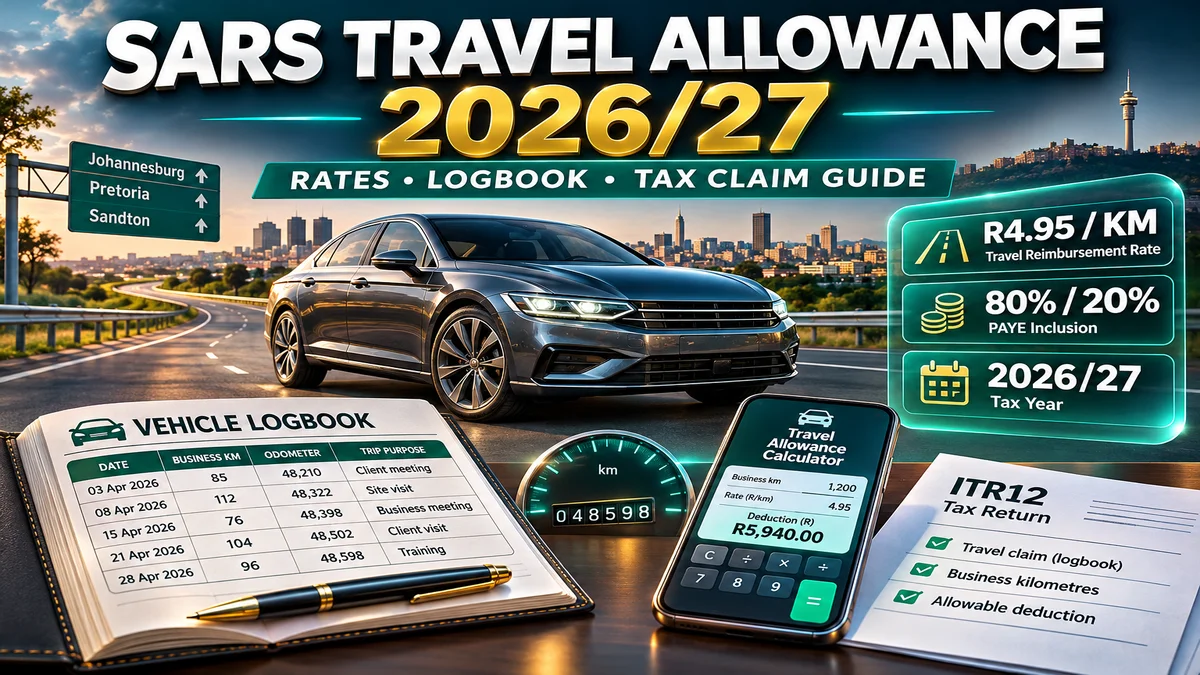
A SARS travel allowance is taxable income. Your employer deducts PAYE on 80% of a fixed allowance, or 20% if at least 80% of your travel is for business. When you file your ITR12, a logbook of business kilometres lets you claim a deduction, which often turns the extra PAYE into a refund.
- What is a travel allowance?
- How is it taxed?
- IRP5 travel codes
- Rate per km table 2026/27
- How to calculate your deduction
- Travel allowance calculator
- Worked example
- SARS logbook rules
- Cost table vs actual costs
- Reimbursive allowance
- Claiming on your ITR12
- Subsistence allowance
- Allowance vs company car
- Advantages and disadvantages
- Leased, financed and second-hand cars
- If SARS checks your claim
- Tips and best practices
- Common mistakes
- Checklist
- FAQ
- Sources
What Is a Travel Allowance in South Africa? The Basics
A travel allowance is money your employer pays you to use your own car for work. It is either a fixed monthly amount (code 3701) or a reimbursement per kilometre travelled (a reimbursive allowance).
If you’re new to this, here are the basics for beginners. If you drive your own car to see clients, visit sites or travel between offices, your employer may pay you a travel allowance to cover the cost. SARS calls the car-related version an allowance for the use of a private motor vehicle for business purposes. Many payslips call it a car allowance, and SARS treats a car allowance paid for business use of your own vehicle in the same way. It is not the same as a company car, where your employer owns the vehicle and you are taxed on a fringe benefit instead.
There are two main types, and the tax works very differently for each:
- Fixed travel allowance: a set amount every month, for example R6,000, no matter how far you drive. It is fully taxable, and you claim your business costs back on assessment with a logbook.
- Reimbursive travel allowance: your employer pays you a rate for each business kilometre you record, for example R4.95 per km. If the rate is at or below the SARS rate and you get nothing else, it isn’t taxed at all.
Fixed travel allowance vs travel reimbursement
| Feature | Fixed travel allowance | Reimbursive allowance (per km) |
|---|---|---|
| How it’s paid | Same amount every month | Rate × business km you submit |
| IRP5 code | 3701 | 3703 (non-taxable), or 3702 and 3722 (taxable) |
| PAYE | On 80% or 20% of the allowance | None if at or below 495c per km and no other travel pay |
| Records needed? | A logbook, to claim anything back | Business km records for your employer; a logbook for your own deduction only if the reimbursement is taxable |
| Best for | Regular, predictable travel | Irregular or low business travel |
Some employers pay both, and some add a fuel card or a maintenance plan. That mix matters, because it changes which codes appear on your IRP5 and what you’re allowed to claim. In practice, a common surprise is a tax bill after the first assessment. It usually happens to people on a fixed allowance who didn’t keep a logbook.
A travel allowance is also different from a subsistence allowance, which covers meals and incidental costs when you sleep away from home for work. We cover that in the subsistence allowance section.
How Is a Travel Allowance Taxed in South Africa?
The full allowance is added to your taxable income. Your employer withholds PAYE on 80% of it, or 20% if at least 80% of your travel is for business. You then claim your business travel cost back when you file.
So, is a travel allowance taxable? Yes. A fixed travel allowance is taxed in two stages. During the year, your employer includes part of it in the income used to work out your monthly PAYE. At the end of the year, SARS looks at your logbook claim and works out the final tax.
Stage 1: PAYE during the year (80% or 20%)
According to SARS’s PAYE rules for travel allowances, only 80% of a fixed travel allowance is subject to PAYE. If your employer is satisfied that at least 80% of your use of the vehicle is for business, only 20% is subject to PAYE. Your employer makes this call month by month, according to the SARS Guide for Employers in respect of Allowances. The full 100% still appears on your IRP5 under code 3701.
Here’s what that means for a R8,000 monthly allowance at a 36% marginal rate: with 80% inclusion, R6,400 a month is added to your PAYE income, which costs about R2,304 in tax each month. With 20% inclusion, only R1,600 is added, about R576 a month. Your final tax is the same either way once your logbook claim is assessed; the 20% option just leaves more money in your pocket during the year.
This 80% inclusion is only an estimate built into payroll. It doesn’t mean 20% of your allowance is tax free. That’s the part people often miss.
Stage 2: Assessment (your logbook claim)
When you file your ITR12, the whole allowance is added to your taxable income. You then deduct your business travel costs, worked out from your logbook. If your business kilometres are high, the deduction is large and you get some of the PAYE back. If you have no logbook, there is no deduction, and the 20% that wasn’t taxed through PAYE gets taxed on assessment.
Is a travel allowance a fringe benefit?
No. A travel allowance is cash paid to you, so it’s included in your income as an allowance. A fringe benefit is a benefit in kind, such as the use of a company car. The two are taxed under different rules, which is why the comparison later in this guide matters.
Limit: SARS limits your travel claim to the travel allowance you received (SARS travel allowance leaflet). You can’t use car costs to reduce your salary or other income.
The tax rate on the taxable part is your marginal rate, from 18% to 45%. Check the 2026/27 tax brackets to see where your income falls. There’s no SARS maximum on the travel allowance an employer may pay, but the more it exceeds your real business cost, the more of it stays taxable.
What Are the SARS Travel Allowance Codes on Your IRP5?
Code 3701 is a fixed travel allowance, 3702 and 3722 are taxable reimbursive amounts, and 3703 is a non-taxable reimbursive allowance. Only the taxable codes allow a logbook claim.
The travel allowance SARS code on your IRP5 tells you, and SARS, how your travel money was paid and taxed. Before you file, check which of these codes appears. The code decides whether you can claim anything at all.
| IRP5 code | What it means | PAYE during the year | Can you claim with a logbook? |
|---|---|---|---|
| 3701 | Fixed travel allowance (full amount shown) | On 80% (or 20% if 80% or more is business use) | Yes |
| 3702 | Reimbursive allowance up to the SARS rate, where the tax-free tests are not met | None on this part | Yes |
| 3722 | Reimbursive amount above the SARS rate per km | Yes, on the excess | Yes |
| 3703 | Non-taxable reimbursive allowance (at or below the SARS rate, no other compensation) | None | No, nothing to claim |
These codes come from SARS’s FAQ on reimbursed travel expenses. SARS’s FAQ on claiming against a reimbursement confirms the rule. With a taxable travel code, you may claim a business travel deduction if you kept the required logbook. With a non-taxable code, there’s nothing to claim.
If your payslip shows a travel allowance but your IRP5 doesn’t, ask payroll to correct it before you file. A wrong code is one of the main reasons travel claims get stuck in verification.
What Is the SARS Rate per km for 2026/27? Travel Rates Table
For reimbursive allowances, the SARS rate is 495 cents per km for the 2027 tax year. For a fixed allowance, your deduction uses the SARS cost table below: a fixed cost based on your car’s value, plus fuel and maintenance per km.
SARS travel rates change every tax year. SARS publishes two sets of figures each year in the Rate per Kilometre Schedule (2027 tax year), which applies to years of assessment starting on or after 1 March 2026.
The simplified rate: 495c per km
The simplified rate is 495 cents per kilometre. It matters most for reimbursive allowances. If your employer pays you per business kilometre at or below this rate, and gives you no other travel compensation apart from parking or tolls, the reimbursement isn’t taxed.
The SARS travel allowance table (cost scale) for 2026/27
If you get a fixed allowance, you use this table to work out your deduction. Find the band for your vehicle’s value, including VAT but excluding finance charges.
| Vehicle value (incl. VAT) | Fixed cost per year | Fuel cost per km | Maintenance cost per km |
|---|---|---|---|
| R0 to R115,000 | R38,344 | 132.9c | 49.1c |
| R115,001 to R230,000 | R68,487 | 148.4c | 61.4c |
| R230,001 to R345,000 | R98,689 | 161.2c | 67.8c |
| R345,001 to R460,000 | R125,393 | 173.4c | 74.0c |
| R460,001 to R575,000 | R152,097 | 185.5c | 86.9c |
| R575,001 to R690,000 | R180,078 | 212.8c | 102.0c |
| R690,001 to R805,000 | R208,106 | 216.5c | 114.5c |
| R805,001 to R920,000 | R237,679 | 220.1c | 126.1c |
| Above R920,000 | R237,679 | 220.1c | 126.9c |
Two rules change how you use the table:
- You can only add the fuel cost if you paid the full cost of fuel yourself. If you have a fuel card or your employer refunds fuel, leave it out.
- You can only add the maintenance cost if you paid the full cost of maintenance yourself (repairs, servicing, tyres). If a maintenance plan covers it, leave it out.
People often search for a “SARS petrol rate”. There isn’t a separate petrol rate: the fuel cost per km in the table is the petrol (or diesel) part of your travel allowance per km, and it depends on your vehicle’s value band.
Notice that the two top bands share the same fixed cost of R237,679. Buying a more expensive car above R805,000 doesn’t increase the fixed-cost part of your claim.
How to Calculate Your SARS Travel Allowance Deduction (Step by Step)
Divide the fixed cost by your total kilometres for the year, add the fuel and maintenance costs per km, then multiply by your business kilometres. The result is your deduction, capped at the allowance you received.
If you want to know how to calculate a travel allowance for SARS, here is the step-by-step method used with the cost table:
- Find your vehicle’s value band in the table and note the fixed cost, fuel cost and maintenance cost.
- If you used the car for business for only part of the year, reduce the fixed cost by days: fixed cost × days used ÷ 365.
- Work out your cost per km: fixed cost ÷ total km (business and private), plus fuel cost and maintenance cost per km (only those you paid in full).
- Multiply the cost per km by your business km from the logbook. That’s your deduction.
- Compare it with your allowance. Your deduction can’t be more than the allowance received.
- Your taxable travel allowance is the allowance minus the deduction.
Formula: Deduction = business km × (fixed cost ÷ total km + fuel c/km + maintenance c/km), limited to the allowance.
One thing that catches people out: the fixed cost is divided by your total kilometres, not your business kilometres. Driving more private kilometres lowers your cost per km, so a high private mileage reduces the claim even if your business mileage stays the same.
Use the calculator below to run your own figures, or read the travel allowance calculation example further down.
SARS Travel Allowance Calculator 2026/27
Enter your allowance, vehicle value and logbook kilometres to see your deduction, the taxable part of your allowance and an estimate of your refund. It uses the SARS 2026/27 cost table and tax brackets.
The calculator follows the cost-table method in section 5. It doesn’t handle actual-cost claims, leased vehicles or reimbursive allowances, and it assumes you are under 65 with no other deductions. For your full tax picture, use our income tax calculator.
How Much Tax Can a Logbook Save You? Travel Allowance Calculation Examples
In this example, a R96,000 allowance with 12,000 business km out of 30,000 km gives a deduction of R79,845.20 and a refund of about R21,832. Without a logbook, the same person would owe about R6,918 extra.
Assumptions: Thandi earns a salary of R600,000 a year and gets a fixed travel allowance of R8,000 a month (R96,000 a year). Her car cost R350,000 including VAT. Her logbook shows 30,000 km in total, of which 12,000 km were for business. She pays all fuel and maintenance herself, used the car all year, is under 65, and her PAYE was on 80% of the allowance. 2026/27 SARS tables.
Because 80% of her allowance (R76,800) was taxed through PAYE but only R16,154.80 is taxable after her logbook claim, Thandi gets back the tax on the difference. All of it falls in the 36% band, so the refund is about R21,832.
What changes if the facts change?
- No logbook: the full R96,000 is taxable. Instead of a refund, she’d owe about R6,918 more than the PAYE already deducted.
- Fuel card from her employer: no fuel cost per km, so her rate drops to R4.92 per km, the deduction to R59,037.20 and the refund to about R14,341.
- Car bought during the year: if she used it for business for 243 of 365 days, the fixed cost shrinks and her rate drops to about R5.26 per km.
Thandi’s R96,000 allowance in 2026/27
Figures are estimates based on the SARS 2026/27 tables and assume her monthly PAYE matched the annual tax on R676,800. Rand amounts are not subject to VAT.
Example 2: mostly business travel (PAYE on 20%)
Now say Thandi drives 26,000 business km out of 30,000 km, and her employer applies PAYE to only 20% of the allowance (R19,200). Her cost-table claim works out at R172,998, but SARS limits it to the R96,000 allowance, so none of the allowance is taxable. She gets back the tax on R19,200, about R6,912. The refund is smaller than in example 1 because far less PAYE was withheld during the year, which is exactly the point of the 20% option.
What Must a SARS Vehicle Logbook Include? Rules and Template
Your opening odometer reading on 1 March, your closing reading at the end of February, and for each business trip the date, kilometres, start point, destination and reason. Without odometer readings you can’t claim at all.
A SARS vehicle logbook doesn’t have to be fancy. SARS’s travel logbook page lists what you need. It’s simple, but it has to be complete:
- Odometer reading on 1 March 2026 (start of the tax year)
- Odometer reading on 28 February 2027 (end of the tax year)
- Total kilometres for the year (closing minus opening)
- For each business trip: the date, kilometres travelled, start point and destination
- For each business trip: the reason, for example “client meeting, Sandton”
- Total business kilometres for the year
- A separate logbook for each vehicle you used for business
You don’t need to record private trips. Your private kilometres are simply total kilometres minus business kilometres.
Vehicle log book template (example entries)
| Date | Odometer start | Odometer end | Business km | From | To | Reason for trip |
|---|---|---|---|---|---|---|
| 03/03/2026 | 45,210 | 45,268 | 58 | Office, Midrand | Client, Pretoria East | Quarterly review meeting |
| 05/03/2026 | 45,301 | 45,423 | 122 | Office, Midrand | Site, Vereeniging | Installation check |
| 10/03/2026 | 45,512 | 45,546 | 34 | Client, Sandton | Office, Midrand | Return from supplier visit |
Want a blank copy? Download this free vehicle logbook template as a spreadsheet file (CSV), which opens in Excel or Google Sheets:
Where to get the official SARS logbook
SARS offers a free 2026/27 eLogbook for 1 March 2026 to 28 February 2027, and older years back to 2014. A spreadsheet, app or paper book can also work, as long as it records the details above. If you use an app, export a full-year report before you file.
Timing tip: the 2026/27 logbook year ends on 28 February 2027. Take a photo of your odometer that day, with the date visible. SARS says that without your opening and closing readings you can’t claim a travel deduction.
What counts as business travel?
Business travel is driving you do for your job, such as visiting clients or suppliers, going to a site, or travelling between your employer’s offices. Travel between your home and your normal place of work is private, even if you work late or carry work equipment. In practice, SARS verifications often focus on this point, so keep the reason for each trip specific.
Keep your logbook for at least five years from the date you submit your return. Our guide to SARS supporting documents explains what to upload if SARS asks.
Fixed Cost Table vs Actual Costs: Which Claim Method Is Better?
Most people use the SARS cost table because it only needs a logbook and the vehicle’s value. Actual costs can give a bigger claim, but you need proof of every expense for the whole year.
You can work out your deduction in one of two ways. Both need a logbook.
| Point | SARS cost table (deemed cost) | Actual costs |
|---|---|---|
| Records needed | Logbook and vehicle cost | Logbook plus every fuel slip, service invoice, insurance, licence and finance document |
| How it’s worked out | Fixed cost ÷ total km, plus fuel and maintenance per km, × business km | Total actual costs × business km ÷ total km |
| Vehicle cost | Built into the fixed cost | Wear-and-tear over seven years, plus finance charges (or lease payments with the lease agreement) |
| Best for | Most employees | Cars with high running costs compared with their value |
According to the SARS travel allowance leaflet, actual costs include fuel and oil, maintenance and repairs, wear-and-tear (calculated over seven years) and finance charges, lease payments, insurance and licensing. If you financed the car, you claim wear-and-tear and finance charges, not your monthly instalments.
Example: actual costs vs the table
Take Thandi’s R350,000 car again. Her actual costs for the year are: wear-and-tear of R50,000 (R350,000 over seven years), finance charges of R30,000, fuel of R40,000, maintenance of R8,000, insurance of R12,000 and licence fees of R1,000. That’s R141,000. With 12,000 business km out of 30,000, her actual-cost claim is R141,000 × 12,000 ÷ 30,000 = R56,400. The cost table gives R79,845, so the table is the better method for her.
A practical tip: work out both before you file. If the difference is small, use the cost table, because it’s much easier to support if SARS asks for documents.
How Does a Reimbursive Travel Allowance Work?
Your employer pays you per business kilometre. If the rate is at or below 495c per km and you get no other travel compensation apart from parking or tolls, it isn’t taxed (code 3703). Otherwise, the part above the SARS rate is taxed.
A reimbursive travel allowance is based on distance: you submit your business kilometres and your employer pays you a rate per kilometre. According to SARS’s FAQ, it is not taxed when both of these tests are met:
- The rate paid doesn’t exceed the rate per kilometre fixed by the Minister of Finance (495c per km for 2026/27).
- You don’t receive any other compensation for travel, such as a fixed allowance, apart from parking or toll fees.
If both tests are met, your IRP5 shows code 3703 and you don’t claim anything on your return.
If either test fails, PAYE is deducted on the amount above the SARS rate. The part up to the SARS rate is shown under code 3702, and the excess under code 3722. For example, if your employer pays R5.50 per km for 12,000 business km, R59,400 (12,000 × R4.95) goes under code 3702 and R6,600 (12,000 × R0.55) is the taxable excess under code 3722.
With a taxable reimbursive code, you can still claim a business travel deduction on your ITR12, but only if you kept the required logbook.
How Do You Claim Your Travel Allowance on the ITR12?
Check your IRP5 code, total your logbook kilometres, choose the cost table or actual costs, then complete the travel section of your ITR12 on eFiling. Keep your logbook ready in case SARS asks for it.
Here’s how to make a SARS travel claim when you file:
- Check your IRP5 travel codeLook for code 3701 (fixed allowance) or 3702/3722 (taxable reimbursive allowance). If you only have code 3703, the allowance is not taxable and there is nothing to claim.
- Total your kilometres from the logbookSubtract the 1 March opening odometer reading from the closing reading at the end of February to get total km, and add up the business km in your logbook.
- Choose the cost table or actual costsUse the SARS cost table if you only have a logbook. Use actual costs only if you have proof of every vehicle expense for the year.
- Open your ITR12 and complete the wizardOn eFiling, open the return and answer the travel questions. Enter how many vehicles you used for business so the right number of travel sections open.
- Enter vehicle and logbook detailsFill in the vehicle cost, the dates you used it, opening and closing odometer readings, total km and business km, and whether you paid the full fuel and maintenance costs.
- Submit and keep your proofSubmit the return and keep your logbook and documents for five years. If SARS asks for verification, upload the logbook and proof of vehicle cost.
If you’re auto-assessed, SARS works from third-party data, and that data can’t include your logbook claim. If you have a travel allowance, review the auto-assessment, add your travel claim and file. Our guide to SARS auto-assessments explains how to edit one, and the SARS tax season guide covers the filing dates. For the 2026/27 year, SARS shows the filing season starting on 1 July 2027 (to be confirmed).
If you used more than one vehicle, enter the number of vehicles when you customise the return. SARS then opens a separate travel section for each one, according to the SARS travel allowance leaflet.
What About Subsistence Allowances on Business Trips?
A subsistence allowance covers meals and incidental costs when you sleep away from home for work. For 2026/27, SARS deems R595 a day for meals and incidentals, or R184 a day for incidentals only, for trips within South Africa.
A subsistence and travel allowance often go together, but they’re taxed separately. The travel allowance covers your car. The subsistence allowance covers meals and small costs when your employer requires you to spend at least one night away from your usual home.
According to SARS’s subsistence allowance page, the deemed amounts for local travel in the 2027 tax year are:
| Local trip (within South Africa) | Deemed amount per day |
|---|---|
| Meals and incidental costs | R595 |
| Incidental costs only (meals provided) | R184 |
For trips outside South Africa, SARS publishes a separate amount per country in its foreign subsistence annexure. If your allowance stays within the deemed amount, it’s generally not taxed through PAYE. Timing matters, though: according to the SARS Guide for Employers in respect of Allowances, if an allowance or advance isn’t spent on the trip or paid back by the last day of the following month, it’s treated as payable to you in that following month, and PAYE then applies.
Is a Travel Allowance Better Than a Company Car? Fringe Benefit Rates Compared
A company car is taxed as a fringe benefit of 3.5% of its determined value every month (3.25% if the price included a maintenance plan), with PAYE on 80% of that value. A logbook reduces it on assessment. Which option is better depends on your business kilometres and who pays the running costs.
With a company car, your employer owns the vehicle and you are taxed on the right to use it. According to the SARS Guide for Employers in respect of Employees’ Tax (2027), the monthly taxable value is:
| Company car situation | Monthly taxable value |
|---|---|
| Employer-owned car | 3.5% of the determined value |
| Price included a maintenance plan | 3.25% of the determined value |
| Arm’s-length operating lease | The employer’s actual lease cost, plus fuel costs |
The determined value is broadly the original cost to your employer, including VAT but excluding finance charges, according to SARS Interpretation Note 72 (right of use of a motor vehicle). A lower value can apply if you only got the car a year or more after your employer bought it.
How a company car is taxed, step by step
- Your employer includes 80% of the monthly value in your PAYE income, or only 20% if satisfied that at least 80% of the car’s use is for business.
- On assessment, the full value is taxable, but you can reduce it by the business share of your kilometres: value × business km ÷ total km. SARS won’t allow this reduction without accurate records, so you still need a logbook.
- You can reduce it further if you paid 100% of the licence, insurance, maintenance or fuel yourself, without being refunded, using records of your private kilometres.
Company car example
Assumptions: salary R600,000, an employer-owned car with a determined value of R450,000 (no maintenance plan), 12,000 business km out of 30,000 km, employer pays all running costs, 2026/27 tables, under 65.
Without a logbook, the whole R189,000 stays taxable, which costs about R70,836 in extra tax. With a maintenance plan included in the price, the monthly value would be R14,625 (3.25%) instead of R15,750.
So which is better?
- Company car: your employer pays for the car and usually the running costs, and you pay tax on the benefit. It often suits people with lower business mileage, because you don’t carry the cost of owning the car.
- Travel allowance: you own the car and pay all the costs, but with high business kilometres most of the allowance becomes tax free through your logbook claim.
- Admin: both options need a logbook if you want to reduce the tax.
The two numbers aren’t directly comparable, because with an allowance you also pay for the car, fuel and maintenance yourself. When you compare offers, look at the after-tax cash you keep plus the car costs you would carry. Our PAYE calculators guide helps you see the monthly effect on your take-home pay.
What Are the Advantages and Disadvantages of a Travel Allowance?
The main benefit is a tax deduction that can turn into a refund if you drive a lot for work. The main disadvantages are the logbook admin, lower take-home pay during the year when PAYE is on 80%, and the risk of a tax bill if your business kilometres are low.
| Advantages | Disadvantages |
|---|---|
| You choose and own your car | You carry the full cost and resale risk of the car |
| A good logbook can reduce the tax to near zero | Without a logbook, the full allowance is taxed |
| Often leads to a refund on assessment | PAYE on 80% lowers your monthly take-home pay |
| Cash that you can use for any car costs | Low business km can mean a tax bill |
| Simple for employers to run through payroll | You must keep records for five years |
In practice, a travel allowance suits people who drive a lot for work and are willing to keep a proper logbook. If your business travel is occasional, a reimbursive allowance at or below 495c per km is usually simpler, because it isn’t taxed and needs no claim on your return.
It’s also worth thinking about cash flow. If your business travel is clearly above 80%, ask your employer whether they’re satisfied to apply PAYE to only 20% of the allowance. Your final tax doesn’t change, but you won’t be lending SARS money for a year.
How Do Leased, Financed and Second-Hand Cars Affect Your Claim?
The vehicle value in the cost table is what you paid for the car, including VAT and excluding finance charges, so a second-hand car uses its purchase price. Leased cars follow different valuation rules, and financed cars claim wear-and-tear and finance charges under actual costs, not monthly instalments.
The cost table depends on your vehicle’s value, so it’s important to use the right figure. According to the SARS rate per kilometre schedule, the value is generally the original cost of the vehicle, including VAT but excluding finance charges.
- Second-hand car: use the price you paid, from your purchase agreement, not the car’s original new price or today’s market value.
- Financed car: the value is still the cost price, not the total of your instalments. Under actual costs, you claim wear-and-tear and finance charges, not the monthly repayments, according to the SARS travel allowance leaflet.
- Leased car: the schedule applies different valuation rules to leased vehicles. Under actual costs, you claim the lease payments and must keep a copy of the lease agreement.
- Car bought or sold during the year: reduce the fixed cost by the days you used it for business, and keep separate odometer readings for each car.
- Two or more cars: keep a separate logbook for each and claim each car in its own travel section.
One thing that catches people out is trading in a car halfway through the year and carrying on in the same logbook. SARS needs the opening and closing readings for each vehicle, so start a new logbook the day you change cars.
What Happens if SARS Checks Your Travel Claim?
SARS may select your return for verification and ask you to upload your logbook, proof of the vehicle cost and, for actual costs, your expense records. If you cannot support the claim, SARS can disallow or limit it.
Travel claims are a common reason for SARS verification, because the deduction can be large. If your return is selected, SARS will ask for supporting documents through eFiling. The SARS travel allowance leaflet lists what’s expected: a valid logbook with opening, closing and total kilometres, the date, reason and nature of each business trip, proof of expenses, and the lease or purchase agreement for the car.
If you don’t provide the documents, the claim will be disallowed or limited. To get through a verification smoothly:
- Upload the full-year logbook in one file, with the totals clearly shown.
- Include your purchase or lease agreement showing the vehicle cost.
- Make sure your logbook kilometres line up with odometer readings on service invoices, because they can be compared.
- Answer within the time stated in the SARS letter.
Our guide to SARS supporting documents explains how to upload documents on eFiling.
How Can You Maximise Your Travel Claim Legally? Tips and Best Practices
Record every business trip as it happens, photograph your odometer on 1 March and 28 February, check your IRP5 code, compare both claim methods and ask for 20% PAYE if your business use is above 80%.
These practical tips help you claim everything you’re entitled to, without giving SARS a reason to question it:
- Log trips as they happen. A logbook rebuilt from memory in June is hard to defend. A GPS app or a notebook in the car both work.
- Be specific about the reason. “Client meeting, ABC Ltd, Rosebank” is much stronger than “work”.
- Photograph your odometer. Do it on 1 March, on 28 February and whenever you change cars.
- Don’t round your kilometres. Exact readings look like real records; round numbers look estimated.
- Check fuel and maintenance. Only include those costs per km if you paid them in full yourself.
- Compare both methods. Run the cost table and actual costs before you file and use the higher claim you can support.
- Ask about 20% PAYE. If at least 80% of your travel is business, ask your employer to apply PAYE to 20% of the allowance.
- Keep everything for five years. Store the logbook, purchase agreement and IRP5 together.
What Mistakes Cost People Their SARS Travel Claim?
The biggest mistakes are not keeping a logbook, logging home-to-work trips, missing odometer readings and adding fuel costs when the employer paid for fuel.
These are the problems that most often reduce or cancel a travel claim:
Mistake 1: Not keeping a logbook
Without a logbook, SARS disallows the claim and the full allowance is taxed. People on 80% PAYE then owe tax on assessment.
Fix: Start a logbook on 1 March, or today, and record every business trip as you go.
Mistake 2: Claiming home-to-work trips
SARS treats travel between home and your normal workplace as private. Including it inflates your business km and can lead to penalties in a verification.
Fix: Log only trips to clients, sites or other work locations.
Mistake 3: Missing odometer readings
SARS says you can’t claim without your 1 March opening and end-of-February closing readings.
Fix: Photograph your odometer on both dates and save the photos with your logbook.
Mistake 4: Adding fuel cost with a fuel card
The fuel cost per km only applies if you paid all your fuel yourself. Adding it anyway overstates the claim.
Fix: Untick fuel (or maintenance) if your employer or a plan covered it.
Mistake 5: Using the wrong vehicle value
The value is the original cost including VAT, excluding finance charges. Using today’s market value or the financed amount puts you in the wrong band.
Fix: Use the purchase agreement to confirm the cost price.
Mistake 6: Expecting a claim on a non-taxable allowance
If your IRP5 shows only code 3703, the reimbursement wasn’t taxed, so there’s nothing to claim.
Fix: Check your IRP5 codes before you file.
What Should Be on Your SARS Travel Allowance Checklist for 2026/27?
Before you file, confirm your IRP5 code, odometer readings, logbook totals, vehicle cost and whether you paid fuel and maintenance yourself.
- IRP5 checked: code 3701, 3702, 3722 or 3703
- Odometer photo on 1 March 2026 and 28 February 2027
- Logbook complete: date, km, start point, destination and reason for every business trip
- Total km and business km added up
- Purchase agreement showing the vehicle cost (incl. VAT)
- Note of whether you paid all fuel and all maintenance yourself
- Days the vehicle was used for business, if bought or sold during the year
- Actual-cost records (only if you use actual costs)
- Calculator run to estimate your refund
- Logbook and records stored for five years
SARS Travel Allowance: Frequently Asked Questions
Answers to the 18 questions people ask most about the SARS travel allowance, logbooks and the rate per km.
Is a travel allowance taxable in South Africa?
Yes. A fixed travel allowance is added to your taxable income, and your employer deducts PAYE on 80% of it (or 20% if your employer is satisfied that at least 80% of your travel is for business). You can then reduce the taxable amount on assessment by claiming your business travel with a logbook.
How much of a travel allowance is tax free?
No part of a fixed monthly travel allowance is automatically tax free. The tax-free part comes from your logbook claim. A reimbursive allowance paid per kilometre is not taxed if it does not exceed the SARS rate of 495 cents per km for 2026/27 and you receive no other travel compensation apart from parking or tolls.
What is the SARS rate per km for 2026/27?
The simplified rate is 495 cents per kilometre for the 2027 tax year (1 March 2026 to 28 February 2027). For a fixed allowance, your deduction uses the SARS cost table instead: a fixed cost based on your vehicle value, plus fuel and maintenance costs per km.
What is travel allowance code 3701 on my IRP5?
Code 3701 shows the full fixed travel allowance you received in the year. Codes 3702 and 3722 show taxable reimbursive amounts, and code 3703 shows a non-taxable reimbursive allowance. Only taxable travel codes allow a logbook claim.
Can I claim travel between home and work?
No. SARS treats travel between your home and your normal place of work as private travel, so those kilometres can’t be included in your business kilometres, even if you drive a long way.
What happens if I did not keep a logbook?
You can’t claim the travel deduction without a logbook, so the whole allowance stays taxable. If PAYE was only deducted on 80%, you’ll usually owe SARS the tax on the remaining 20% when you’re assessed.
Can my travel claim be more than my travel allowance?
No. SARS limits the travel claim to the travel allowance you received. If your costs are higher than your allowance, the extra cost cannot reduce your salary or other income.
Can I claim fuel if my employer gives me a fuel card?
Not under the fixed cost table. You can only include the fuel cost per km if you paid the full cost of fuel yourself. The same applies to maintenance: if a maintenance plan or your employer covers it, you can’t include the maintenance cost per km.
Do I need a logbook if I get a reimbursive travel allowance?
It depends on your IRP5 code. If the reimbursement is non-taxable (code 3703), there’s nothing to claim. If it is taxable (code 3702 or 3722), you can claim a business travel deduction, but only if you kept the required logbook.
What details must a SARS logbook show?
Your opening odometer reading on 1 March and closing reading at the end of February, plus, for each business trip, the date, the kilometres travelled, where you started and went, and the reason for the trip. You do not need to record private trips.
How long must I keep my logbook?
SARS asks you to keep your logbook for at least five years from the date you submit your tax return, along with proof of expenses if you claim actual costs.
Should I use the SARS cost table or actual costs?
The cost table needs only a logbook and your vehicle value. Actual costs need every fuel slip, service invoice, insurance and finance document as well. Actual costs usually win only if your car is expensive to run compared with its value; otherwise the table is simpler and often similar.
I used two cars for work. How do I claim?
Keep a separate logbook for each vehicle. When you customise your ITR12, enter the number of vehicles you used, and the return opens a separate travel section for each one.
Is there a maximum travel allowance in South Africa?
SARS doesn’t set a maximum travel allowance that an employer may pay. What SARS limits is your deduction: your travel claim can’t be more than the allowance you received, so any allowance above your real business cost stays taxable.
How much travel allowance can I claim back?
You can claim your business travel cost, worked out from your logbook with the SARS cost table or your actual costs, up to the amount of the allowance. Use the calculator in this guide to estimate it before you file.
Is a travel allowance a fringe benefit?
No. A travel allowance is cash, so it is taxed as an allowance and included in your income. A company car is a fringe benefit, taxed at 3.5% of its determined value per month (3.25% if the price included a maintenance plan), which you can reduce with a logbook of business kilometres.
What is the SARS petrol rate per km?
SARS does not publish a separate petrol rate. The fuel cost per km in the 2026/27 cost table ranges from 132.9c to 220.1c depending on your vehicle value band, and you can only use it if you paid all your fuel yourself.
How is the fixed cost worked out if I bought the car during the year?
The fixed cost is reduced in proportion to the number of days you used the vehicle for business during the tax year. For example, if you used it for 243 of 365 days, you use 243/365 of the fixed cost from the table.
Sources
We checked this guide against these SARS sources as at 9 November 2026:
- SARS Rate per Kilometre Schedule, 2027 tax year (cost table and 495c simplified rate)
- SARS: Rates per kilometre
- SARS: When can you claim for travel? (travel eLogbook)
- SARS eLogbook 2026/2027
- SARS FAQ: Reimbursed travel expenses and PAYE (codes 3701, 3702, 3703, 3722)
- SARS FAQ: Claiming travel against a reimbursement
- SARS travel allowance leaflet (actual costs, claim limit)
- SARS: Subsistence allowances and advances (2027 amounts)
- SARS Guide for Employers in respect of Allowances
- SARS Guide for Employers in respect of Employees’ Tax (2027): company car rates
- SARS Interpretation Note 72: right of use of a motor vehicle
Add your salary, bonus and travel allowance together and see your PAYE and take-home pay for 2026/27.
Open the income tax calculatorDisclaimer: This guide is general information, not tax advice. Your tax depends on your own facts, and SARS rules can change. Speak to a registered tax practitioner before relying on it for your return.