
IRP5 Form 2026: Meaning, Codes and How to Get Yours
Your IRP5 is the one document that sums up your whole tax year as an employee. Most people glance at it once, see a page full of four-digit codes, and file it away. That’s a pity, because a two-minute check can catch an error that costs you a refund. This guide explains the IRP5 meaning in plain English and walks through the SARS source codes line by line. It also shows how to get your IRP5, what to do when it’s missing or wrong, and how it feeds your tax return. It was checked against SARS’s 2027 tax certificate guides and 2026 filing season notices as at 14 November 2026.
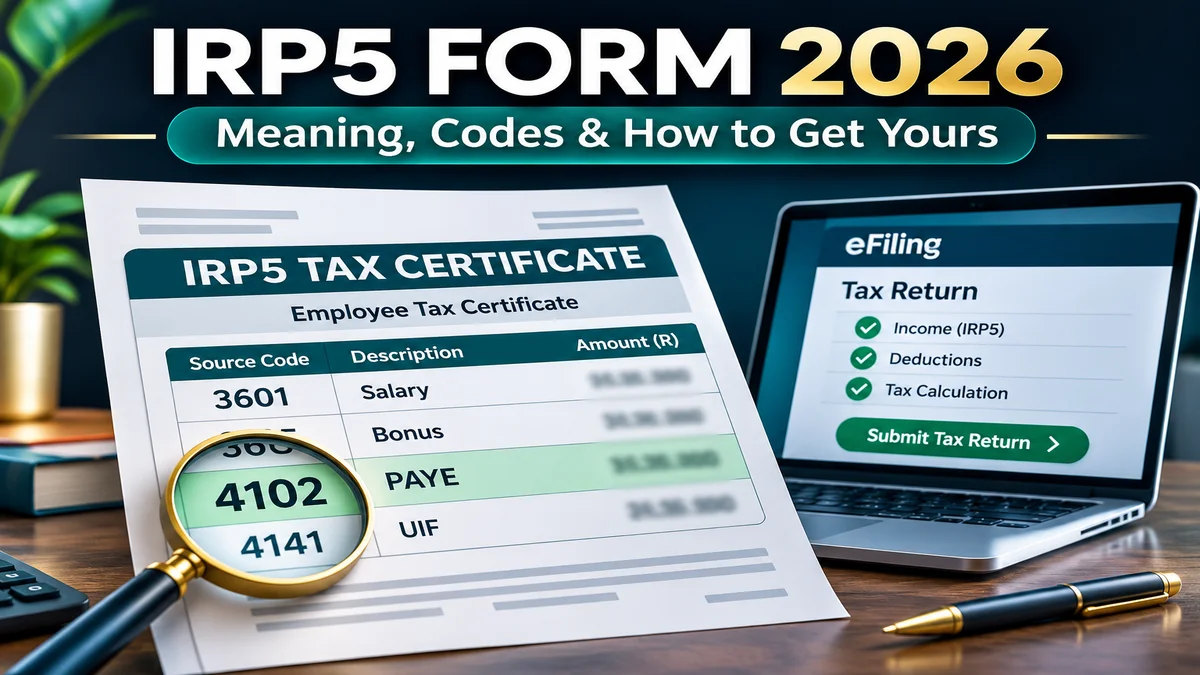
An IRP5 is the tax certificate your employer gives you after each tax year, or when you leave. It lists your income, the PAYE deducted (code 4102) and your deductions using SARS source codes. SARS uses it to prefill your eFiling return. If no PAYE was deducted, you get an IT3(a) instead.
What Is an IRP5 Form?
An IRP5 is the Employees’ Tax certificate your employer issues for each tax year. It shows what you earned, what PAYE was deducted and what went to retirement funds and medical aid, using four-digit SARS source codes. Your employer sends the same data to SARS.
Let’s start with the basics for beginners. Every month your employer deducts PAYE from your salary and pays it to SARS. The tax year runs from 1 March to the end of February. When it ends, your employer adds it all up and gives you a certificate with the totals. That certificate is your IRP5.
SARS’s guide for completing employees’ tax certificates defines the “Employees’ Tax certificate” under the Fourth Schedule to the Income Tax Act. It covers two forms: the IRP5 and the IT3(a). Your employer submits the certificates to SARS with its reconciliation (the EMP501), so SARS sees the same figures you do.
What is IRP5, in one sentence?
Think of the IRP5 as your annual payslip for SARS. It’s a single page that proves what you earned from one employer and how much tax was already paid for you.
What’s on an IRP5?
| Section | What it shows |
|---|---|
| Employer details | Name, PAYE reference number and address of your employer |
| Employee details | Your name, ID or passport number, tax reference number and address (this is where to find your tax number on an IRP5) |
| Certificate details | Certificate number, tax year and the period you were employed |
| Income (36xx, 37xx, 38xx, 39xx) | Salary, bonuses, allowances, fringe benefits and lump sums |
| Deductions (40xx, 44xx) | Pension, provident, retirement annuity and medical aid contributions |
| Tax (41xx) | PAYE, UIF and SDL totals, plus the medical tax credit |
What is an IRP5 used for?
Mostly for your tax return, but not only that. Banks and landlords often ask for your latest IRP5 tax certificate as proof of income, and some embassies want it for visa applications. Pensioners get one too: a pension fund that pays you a monthly pension deducts PAYE and issues an IRP5, usually with the pension under code 3603.
Why does it matter so much? Because SARS uses the IRP5 to work out whether the PAYE you paid was right. If too much was deducted, the IRP5 is what gets you a refund; if too little, it shows what you still owe.
IRP5 vs IT3(a): Which One Will You Get?
You get an IRP5 if PAYE was deducted from your pay, and an IT3(a) if your employer paid you but deducted no PAYE. The IT3(a) shows a reason code (source code 4150) that explains why no tax was deducted, for example because you earned below the tax threshold.
| IRP5 | IT3(a) | |
|---|---|---|
| When issued | PAYE was deducted | Remuneration paid, but no PAYE deducted |
| Typical reason | Normal salary above the threshold | Income below the threshold, or exempt income |
| Special code | 4102 shows the PAYE amount | 4150 shows the reason for no PAYE |
| Goes on your return? | Yes | Yes, it is still income you declare |
In 2026 SARS changed the field type and validation of source code 4150, according to its interim filing season notice. SARS’s completion guide also lists issuing an IT3(a) to someone with a tax number when PAYE should have been deducted as an error. In practice, if you’re told you’ll get an IT3(a) but you earn well above the R99,000 threshold for under-65s, ask payroll why.
Both certificates count. Even if no tax was deducted, the income on an IT3(a) still has to go on your tax return, because SARS taxes your total income from all sources.
What Do the IRP5 Codes Mean?
SARS source codes are four-digit numbers that label each amount on your IRP5. Codes starting with 36 are income, 37 allowances, 38 fringe benefits, 39 lump sums, 40 and 44 deductions and employer contributions, and 41 the tax totals such as PAYE (4102), UIF (4141) and SDL (4142).
SARS publishes the full list in its Guide for Codes Applicable to Employees’ Tax Certificates 2027. You don’t need all of them. Here’s the structure, then the codes you’re most likely to see.
| Code range | What it covers | Example |
|---|---|---|
| 36xx | Normal income | 3601 salary, 3605 bonus |
| 37xx | Allowances | 3701 travel allowance |
| 38xx | Fringe benefits | 3802 company car |
| 39xx | Lump sums | 3915 retirement lump sum |
| 40xx | Your deductions | 4001 pension fund |
| 41xx | Tax and levies | 4102 PAYE |
| 44xx, 45xx | Employer contributions and remuneration figures | 4474 employer medical aid |
Tip: work done outside South Africa uses the same code plus 50. So 3651 is the foreign-service version of 3601, and 3655 the version of 3605. SARS’s code guide lists them in pairs (3601/3651).
Income codes (36xx)
| Code | Meaning |
|---|---|
| 3601 | Taxable income from employment, mainly salary or wages subject to PAYE |
| 3603 | Pension or qualifying purchased annuity paid to you regularly (taxable) |
| 3602 | Non-taxable income, such as certain exempt or capital payments |
| 3605 | Annual payment: bonus, 13th cheque, incentive bonus or leave pay paid out |
| 3606 | Commission |
| 3607 | Overtime |
| 3608 | Arbitration award (taxable) |
| 3616 | Payments to an independent contractor |
| 3617 | Payments to a labour broker |
For most employees 3601 is the big one. If you got a bonus or sold leave back, you’ll also see 3605, and our bonus tax calculator shows how much PAYE comes off it. A separate 3607 line means your overtime was reported on its own rather than inside 3601.
Allowance codes (37xx)
| Code | Meaning |
|---|---|
| 3701 | Travel allowance, including fuel, garage or maintenance cards |
| 3702 | Reimbursive travel allowance, taxable portion |
| 3703 | Reimbursive travel allowance, non-taxable portion |
| 3704 | Subsistence allowance (local travel) |
| 3713 | Other allowances that are taxable and fit no other allowance code |
| 3714 | Other allowances that are not taxable |
Code 3713 is one of the most searched codes because it’s a catch-all for taxable allowances. If you see a large 3713 amount, ask payroll which allowance it is. A travel allowance under 3701 is different: you may be able to claim business travel against it on your return, which our SARS travel allowance guide covers.
Fringe benefit codes (38xx)
| Code | Meaning |
|---|---|
| 3801 | General fringe benefits that fit no other code |
| 3802 | Use of a company car the employer bought (not under an operating lease) |
| 3810 | Medical aid contributions your employer paid for you (taxable benefit) |
| 3813 | Medical services costs paid by your employer |
| 3816 | Use of a motor vehicle acquired by the employer under an operating lease |
| 3808 | Employee’s debt paid or written off by your employer |
| 3817 | Taxable benefit of your employer’s pension fund contributions |
| 3825 | Taxable benefit of your employer’s provident fund contributions |
| 3828 | Retirement annuity contributions your employer paid for you |
Lump sum codes (39xx)
| Code | Meaning |
|---|---|
| 3907 | Other lump sums, for example a non-severance payment when you leave |
| 3915 | Retirement or termination lump sum benefits and commuted annuities |
| 3920 | Lump sum withdrawal benefits from a retirement fund |
| 3921 | Living annuity and section 15C surplus apportionments |
| 3922 | Compensation for death during employment |
Tip: lump sums are usually taxed under a tax directive, not the normal PAYE tables, so the tax on them often sits under 4115 rather than 4102. If you were retrenched, our retrenchment package guide explains the severance tax table.
Totals (369x)
| Code | Meaning |
|---|---|
| 3696 | Gross non-taxable income (total of the non-taxable codes) |
| 3699 | Gross taxable employment income |
What Do the IRP5 Deduction and Tax Codes Mean?
Codes 4001, 4003 and 4006 show your pension, provident and retirement annuity contributions, and 4005 your medical aid. Code 4102 is the PAYE deducted, 4141 is UIF, 4142 is SDL and 4149 is the total of all three. Employer contributions appear under 4472, 4473 and 4474.
Your deductions (40xx)
| Code | Meaning |
|---|---|
| 4001 | Pension fund contributions paid by you (and deemed paid) |
| 4003 | Provident fund contributions paid by you (and deemed paid) |
| 4005 | Medical aid contributions |
| 4006 | Retirement annuity contributions paid through payroll |
These amounts matter on assessment. SARS uses the retirement fund codes to work out your retirement contribution deduction, and the medical aid codes to apply your medical tax credits.
Employer contributions and remuneration (44xx, 45xx)
| Code | Meaning |
|---|---|
| 4472 | Employer’s pension fund contributions for you |
| 4473 | Employer’s provident fund contributions for you |
| 4474 | Employer’s medical aid contributions for you |
| 4493 | Employer’s medical aid contributions for a retired or former employee |
| 4497 | Total of all deductions and contributions |
| 4582 | The part of your allowances and fringe benefits that counts as remuneration |
Employer contributions to a pension or provident fund are taxed as a fringe benefit (codes 3817 and 3825) and then treated as if you paid them yourself, which SARS’s code guide calls “deemed paid”. That’s why the same rand amount can show up in two or three places on your IRP5. It isn’t double-counting.
Tax codes (41xx)
| Code | Meaning |
|---|---|
| 4102 | PAYE (employees’ tax) deducted |
| 4115 | PAYE on retirement lump sum and severance benefits |
| 4116 | Medical scheme fees tax credit taken into account by payroll |
| 4141 | UIF contributions (employee and employer) |
| 4142 | Skills Development Levy (an employer cost) |
| 4149 | Total of PAYE, UIF and SDL |
| 4150 | Reason code on an IT3(a), explaining why no PAYE was deducted |
A quick check for any IRP5: 4149 should equal 4102 + 4115 + 4141 + 4142. SDL (4142) is paid by your employer, not taken off your salary, so don’t add it to the tax you paid when you compare with your payslips.
A few tips for checking these codes: start with 4102, then the retirement fund codes, then UIF.
Want to check the UIF figure? Our UIF calculator works out the 1% employee and 1% employer contribution on your salary.
IRP5 Code Lookup: What Does My Source Code Mean?
Type any four-digit source code from your IRP5 into this free lookup to see what it means in plain English. It covers the 48 codes employees see most, plus their foreign-service versions.
Think of it as a simple IRP5 code finder rather than an IRP5 calculator: it explains codes, it doesn’t recalculate your tax. For the tax itself, use our income tax calculator.
The lookup uses the code descriptions in this guide, which summarise SARS’s 2027 source code guide in everyday language. It runs in your browser and doesn’t send anything anywhere. If a code isn’t listed, it’ll still tell you the category, so you know whether it’s income, a deduction or tax.
One limitation to keep in mind: a SARS IRP5 code tells you what kind of amount it is, not whether the amount is right. To check the amount, compare it with the year-to-date totals on your last payslip for the tax year.
How Do You Read an IRP5? A Worked Example
Read an IRP5 from top to bottom: check your personal details, then the income codes, then deductions, then the tax totals. In the example below, Thabo earned R384,000 salary and a R32,000 bonus, and had R67,450 PAYE deducted.
Here’s an IRP5 example with made-up but realistic figures for a full tax year, so you can see how the codes fit together.
| Code | Description | Amount |
|---|---|---|
| 3601 | Salary | R384,000 |
| 3605 | Annual bonus | R32,000 |
| 3701 | Travel allowance | R36,000 |
| 3810 | Medical aid paid by employer | R18,000 |
| 3699 | Gross taxable employment income | R470,000 |
| 4001 | Pension fund contributions | R28,800 |
| 4005 | Medical aid contributions | R36,000 |
| 4102 | PAYE | R67,450 |
| 4141 | UIF (employee and employer) | R4,250.88 |
| 4142 | SDL | R4,700 |
| 4149 | Total of 4102, 4141 and 4142 | R76,400.88 |
Example: Thabo works in Durban and got his IRP5 in May 2026. He noticed 3699 was higher than his salary and bonus combined. That’s normal: the travel allowance and the medical aid his employer paid are added to taxable income. When he filed, he claimed his business travel against the 3701 allowance and got part of the PAYE back.
The PAYE, UIF and SDL figures here are illustrations, not calculations from your own pay. UIF is capped. SARS’s UIF page puts the ceiling at R17,712 a month, so the most anyone pays is R177.12 a month each for employee and employer, or R4,250.88 combined over a full year.
Taxable earnings on your payslip and 3699 on your IRP5 should tell the same story. If they’re far apart, it’s usually a fringe benefit or allowance that the payslip shows on a separate line.
How Do You Get Your IRP5?
Your employer must give it to you. Ask HR or payroll, or download it from your employer’s payroll portal. On eFiling, the same IRP5 data usually appears inside your ITR12 return automatically, because your employer has already submitted it to SARS.
- Ask your employerRequest your IRP5 from HR or payroll for the tax year you need, or download it from the employer’s payroll portal.
- Log in to eFiling or the MobiAppOpen SARS eFiling or the SARS MobiApp with your username and password.
- Open your ITR12 returnGo to your income tax return for the year. SARS prefills it with the IRP5 data your employer submitted.
- Check the IRP5 figuresCompare the income codes, PAYE (4102) and deductions with your payslips and the certificate from your employer.
- Fix any differences firstIf the IRP5 is missing or wrong, ask your employer to correct and resubmit it before you file.
- Accept or file your returnAccept the auto-assessment or submit your return. SARS then issues your notice of assessment (ITA34).
That’s the short how-to. Now the timing. For the tax year that ended on 28 February 2026, employers had to submit their annual EMP501 reconciliation between 1 April and 31 May 2026 and issue IRP5s to their staff. SARS’s completion guide adds that if you resign or retire, your employer must give you your IRP5 within 14 days.
Where do I get my IRP5 if I’ve left the company?
Contact your former employer’s HR or payroll team. They still have to issue it. Many employers email it to the address you gave them, so check your personal inbox and spam folder first.
How to get your IRP5 on eFiling
Log in to eFiling or the MobiApp and open your ITR12 for the tax year. SARS’s filing season 2026 notice explains that SARS prepopulates returns with third-party data it already holds, and employer IRP5 data is the main example. If you need a copy for a bank or a visa application, ask your employer for the certificate itself, because eFiling shows the figures inside the return.
Can I download a blank IRP5 form?
Not as an employee. The IRP5 is issued by your employer’s payroll system in SARS’s HTML5 or CSV format. A blank form you fill in yourself isn’t a valid certificate.
What to Do If Your IRP5 Is Missing or Not on eFiling
First ask your employer, in writing, to issue and submit your IRP5. If it still doesn’t appear, call SARS on 0800 00 7277 or visit a branch. SARS only accepts payslips and bank statements instead of an IRP5 if the employer is insolvent, untraceable, deceased or not registered for PAYE.
A missing IRP5 is the most common reason people can’t file on time. Here are the usual causes and the solution for each:
| Problem | Likely cause | Solution |
|---|---|---|
| IRP5 not on eFiling | Employer hasn’t submitted its reconciliation yet | Ask payroll when the EMP501 was submitted |
| IRP5 on eFiling under the wrong year | Employer used the wrong tax year | Ask the employer to correct and resubmit |
| IRP5 not linked to you | Wrong ID or tax number on the certificate | Give payroll your correct SARS tax number |
| Employer won’t give it | Dispute, or a business in trouble | Request in writing, then contact SARS |
| Company closed down | Employer insolvent or untraceable | Take payslips and bank statements to SARS |
SARS’s FAQ on missing IRP5s says that if your employer didn’t provide your IRP5 or IT3(a) after you asked, you must visit a branch or call the Contact Centre for advice. Take every payslip for the year, bank statements showing your salary payments, a service contract if you have one, and your employer’s name, contact details and physical address.
There’s a catch. SARS says it accepts this documentation only if the employer is insolvent or in liquidation, untraceable, deceased or not registered for PAYE. If your employer is still trading, SARS expects them to issue the certificate.
Example: Nomsa left a call centre job in August 2025 and started a new one in September. Her new employer’s IRP5 showed up on eFiling, but the old one didn’t. She emailed her former HR department, they found a typo in her ID number, resubmitted, and the missing IRP5 appeared on her return two weeks later.
What not to do: don’t make up an IRP5 number or type figures from memory into your return. A mismatch with what your employer reports is one of the triggers for a SARS verification.
How Do You Submit or Upload an IRP5 on eFiling?
Employees don’t submit IRP5s; employers do, with the EMP501 on eFiling or e@syFile Employer. If a certificate is missing from your ITR12, you can add it yourself by increasing the number of IRP5/IT3(a) certificates in the return wizard and capturing the details exactly as printed.
People search “how to submit IRP5 on eFiling” for two different reasons, so here’s the answer for each.
If you’re an employee
You don’t upload your IRP5 as a PDF. Your employer has already sent the data to SARS, and it appears inside your ITR12. When it doesn’t, SARS’s FAQ on missing lump sum certificates explains the fix. Increase the number of certificates in the return wizard, and a blank certificate opens for you to complete.
- Copy, don’t estimate: capture every code and amount exactly as it appears on the certificate.
- Use the right certificate number: it’s printed on the IRP5 and includes your employer’s PAYE reference.
- Keep the certificate: SARS may ask for it as a supporting document.
Manual capture is the backup plan, not the first step. If your employer simply hasn’t submitted yet, wait for the data or ask payroll to submit, because SARS checks your figures against the employer’s.
If you’re an employer
You “submit IRP5s” by filing the EMP501 reconciliation with all your employees’ certificates on eFiling or e@syFile Employer. The IRP5 submission deadline for the 2025/26 annual reconciliation was 31 May 2026; the 2026/27 interim one closed on 31 October 2026. See the employer section below for the details.
What If Your IRP5 Is Wrong?
Only your employer can fix an IRP5. Ask payroll to issue a corrected certificate and resubmit it to SARS. Compare the corrected figures with your payslips before you file, and if you have already filed, request a correction once the new IRP5 reaches SARS.
Common errors include the wrong ID number, a bonus in the wrong tax year, an allowance under the wrong code, or missing pension or medical aid contributions. Each one can change your tax.
- Check your details: name, ID number and tax number must match SARS’s records.
- Check the period: the employment dates should match when you actually worked there.
- Check the totals: income and PAYE should match the year-to-date figures on your last payslip.
- Check the deductions: pension (4001), provident (4003), RA (4006) and medical aid (4005) should all be there.
SARS’s completion guide says each certificate number can be used twice only when the employer replaces a certificate already given to you. So a corrected IRP5 replaces the old one rather than adding a second certificate.
If your employer is slow, keep a record of every request. You can still file before the deadline, but filing with figures you know are wrong usually means fixing the return later.
How Does Your IRP5 Feed Your Tax Return?
Your employer sends the IRP5 to SARS, SARS prefills your ITR12 with it, and in many cases SARS auto-assesses you directly from that data. In 2026, auto-assessments ran from 1 to 12 July, and non-provisional taxpayers had to file by 23 October 2026.
Your SARS tax return and your IRP5 are tied together. Here’s how the information flows, step by step:
- Your employer deducts PAYE every month.
- After the tax year ends, the employer submits the EMP501 with every employee’s IRP5.
- SARS uses that data, plus data from banks, medical schemes and retirement funds, to prefill your return.
- You accept the auto-assessment or file your ITR12.
- SARS issues a notice of assessment showing a refund or an amount owing.
According to SARS’s filing season 2026 notice, these were the 2026 dates:
| Who | 2026 dates |
|---|---|
| Auto-assessment notices | 1 to 12 July 2026 |
| Non-provisional individuals (not auto-assessed) | 13 July to 23 October 2026 |
| Provisional taxpayers (not auto-assessed) | 13 July 2026 to 22 January 2027 |
So how do you “claim” your IRP5 online? You don’t claim money from the certificate itself. You file your return, and if your PAYE (4102) was more than the tax you owe, SARS refunds the difference. Our guide to filing your SARS tax return walks through it, and our auto-assessment guide explains when to accept and when to edit.
Should you just accept an auto-assessment? Only if every IRP5 is there and correct. If you had two jobs, travel you can claim, or medical expenses beyond your medical aid, editing the return can make a real difference.
What Must Employers Do With IRP5s in 2026?
Employers must issue an IRP5 or IT3(a) to every employee and submit them to SARS with the EMP501. The 2026/27 interim reconciliation for 1 March to 31 August 2026 ran from 21 September to 31 October 2026, and every employee needs a valid income tax reference number.
If you run payroll, these are the main IRP5 duties, taken from SARS’s completion guide and its interim filing season notice:
| Duty | What SARS requires |
|---|---|
| Annual reconciliation (IRP5 submission deadline) | Submit the EMP501 with all IRP5s and IT3(a)s after the tax year (1 April to 31 May 2026 for 2025/26) |
| Interim reconciliation | Submit for 1 March to 31 August 2026 between 21 September and 31 October 2026 |
| Format | Certificates submitted after 28 February 2026 must use the 2027 format |
| Tax numbers | Confirm that every employee has a valid income tax reference number |
| Leavers | Give the IRP5 within 14 days after resignation, retirement or death (to the executor) |
| Corrections | A certificate number may be reused only to replace a certificate already issued |
SARS also added new 2027 source codes for things like an additional ID number, expired passport details and country of birth. Make sure your payroll software or e@syFile Employer is on the latest version before you submit.
Not registered for PAYE yet? An employee can’t get a valid IRP5 until you are. Our eFiling registration guide covers the eFiling side.
What Are the Most Common IRP5 Mistakes?
The big ones are filing without all your IRP5s, ignoring an IT3(a), not checking the figures against payslips, and capturing an IRP5 manually with wrong numbers. Each one can lead to an incorrect assessment or a SARS verification.
Mistake 1: Forgetting a second job
If you had two employers, you have two IRP5s, and the second employer’s PAYE often isn’t enough.
Fix: Declare every IRP5 and IT3(a) for the year.
Mistake 2: Ignoring an IT3(a)
People assume no tax means nothing to declare.
Fix: Include the IT3(a) income on your return.
Mistake 3: Accepting figures you haven’t checked
An auto-assessment is only as good as the IRP5 data behind it.
Fix: Compare 3601, 3605 and 4102 with your last payslip of the tax year.
Mistake 4: Capturing an IRP5 from memory
Figures that don’t match the employer’s submission cause delays and verifications.
Fix: Ask the employer to submit it, or capture it exactly as printed on the certificate.
Mistake 5: Adding SDL to your tax paid
Code 4142 is your employer’s levy, not your tax.
Fix: Use 4102 (and 4115 for lump sums) as your tax paid.
Mistake 6: Throwing the IRP5 away
SARS can ask for supporting documents years later.
Fix: Keep it for five years from the date you file the return.
What Should Be on Your IRP5 Checklist?
Before you file, make sure you have every IRP5 and IT3(a) for the year, that your details are correct, and that income, PAYE and deductions match your payslips. Then check eFiling shows the same figures.
- One IRP5 or IT3(a) for every employer you worked for in the tax year
- Name, ID number and tax reference number correct on each certificate
- Employment dates match when you actually worked there
- 3601 and 3605 match the year-to-date salary and bonus on your last payslip
- PAYE (4102) matches the tax deducted on your payslips
- Pension, provident, RA and medical aid codes are all present
- eFiling shows the same IRP5 figures in your ITR12
- Any missing or wrong IRP5 raised with your employer in writing
- Supporting documents saved for travel, medical or RA claims
- Copies kept for five years from the date you file
IRP5: Frequently Asked Questions
Answers to the 29 questions people ask most about the IRP5, its codes and how to get it in 2026.
What is an IRP5?
An IRP5 is the employee’s tax certificate your employer issues after the end of each tax year, or when you leave. It shows what you earned, the PAYE deducted and your retirement fund and medical aid contributions, using SARS source codes. SARS uses it to prefill your tax return.
What does IRP5 stand for?
SARS doesn’t spell the letters out; IRP5 is simply the name of the form. SARS’s guides call it an Employees’ Tax certificate, and it is the version issued to employees who had PAYE deducted.
What is the difference between an IRP5 and an IT3(a)?
An IRP5 is issued when PAYE was deducted from your pay. An IT3(a) is issued when your employer paid you but deducted no PAYE, for example because you earned below the tax threshold. The IT3(a) carries a reason code (source code 4150) that explains why no tax was deducted.
How do I get my IRP5?
Your employer must give it to you. Ask HR or payroll for your IRP5 for the tax year you need. If you file on eFiling, your IRP5 information usually appears on your ITR12 return automatically, because your employer has already sent it to SARS.
Where do I get my IRP5 online?
Log in to SARS eFiling or the MobiApp and open your income tax return (ITR12) for the year. SARS prefills it with the IRP5 data your employer submitted. Many employers also publish IRP5s on their payroll or HR self-service portal.
What is an IRP5 used for?
Mainly for your income tax return. SARS uses it to prefill your ITR12 and to auto-assess you. Banks, landlords and embassies also ask for an IRP5 as proof of income, and it helps you check that your employer paid over the PAYE it deducted.
How do I submit or upload my IRP5 on eFiling?
As an employee you normally don’t upload anything: your employer submits the IRP5 to SARS and it appears on your ITR12. If a certificate is missing, you can increase the number of IRP5/IT3(a) certificates in the return wizard and capture the details exactly as they appear on the certificate.
Where do I find my tax number on my IRP5?
In the employee details section, next to your name and ID number. The employer’s PAYE reference number (starting with 7) is a different number, so don’t confuse the two.
Do pensioners get an IRP5?
Yes. A pension fund or annuity provider that pays you a regular pension deducts PAYE and issues an IRP5, usually with the pension under code 3603. Funds such as the GEPF send these to pensioners after the tax year.
What is the difference between an IRP5 and an IRP6?
An IRP5 is a certificate your employer gives you. An IRP6 is the provisional tax return that provisional taxpayers, such as the self-employed, submit to SARS twice a year. Employees with only a salary usually never need an IRP6.
Can I download my IRP5 from eFiling?
eFiling shows your IRP5 figures inside your ITR12 return rather than as a separate certificate. For the certificate itself, ask your employer or use its payroll portal. If the figures on eFiling are wrong or missing, your employer needs to correct and resubmit them.
When should I receive my IRP5?
For the tax year that ended on 28 February 2026, employers had to submit their annual reconciliation between 1 April and 31 May 2026, and issue IRP5s to employees. If you resign or retire, your employer must give you your IRP5 within 14 days.
How do I claim my IRP5 money online?
You don’t claim money from the IRP5 itself. You file your tax return on eFiling and SARS uses your IRP5 to work out your tax. If more PAYE was deducted than you owe, SARS refunds the difference into your bank account.
What is source code 3601 on my IRP5?
Code 3601 is your taxable income from employment, mainly your salary or wages that were subject to PAYE. It is usually the biggest amount on an IRP5. The same income earned while working outside South Africa is reported under code 3651.
What is code 3605 on an IRP5?
Code 3605 is an annual payment, such as a bonus, 13th cheque, incentive bonus or leave pay paid out. It is taxable and shown separately from your normal salary under 3601.
What is code 4102 on an IRP5?
Code 4102 is the total PAYE (employees’ tax) your employer deducted from your pay during the period on the certificate. It is the figure SARS compares with your final tax bill to see whether you get a refund or owe more.
What do codes 4141 and 4142 mean?
Code 4141 is the total UIF contribution (employee and employer share) and 4142 is the Skills Development Levy your employer paid. SDL is an employer cost, not a deduction from your salary. Code 4149 is the total of the PAYE, UIF and SDL codes.
What is code 4005 on my IRP5?
Code 4005 shows medical aid contributions. SARS uses it, with code 4116 (medical scheme fees tax credit), to apply your medical tax credits on assessment.
What are codes 4001, 4003 and 4006?
They show retirement fund contributions: 4001 is pension fund, 4003 is provident fund and 4006 is retirement annuity contributions paid through payroll. Employer contributions appear under codes 4472 (pension) and 4473 (provident).
Why does my IRP5 not show on eFiling?
Usually because your employer has not yet submitted its reconciliation to SARS, or submitted it with a wrong ID or tax number. Ask your employer to check and resubmit. Don’t add the IRP5 manually with made-up numbers.
What if my employer refuses to give me an IRP5?
Ask in writing first. If they still don’t provide it, SARS says to visit a branch or call the Contact Centre on 0800 00 7277. SARS may accept payslips, bank statements and the employer’s details, but only if the employer is insolvent, untraceable, deceased or not registered for PAYE.
My IRP5 is wrong. What do I do?
Ask your employer to correct it. Only the employer can issue a corrected IRP5 and resubmit it to SARS. If you have already filed using the wrong figures, request a correction on your return once the corrected certificate reaches SARS.
Can I have more than one IRP5 in a year?
Yes. You get one IRP5 from each employer you worked for in the tax year, and sometimes more than one from the same employer. You must declare all of them on your return.
Is an IRP5 the same as a payslip?
No. A payslip covers one pay period. The IRP5 is the tax certificate for the whole tax year, or the part you worked, and SARS uses it for your tax return. The year-to-date totals on your last payslip should broadly match your IRP5.
What is an IRP3?
IRP3 forms deal with tax directives, which tell an employer or fund how much tax to deduct from a lump sum such as a severance package or retirement fund payout. The directive number is then shown on the IRP5 for that payment.
What is the IRP5 certificate number?
Each IRP5 has a unique certificate number. SARS’s completion guide says it includes the employer’s PAYE reference number. You need it when you capture an IRP5 manually on a return.
Do I need an IRP5 if I earn below the tax threshold?
Your employer still issues a certificate. If no PAYE was deducted, it is an IT3(a) rather than an IRP5. For 2026/27 the tax threshold is R99,000 for people under 65.
How long should I keep my IRP5?
Keep it for at least five years from the date you submit the return it relates to. That is the record-keeping period SARS gives for people who have filed, and longer if you are under audit or have lodged an objection.
Does SARS auto-assess me from my IRP5?
Yes, for many employees. SARS uses employer IRP5 data and other third-party data to issue auto-assessments. In 2026, auto-assessment notices were sent from 1 to 12 July 2026.
Sources
We checked this guide against these primary sources as at 14 November 2026:
- SARS: Guide for Codes Applicable to Employees Tax Certificates 2027 (source code structure, foreign-service pairs, lump sum codes)
- SARS: Guide for Completion and Submission of Employees Tax Certificates 2027 (IRP5 and IT3(a) definition, 2027 format, certificate numbers)
- SARS: PAYE-AE-06-G08 completion guide, revision 15 (PDF) (14-day rule for leavers, replacement certificates)
- SARS: PAYE interim filing season opens 21 September 2026 (interim period, valid tax numbers, code 4150 change)
- SARS: Changes for filing season 2026 (auto-assessment and filing dates, prepopulated returns)
- SARS FAQ: What if my employer didn’t give me an IRP5 or IT3(a)?
- SARS: Rates of tax for individuals (2026/27 tax threshold)
- SARS: PAYE Employer Reconciliation BRS (descriptions of codes 4001, 4003, 4005, 4102, 4115, 4116, 4141, 4142, 4149, 4150, 4474, 4493, 4497)
- SARS FAQ: IRP5/IT3(a) for a lump sum not on my ITR12 (capturing a missing certificate)
- SARS: Unemployment Insurance Fund (1% + 1%, R17,712 monthly ceiling)
- SARS: Record keeping (five years from submission)
Enter your income and PAYE from your IRP5 to estimate your 2026/27 tax and refund with our free calculator.
Open the income tax calculatorDisclaimer: This guide gives general information, not tax or legal advice. Code descriptions are plain-English summaries; SARS’s official guides and your employer’s payroll records take precedence. Confirm on the SARS website or with a registered tax practitioner before you act.