
VAT Deregistration South Africa 2026: How to Deregister Under the New R2.3M Threshold
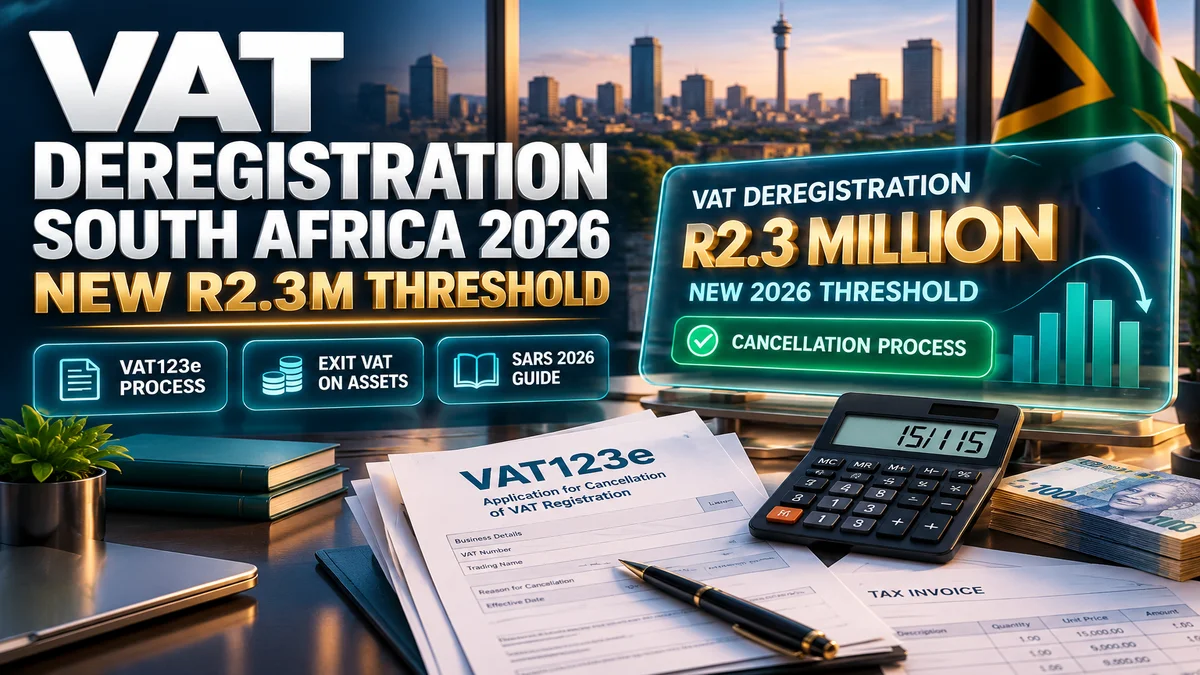
From 1 April 2026, SARS applies a compulsory VAT registration threshold of R2.3 million, up from R1 million, the first increase since 2009. Vendors whose taxable supplies will stay below the new threshold can now apply to cancel their VAT registration. This guide covers how to apply, what the exit VAT on your assets will cost, and how to work out whether deregistering is worth it.
Yes, you can cancel your VAT registration if your taxable sales will stay under R2.3 million over the next 12 months, or if you have stopped trading. It isn’t automatic. You apply to SARS on the VAT123e form, and in your last VAT return you pay “exit VAT” on the stock and assets you still own. That exit VAT is the real cost, so work it out before you apply.
- What Is VAT Deregistration?
- Can You Deregister Under R2.3M?
- When Can’t You Deregister?
- What Is Exit VAT?
- How Do You Apply?
- Your Final VAT201 Return
- What Changes After Deregistration?
- Should You Deregister?
- Turnover Tax as an Alternative
- Selling Your Business (Going Concern)
- Common Mistakes
- Pre-Deregistration Checklist
- FAQ
1. What Is VAT Deregistration?
VAT deregistration is the cancellation of your VAT vendor registration with SARS. Once cancelled, you no longer charge VAT, issue tax invoices, or claim input VAT. Deregistration is governed by Section 24 of the Value-Added Tax Act 89 of 1991. It isn’t automatic. You must apply, and the effective date is set by SARS.
In practice, the real question for most vendors isn’t whether they’re allowed to deregister. It’s whether deregistering still pays once the exit VAT on their stock and assets is counted.
Deregistration is governed primarily by Section 24 of the Value-Added Tax Act 89 of 1991. The legal right to deregister exists when one of the qualifying grounds in Section 24 is met, most importantly, when your taxable turnover falls below the compulsory registration threshold.
In the 2026 Budget Speech on 25 February 2026, the Minister of Finance announced that the compulsory VAT registration threshold would rise from R1,000,000 to R2,300,000 and the voluntary threshold from R50,000 to R120,000, effective 1 April 2026. The amendments to section 23 of the VAT Act are contained in the 2026 Rates and Monetary Amounts and Amendment of Revenue Laws Bill. SARS’s Budget 2026 FAQ (last updated 12 August 2026) states that, although the amendments had not yet been promulgated, SARS is administering registration and deregistration requests on the new threshold from 1 April 2026.
This is the first change to the compulsory threshold since 2009. Many vendors who were registered compulsorily because their turnover was between R1 million and R2.3 million may now be eligible to apply for deregistration.
One thing catches people out: dropping below R2,300,000 doesn’t cancel your registration by itself. You have to apply. Until SARS approves the cancellation and issues an effective deregistration date, you remain a vendor and must continue filing VAT201 returns, charging VAT on your supplies, and claiming input VAT on your purchases.
Key legislation
- Section 24 of the VAT Act: grounds for and procedure of deregistration
- Section 8(2): deemed supply rule on deregistration
- Section 11(1)(e): zero-rating for going concern transactions
- Section 17(2): blocked input VAT (passenger vehicles)
- Section 55, read with sections 29 and 32 of the Tax Administration Act: record retention
2. Can You Deregister Under the R2.3M Threshold?
You qualify to apply if: (1) your taxable turnover in the past 12 months did not exceed R2,300,000, and (2) you don’t reasonably expect it to exceed R2,300,000 in the next 12 months, or your business has ceased trading. All four qualifying grounds are set out in Section 24 of the VAT Act.
In practice, start with your last 12 months of VAT201 returns. Add up the taxable supplies (standard-rated plus zero-rated) and you’ll see straight away how far below R2,300,000 you really are.
Section 24 of the VAT Act, as summarised on SARS’s cancellation page, covers four main situations:
- Turnover below threshold (most common): Your taxable supplies in the preceding 12 months did not exceed R2,300,000 and you don’t reasonably expect them to in the next 12 months.
- Cessation of trade: Your enterprise has ceased making taxable supplies entirely: your business has closed, you have retired, or the entity has been wound up. This isn’t optional. A vendor that ceases all enterprises must notify SARS.
- Going concern sale: If you sell your entire enterprise as a going concern to another VAT-registered vendor, you’ve ceased all your enterprises, so the cancellation follows the same route (see Section 10).
- Other grounds SARS lists: SARS may also cancel a registration if the enterprise never actually started, the vendor no longer meets the registration requirements, or a required return hasn’t been submitted. A voluntary registration can also be cancelled if, for example, the vendor doesn’t keep proper accounting records or has no bank account for the business.
| Threshold Type | Before 1 April 2026 | From 1 April 2026 | Change |
|---|---|---|---|
| Compulsory registration | R1,000,000 | R2,300,000 | +R1,300,000 (130%) |
| Voluntary registration (lower limit) | R50,000 | R120,000 | +R70,000 (140%) |
| Voluntary registration (upper limit) | R1,000,000 | R2,300,000 | (same as compulsory) |
The test is subjective, but SARS applies it seriously. If you have a signed contract in place for a large project expected to push your turnover above R2,300,000 in the coming year, you can’t genuinely claim you don’t reasonably expect to exceed the threshold. SARS may request evidence to support your projections.
If your taxable turnover falls between R1,000,000 and R2,300,000, you were compulsorily required to be registered under the old rules but are now only optionally registered under the new rules. You have the right to apply for deregistration, though whether you should deregister is a separate question (see Section 8).
3. When Can’t You Deregister for VAT?
Even if your turnover is below R2,300,000, SARS can’t finalise the cancellation while VAT201 returns or VAT debts are outstanding. If you still reasonably expect your taxable supplies to exceed the compulsory threshold, SARS can refuse the application. SARS’s guidance doesn’t set a minimum registration period, so if you meet the criteria you may apply regardless of how long you have been registered.
A common mistake is applying while a single old nil return is still missing. It looks minor, but the whole application stalls until that return is filed.
Outstanding VAT Returns
SARS can’t finalise the cancellation while any VAT201 return is outstanding, including nil returns for periods with no activity. File every return before you apply.
Outstanding VAT Debt
Per the official SARS cancellation page, SARS can’t finalise the cancellation until all outstanding liabilities and obligations under the VAT Act have been resolved or settled. You may submit the VAT123e application while a payment arrangement is being negotiated, but SARS can’t finalise the cancellation until the debt is resolved, whether by payment, an approved arrangement or a formal dispute. An outstanding debt doesn’t disappear on deregistration: SARS retains full enforcement powers against a deregistered person for all pre-deregistration liabilities.
Expected to Exceed the Threshold
If SARS is satisfied that your taxable turnover is likely to exceed R2,300,000 in the next 12 months, for example if your monthly taxable supplies have been exceeding R191,667, SARS can refuse the application even if you are currently below the threshold.
4. What Is Exit VAT (the Deemed Supply Rule)?
Under Section 8(2) of the VAT Act, goods and rights that form part of your enterprise’s assets are deemed to be supplied immediately before you stop being a vendor. Under Section 10(5), each one is valued at the lesser of its cost (including the VAT you paid) or its open market value, and the output tax is that value × 15/115. Goods on which input tax was denied, such as motor cars and entertainment, fall outside the rule.
In practice, vehicles and equipment usually drive most of the bill, so get written dealer quotes or comparable sale prices for them before you file.
Section 8(2) of the VAT Act applies to goods, and to rights capable of assignment, surrender or cession, that form part of the assets of your enterprise. They are deemed to be supplied in the course of the enterprise immediately before you cease to be a vendor. In effect, SARS treats you as if you had sold those assets to yourself, even though no sale took place. SARS’s Budget 2026 FAQ gives trading stock on hand and assets on which input tax was claimed as the main examples.
Section 10(5) sets the value: the lesser of what the asset cost you (including VAT and, for trading stock, certain further costs) or its open market value. Where an asset has gone up in value, such as some property, you use the lower cost figure, so the increase in value isn’t taxed.
Critically, SARS confirms that “the cost includes VAT incurred on the acquisition.” Because the cost figure is VAT-inclusive, the output VAT is extracted using the 15/115 fraction, not a flat 15% added on top. You can check the VAT inside any amount with our VAT calculator. For example, a deemed supply base of R295,000 (VAT-inclusive) produces output VAT of R295,000 × 15 ÷ 115 = R38,478.
Which assets are included?
- Stock / inventory on hand
- Equipment, tools, and machinery
- Vehicles (where input VAT was claimed, generally commercial vehicles)
- Computers, office furniture, and electronics
- Property (if input VAT was claimed on purchase or improvements)
Which assets are excluded?
- Goods or services on which input tax was denied, for example motor cars (Section 17(2)) and entertainment
- Assets used wholly for exempt or other non-taxable activities
- Assets transferred to the buyer in a qualifying going concern sale (Section 11(1)(e)) before your registration is cancelled
SARS’s Budget 2026 FAQ says goods acquired for no consideration are excluded because their cost is regarded as zero. That only holds if you genuinely paid nothing: where an asset came from a connected person, SARS notes that a deemed open market value may form part of its cost, and any amount you paid makes the cost positive.
Assets bought before you registered aren’t automatically outside the rule either. If you claimed a deduction on them when you registered (for example on second-hand goods held at registration) or claimed input tax on later improvements or parts, they are enterprise assets and must be included. Check each asset against your VAT201 history and registration-date adjustments before leaving it out.
Because cost is VAT-inclusive, the output VAT is extracted using the 15/115 fraction, not added at 15% on top. In this example, OMV is lower than cost for all assets (typical of depreciating equipment). Formula: for each asset, take the lower of VAT-inclusive cost or current OMV; sum all assets; apply 15/115.
Valuation assumptions. All asset cost figures (R35,000; R120,000; R60,000; R180,000) are VAT-inclusive purchase prices, i.e., the amount actually paid including VAT. The open market values (R30,000; R80,000; R45,000; R140,000) are the current estimated resale values at the deregistration date; the 15/115 fraction extracts the VAT component embedded in whichever value is lower. Market values should be supported by evidence such as dealer quotes or recent comparable sales, kept with your records. The total deemed supply value of R295,000 is VAT-inclusive and is what goes in Field 1A; the output tax of R38,478 (R38,478.26) is contained within it, not added on top, and goes in Field 4A. Your figures will differ. The example is illustrative only.
If you purchased a passenger car and input VAT was denied under Section 17(2), that vehicle is excluded from the deemed supply calculation. Only commercial vehicles on which you actually claimed input VAT are included. If unsure, review your original VAT201 returns to check what was claimed.
- Who it covers: the FAQ appears in SARS’s guidance on vendors cancelling under the new R2.3M threshold. It doesn’t say whether it extends to other cancellations (for example a business closing down), so confirm with SARS if that is your situation.
- What the FAQ doesn’t say: how to request the instalments, when the first one is due, or whether interest runs on the deferred amount.
- Why it matters: SARS’s cancellation page says it can’t finalise the cancellation until outstanding liabilities are resolved or settled, so an unconfirmed arrangement can delay your notice of cancellation.
- What to do: request the six-instalment arrangement in writing when you submit the VAT123e, ask SARS to confirm the due dates and the interest position, and keep that confirmation.
Schools exiting VAT under the separate schools amendment have their own concession: 12 equal monthly instalments from 1 January 2027.
Strategies to reduce deemed supply VAT
- Sell assets before deregistration (at full VAT): reduces the asset base on hand at deregistration date
- Write down stock to open market value and document this properly
- Transfer assets to a VAT-registered entity as a going concern: eliminates deemed supply on those assets
- Consider the timing: where market values are falling, a later cancellation date may lower the base, but you keep charging VAT and filing returns until then
5. How Do You Apply for VAT Deregistration?
Complete the VAT123e form and submit it to your SARS branch, by email, eBooking virtual appointment, or in person. SARS reviews your application, clears outstanding obligations, and issues a notice confirming your effective deregistration date. Allow several weeks to months for processing.
The official application to cancel your VAT registration is made using the VAT123e form, Application for the Cancellation of Registration of a Person in respect of all his Enterprises, available to download on the SARS VAT deregistration page. If you are cancelling only a separately registered enterprise or branch (not your entire VAT registration), use the VAT123T instead.
- 1Bring all VAT201 returns up to date. Before applying, ensure every outstanding VAT201 return is submitted. SARS can’t finalise the cancellation while returns are outstanding.
- 2Settle or resolve outstanding VAT debt. Pay, formally dispute or arrange payment of any VAT, penalties or interest. SARS can’t finalise the cancellation until outstanding liabilities are resolved or settled.
- 3Complete the VAT123e form. Download the VAT123e form from the SARS website and complete all required fields clearly.
- 4Attach a covering letter. State the circumstances that give rise to the cancellation clearly on the form or in an attached letter, for example: turnover below R2,300,000, business ceased trading, or sale of business as a going concern.
- 5Submit to your SARS branch. Address the completed VAT123e (and any covering letter) to the SARS branch where you are registered and submit it using one of the channels SARS lists:
- Email: use the SARS online contact form.
- Virtual appointment: book one on SARS eBooking. Choose “Other” as the reason category, then “VAT and PAYE registration/deregistration”.
- 6Await the SARS notice of cancellation. SARS will review your application and issue a formal notice confirming your effective deregistration date and final tax period. Allow several weeks to months. Follow up via eFiling correspondence if you have not heard back.
- 7Submit your final VAT201 return. Submit a final VAT201 return covering the period up to and including the effective deregistration date, including the deemed supply VAT calculation for all assets held on hand.
- 8Pay the exit VAT. Pay the output tax on goods still on hand: 15/115 of the total of the lesser of VAT-inclusive cost or OMV for each qualifying asset. SARS’s Budget 2026 FAQ says this may be paid in six equal monthly instalments; request the arrangement in writing and keep SARS’s confirmation (see Section 4).
- 9Update all business documentation. Remove your VAT number from invoices, your website, letterheads, email signatures, and any other documentation immediately from the effective deregistration date.
- 10Retain your VAT records. Keep tax invoices, credit and debit notes, VAT201 returns and supporting documents for at least five years from the date each VAT201 was submitted (Section 55 of the VAT Act read with Section 29 of the Tax Administration Act). Your final VAT201 therefore starts its own five-year clock on the day you file it. If a return was never submitted, or if an audit, investigation, objection or appeal is open, keep the relevant records for longer (Section 32).
6. What Goes in Your Final VAT201 Return?
SARS will issue a final VAT period ending on your effective deregistration date. Your final VAT201 must include: (1) all normal input/output VAT for the period, and (2) the deemed supply output VAT under Section 8(2), calculated as the total of (lower of VAT-inclusive cost or OMV for each asset) × 15/115. If the return shows a net refund, it remains payable subject to SARS’s normal verification, but refunds after deregistration can be slower.
In practice, keep a one-page schedule listing each asset, what it cost, its market value on the cancellation date and the evidence for that value. It’s exactly what you’d need if SARS queries the return.
Your final VAT201 return covers the period from the start of your last VAT period to the effective date of deregistration. It must include all of the following:
- Normal output VAT: VAT on all taxable supplies made during the final period.
- Normal input VAT: VAT on purchases made during the final period for which you are entitled to deduction.
- Deemed supply output VAT (Section 8(2)): VAT extracted using the 15/115 fraction on the lower of the VAT-inclusive cost price or current open market value of all business assets held on the effective date of deregistration for which input VAT was previously claimed. This is the most significant additional item. SARS states that the value of these goods is declared in Field 1A and the output tax (Field 1A × 15/115) in Field 4A of the final VAT201.
- Unpaid supplier invoices: if you deducted input tax but had not paid the supplier within 12 months at the time of cancellation, you must account for output tax on it (unless you have already made that adjustment).
- Input tax not yet claimed: may be deducted in the final return if you hold the required documents and are within five years of becoming entitled to it. No deductions can be made after the final return is submitted.
- Any outstanding credit notes or debit notes from the final period.
7. What Changes After VAT Deregistration?
From the effective date you must stop charging VAT, remove your VAT number from all documentation, and you lose the right to claim input VAT. Your pre-deregistration VAT debts remain enforceable. You must keep VAT records for at least five years from the date each return was submitted, and longer while an audit or dispute is open. If your taxable supplies later exceed R2.3M, you must apply to register again within 21 business days.
One thing that catches people out is their invoicing software. Check it has stopped printing your VAT number and adding 15% from the cancellation date, not a month later.
| What Changes | What Stays the Same |
|---|---|
| You can no longer charge VAT (15%) on your supplies | Pre-deregistration VAT debts remain fully enforceable by SARS |
| You can no longer claim input VAT on purchases | Record retention continues (5 years from each return’s submission; longer during an audit or dispute) |
| You must remove your VAT number from all documents | Outstanding refunds owed to you remain payable |
| You stop filing VAT201 returns | SARS can still audit pre-deregistration periods |
| Tax invoices become ordinary invoices (no VAT line) | Income tax, PAYE, and other obligations continue |
Re-registration if turnover later exceeds R2.3M
If your taxable turnover exceeds R2,300,000 in any 12-month rolling period after deregistration, you become liable to register for VAT again compulsorily (see our VAT registration guide). You must apply to SARS to re-register within 21 business days of the date on which your turnover exceeded the threshold. Failure to register timeously exposes you to penalties and interest on VAT that should have been collected.
8. Should You Deregister for VAT?
Deregistering tends to pay off when most customers are consumers who can’t claim VAT, and the VAT you would no longer pay over each year (output tax minus input tax) recovers the once-off exit VAT quickly. If most customers are VAT-registered businesses, it usually doesn’t: at an unchanged price their net cost rises by 15%, and keeping their cost the same means cutting your VAT-inclusive price by about 13.04% (15/115), which hands the saving back to them.
Why the figures are 15% and 13%
The two numbers describe the same R15 of VAT measured against different bases. Take an item a vendor sells for R100 + R15 VAT = R115:
| Measure | Calculation | Result |
|---|---|---|
| B2B client’s net cost today | Pays R115, claims R15 back | R100 |
| After you deregister, price unchanged | Pays R115, claims nothing | R115, +15% on R100 |
| Price cut needed to keep the client’s cost at R100 | R15 ÷ R115 = 15/115 | −13.04% of R115 |
| Your own net receipt at R100 after the cut | R100, no output VAT to pay over | Same as before (R100) |
So “15%” is the increase in a VAT-registered customer’s cost if you keep your price; “13.04%” is the reduction in your VAT-inclusive price needed to cancel that increase. The same logic applies to your own purchases: a R115 VAT-inclusive invoice now costs you R115 instead of R100 net.
Possible benefits
- If your customers are consumers, you can cut your shelf price by up to about 13% (15/115 of the VAT-inclusive price) and still receive the same net amount, or keep your prices and keep the margin.
- No further VAT201 returns once SARS confirms your final tax period (the final return must still be filed).
- Lower ongoing VAT administration and accounting costs, although records must still be kept for the retention period.
- Fewer VAT-specific queries going forward. This doesn’t remove audit exposure for periods before cancellation, which SARS can still review.
Risks and costs
- Once-off exit VAT: 15/115 of the lesser of VAT-inclusive cost or open market value of qualifying goods on hand. It can be a significant cash outlay (SARS’s FAQ allows six monthly instalments; see Section 4).
- Loss of input tax: purchases from VAT-registered suppliers cost you 15% more on a net basis (R115 instead of R100), or put differently, you lose 13.04% of every VAT-inclusive invoice.
- Impact on B2B clients: VAT-registered customers can no longer deduct VAT on your invoices. At an unchanged price their net cost rises by 15%, which may make you less competitive against VAT-registered rivals.
- Re-registration risk: if your supplies grow past R2.3M you must register again within 21 business days.
Financial Analysis: B2C Business (Clients Can’t Claim Input VAT)
For a business selling to consumers, deregistering and keeping prices the same means the business keeps the net VAT it used to pay over to SARS. That is the dominant figure in the decision.
Assumptions behind the R50,400 benefit and 9.2-month break-even: read before applying this to your business:
- Sales of R400,000 excluding VAT a year (R460,000 including VAT), all to consumers who can’t claim VAT.
- Prices stay the same after deregistration, so customers still pay R460,000 and sales volume doesn’t change.
- Taxable purchases of R120,000 excluding VAT (R138,000 VAT-inclusive), carrying R18,000 input tax, continue at the same level.
- The R8,400 compliance saving is an estimate of accountant and VAT201 preparation fees that actually stop; if your bookkeeper’s fee doesn’t fall, leave it out.
- Exit VAT of R38,478 comes from the Section 4 example.
- Figures are before income tax: the R42,000 you keep becomes taxable profit. They also ignore the cash-flow effect of paying the exit VAT in instalments.
Break-even = R38,478 ÷ R50,400 × 12 ≈ 9.2 months, on the assumptions above. If Thandeka’s business is a company taxed at the standard 27% rate, and the whole R50,400 is extra taxable profit, the after-tax benefit is about R36,800 (R50,400 × 73%) and break-even stretches to roughly 12.5 months. This is a simplified check: it ignores whether the exit VAT itself is deductible for income tax, and it won’t fit every business. A small business corporation pays lower rates on its first R550,000 of taxable income, and a sole proprietor pays at their personal marginal rate (18% to 45%), so redo this line with your own rate. Without the R8,400 fee saving, the pre-tax break-even is about 11 months.
Financial Analysis: B2B Business (Clients Are VAT-Registered)
If your clients are VAT-registered, they lose the input tax deduction on your invoices. To keep their net cost unchanged you have to cut your VAT-inclusive price by 15/115 (about 13.04%), from R115 to R100 in the example above. Your own net receipt stays the same because you no longer pay output VAT over, but you gain nothing on revenue, while your purchases now cost you the full VAT-inclusive amount.
No break-even. On these assumptions the business is R9,600 a year worse off, on top of the once-off R38,478 exit VAT. The compliance saving can’t make up for lost input tax when the price cut gives the VAT saving away to clients.
| Business Type | Deregister? | Reason |
|---|---|---|
| Freelancer, all individual clients | Often Yes | Consumers can’t claim VAT; you can cut prices by up to ~13% or keep the margin |
| B2B service provider, mainly corporate clients | Often No | At an unchanged price clients’ net cost rises 15%; matching it means a ~13% price cut |
| Retailer, mixed consumer/business clients | Assess | Depends on client split; model the break-even |
| Business with significant asset base | Assess | Exit VAT may be large; compare it with the net VAT you would keep each year |
9. Is Turnover Tax an Alternative to VAT?
SARS’s Budget 2026 FAQ says the turnover tax limit rises from R1 million to R2.3 million from 1 April 2026, with 0% tax on the first R600,000 and a top rate of 3%. Turnover tax and VAT are separate systems: you can be on turnover tax and still be VAT-registered, but many micro businesses leave VAT when they elect turnover tax to keep administration simple.
In practice, compare what you’d pay under turnover tax with your current income tax bill before switching. For smaller businesses, the proposed 0% band up to R600,000 makes a big difference.
Turnover tax is an optional simplified regime for micro businesses, governed by the Sixth Schedule to the Income Tax Act. Instead of income tax on profit, a qualifying business pays tax on its turnover.
| Annual Taxable Turnover | Rate | Tax Payable |
|---|---|---|
| R0 to R600,000 | 0% | Nil |
| R600,001 to R950,000 | 1% | 1% of amount above R600,000 |
| R950,001 to R1,400,000 | 2% | R3,500 + 2% of amount above R950,000 |
| R1,400,001 to R2,300,000 | 3% | R12,500 + 3% of amount above R1,400,000 |
Turnover tax and VAT aren’t mutually exclusive. SARS’s Budget 2026 FAQ confirms a micro business can be on turnover tax while also VAT-registered. Many still choose to leave VAT when electing turnover tax, because avoiding VAT returns is one of the regime’s main attractions. If you take that route, apply for VAT cancellation first, file your final VAT201, and register for turnover tax before the start of your next tax year. Businesses earning more than 20% of receipts from professional services or investment income, personal service providers and labour brokers don’t qualify. See our turnover tax guide for a full comparison.
10. How Is VAT Handled When You Sell Your Business?
Under Section 11(1)(e) of the VAT Act, the sale of an enterprise as a going concern is zero-rated only if every condition below is met, including three separate written agreements: that it’s sold as a going concern, that it will be an income-earning activity on the date of transfer, and that the price includes VAT at the zero rate. If any condition isn’t met, the zero rate under Section 11(1)(e) can’t be used, and the sale is normally subject to VAT at the standard 15% rate, unless another zero-rating or exemption applies to it.
Under Section 11(1)(e) of the VAT Act, the supply of an enterprise, or of a part capable of separate operation, as a going concern is zero-rated only if all of the following are met:
- The seller is a registered VAT vendor.
- The buyer is a registered VAT vendor at the time of the supply.
- The enterprise, or the part sold, is capable of separate operation.
- The parties agree in writing, when the agreement is concluded, that the enterprise is disposed of as a going concern.
- The parties agree in writing that the enterprise will be an income-earning activity on the date of transfer.
- The assets necessary for carrying on the enterprise are disposed of by the seller to the buyer.
- The parties agree in writing that the consideration for the supply is inclusive of VAT at the zero rate.
In addition, Section 11(3) requires the seller to obtain and keep the documentary proof SARS prescribes, in practice the signed sale agreement containing the clauses above, or the zero rate can’t be applied.
Buyer not yet registered: if the buyer isn’t a registered vendor when the supply takes place, the Section 11(1)(e) zero rate isn’t available, and the sale is normally standard-rated at 15%. Make the agreement conditional on the buyer’s registration being in place.
Business stops trading before transfer: if the income-earning activity is interrupted between signing and transfer (for example tenants leave a property, or the shop closes for a refit), the going-concern condition can fail.
If the seller has sold its entire enterprise, it will generally have no remaining taxable supplies and must apply for VAT deregistration. Assets transferred in a qualifying going concern sale leave the seller’s enterprise before cancellation, so no exit VAT arises on them. Any assets the seller keeps remain subject to the deemed supply on deregistration.
11. What Are the Most Common VAT Deregistration Mistakes?
Most failed or costly deregistrations come down to six things: assuming it happens automatically, skipping the exit VAT sum, applying with returns or debt outstanding, throwing records away too soon, charging VAT after the cut-off, and a going-concern buyer who isn’t registered yet.
Thinking Deregistration Is Automatic
Many vendors believe that because their turnover fell below R2,300,000 after 1 April 2026, they are automatically deregistered. They aren’t. They remain registered vendors liable for VAT201 returns, VAT on supplies, and all compliance obligations until SARS formally cancels the registration.
✅ Apply for deregistration using the VAT123e form as soon as you qualify and all your returns are up to date.
Ignoring the Deemed Supply Calculation
Some businesses either over-include assets (including assets for which they never claimed input VAT, inflating the liability) or under-include them (omitting assets for which they did claim input VAT, leading to an under-declaration and potential penalties).
✅ Do a methodical asset review against your historical VAT returns before submitting the final VAT201.
Applying with Outstanding Returns or Debts
SARS can’t finalise the cancellation while VAT201 returns, including nil returns, or VAT debts are outstanding, so the business keeps incurring VAT obligations while it waits.
✅ Clear all outstanding returns and resolve any VAT debts before submitting the VAT123e form. Check your SARS correspondence and eFiling account first.
Destroying VAT Records Too Early
It’s common for deregistered businesses to destroy or lose their VAT records within a year or two, particularly when changing premises or switching accounting systems. Records must be kept for five years from the date each VAT201 was submitted, and longer while an audit or dispute is open. A SARS audit within that window can result in penalties and estimated assessments if records can’t be produced.
✅ For each VAT201, note the date you submitted it and add five years. Records for that period may only be destroyed after that date, and only if no audit, objection or appeal is open. Store all VAT records digitally in a secure cloud backup with clear period labelling so nothing is deleted prematurely.
Continuing to Charge VAT After Deregistration
From the effective deregistration date, you may not add VAT to your prices. If you continue to charge 15% VAT after deregistration, you are collecting VAT unlawfully and must remit those amounts to SARS regardless. Without being a registered vendor, this creates a significant legal and financial problem.
✅ Update your invoicing system, accounting software, and price lists immediately on your effective deregistration date.
Missing the Going Concern Buyer Registration Requirement
Selling as a going concern to a buyer who isn’t yet VAT-registered on the transaction date means the going-concern zero rate can’t be applied. The sale will then normally carry VAT at 15%, which can be a large, unexpected bill on a deal priced as zero-rated.
✅ Confirm the buyer’s VAT registration number and status before signing the sale agreement, and make the zero-rating conditional on the buyer being VAT-registered on the transaction date.
12. What Should You Check Before You Deregister?
Before you send the VAT123e, confirm four things: you meet the threshold or cessation test, your SARS account is clean, your exit VAT is calculated and funded, and you have a plan for the day after cancellation.
Work through the list below and tick each item. If you can’t tick one, sort it out first, because SARS can’t finalise the cancellation until it’s done.
Eligibility Check
- Confirmed taxable turnover was below R2,300,000 in past 12 months
- Confirmed I don’t reasonably expect to exceed R2,300,000 in the next 12 months
- Confirmed there are no outstanding VAT201 returns or unresolved VAT debts on the account
- Checked that no signed contracts will push turnover above the threshold
SARS Account Housekeeping
- All outstanding VAT201 returns submitted (including nil returns)
- All VAT assessments, penalties, and interest settled or formally disputed
- VAT123e form downloaded and completed, covering letter prepared
- eFiling login credentials are current and working (for correspondence monitoring)
Deemed Supply Preparation
- Compiled a full list of business assets on hand at proposed deregistration date
- Identified which assets had input VAT claimed (cross-referenced with historical VAT201s)
- Obtained or estimated open market values of all assets in the deemed supply
- Calculated the estimated deemed supply exit VAT (total lower-of-cost/OMV base × 15/115, where cost is VAT-inclusive)
- Confirmed cash/facility available to pay the deemed supply VAT on the final VAT201 due date
Post-Deregistration Action Plan
- Invoicing template updated to remove VAT line and VAT number
- Website updated to remove VAT number and VAT-inclusive pricing
- Email signatures and letterheads updated
- Accounting software updated to non-VAT mode
- Suppliers notified that you are no longer a VAT vendor
- VAT record archive set up, kept for 5 years from each return’s submission date (longer if an audit or dispute is open)
- Six-instalment arrangement for exit VAT requested and confirmed in writing (if needed)
13. Frequently Asked Questions
Sources
- SARS: Budget 2026 Frequently Asked Questions (threshold, deregistration, exit VAT, instalments, turnover tax)
- SARS: Cancellation of VAT registration (grounds, VAT123e, outstanding liabilities, final return)
- SARS: VAT Connect, Issue 21 (September 2026) (legislative status of the threshold amendments)
- SARS: Bills introduced in Parliament (2026 Rates Bill B34-2026, introduced 21 October 2026)
- SARS: Record keeping (Tax Administration Act sections 29 and 32)
- Value-Added Tax Act 89 of 1991: sections 8(2), 11(1)(e), 11(3), 17(2), 23, 24 and 55
- SARS Interpretation Note 57: Sale of an enterprise or part thereof as a going concern
Need Help with Your VAT Deregistration?
Use our free South African VAT calculator to check your VAT position, or explore our full suite of tax guides for small business owners.
Open VAT Calculator →Related South African VAT & Tax Guides
- VAT Registration South Africa: Complete 2026 Guide
- Turnover Tax South Africa: Is It Right for Your Business?
- Free South African VAT Calculator
- SARS eFiling Registration 2026: Complete Guide
- SARS Supporting Documents Required: Complete Checklist
- South African Income Tax Calculator
- Tax Brackets South Africa 2026/2027
This article is provided for general information and educational purposes only. It does not constitute professional tax advice, legal advice, or financial advice. Tax laws and SARS interpretations change frequently. While every effort has been made to ensure accuracy as at 7 November 2026, TaxPlanners does not accept liability for any errors or omissions, or for any reliance placed on this content. Your individual tax circumstances may differ. Always consult a qualified and registered South African tax practitioner or tax attorney for advice specific to your situation before making tax decisions. TaxPlanners is not a registered tax practitioner and this content is not a substitute for professional advice.