
Tax Clearance Certificate South Africa 2026: TCS PIN Guide
This guide explains how to get a tax clearance certificate from SARS in 2026, which is now called a Tax Compliance Status (TCS) and comes as a PIN. You’ll learn what SARS checks, how to apply on eFiling step by step and which request type you need. It also covers how long the PIN lasts and how to fix a red status. It was checked against SARS’s TCS pages and its eFiling guide (revision 24, effective 28 August 2026) as at 12 November 2026.
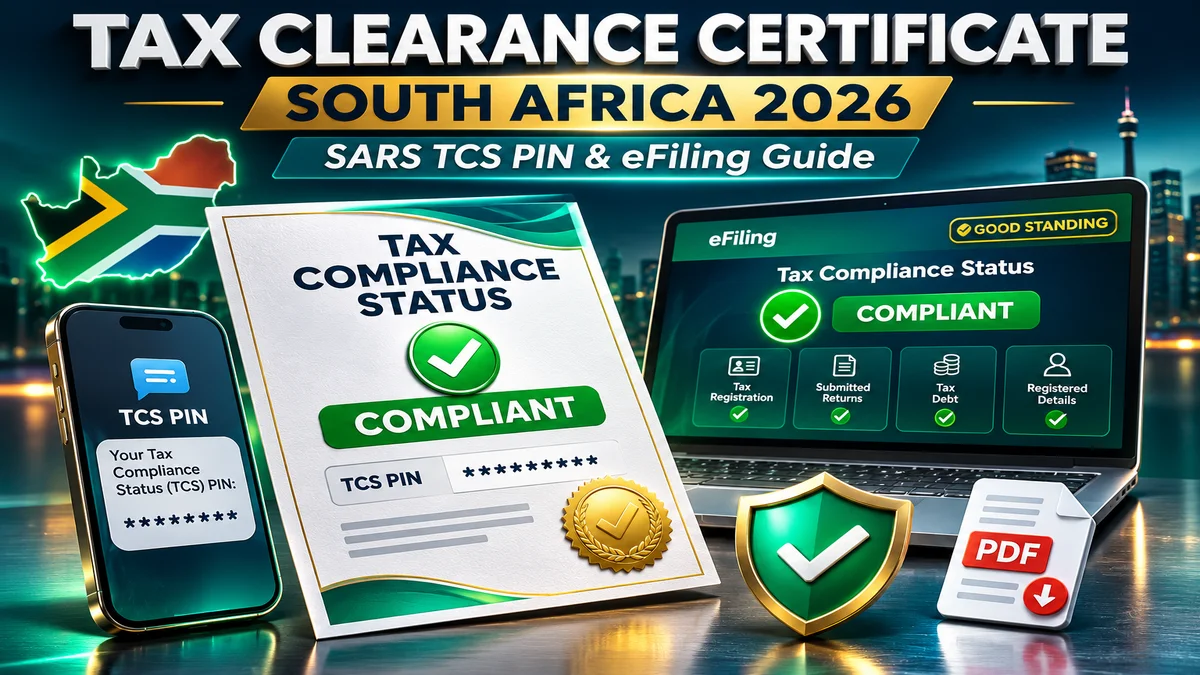
SARS no longer issues paper tax clearance certificates. You request a Tax Compliance Status on eFiling or the SARS Online Query System, and if your returns, debt and registrations are in order, SARS sends a PIN by SMS. You share the PIN, and the other party checks your live status online.
What Is a Tax Clearance Certificate in South Africa?
A tax clearance certificate is proof from SARS that your tax affairs are in order. Since 2015 it has been replaced by the Tax Compliance Status (TCS) system, which gives you a PIN instead of a paper certificate.
According to SARS’s Tax Compliance Status page, SARS introduced the TCS system in 2015 to replace the paper-based tax clearance system. When you apply, you receive a security PIN. Anyone you give the PIN to, such as a client, landlord, bank or government department, can then view your status online on eFiling.
The key difference from the old certificate is that the status is live. SARS shows the third party your overall compliance status at the date and time they check it, not at the date the PIN was issued. So a PIN you shared six months ago will show “non-compliant” today if you’ve since missed a return.
Benefits of keeping your tax compliance status green
- Tenders and contracts: government buyers and many large companies won’t appoint a supplier with a red status.
- Offshore investment: your bank needs a verified status before it moves money under the foreign investment allowance.
- Speed: if you’re always compliant, you can get a PIN the same day someone asks for one.
Those are the basics. People still use the old names, so you’ll see the same thing called several ways:
| Name people use | What it means today |
|---|---|
| Tax clearance certificate (TCC) | The old paper certificate, replaced by the TCS system in 2015 |
| Tax Compliance Status (TCS) | SARS’s current name for proof of tax compliance |
| TCS PIN, tax pin or tax compliance status PIN | The security PIN you share so others can check your status |
| Tax compliance certificate or SARS clearance certificate | Other everyday names for the same TCS proof |
| TCS result letter | The printable letter with your PIN, often called the certificate |
| Letter of good standing (SARS) | A TCS request of the Good Standing type |
Don’t confuse these: a “tax certificate” usually means an IRP5 or IT3(a) from your employer, or an IT3(b) from your bank, showing your income for the year. A letter of good standing for COIDA comes from the Compensation Fund, not SARS. Neither one proves tax compliance.
Are You Tax Compliant? Free TCS Readiness Checker
Answer five quick questions to see whether SARS is likely to give you a green or red tax compliance status, which request type to choose and what to fix before you apply.
This tax compliance checker mirrors the four requirements SARS lists on its My Compliance Profile page, plus the merge step that trips up many people. It runs in your browser and stores nothing.
Its limitations: it’s a guide, not a SARS result. Only your My Compliance Profile on eFiling shows your real status. SARS also checks things you might not know about, such as an old return for a tax type you forgot you had. If the checker says green but eFiling says red, eFiling is right, so expand the red item there to see the reason.
What Does SARS Check Before Issuing a Tax Compliance Status?
SARS checks four things: registration for all your taxes, no outstanding returns, no unarranged debt and current registered details. All your tax numbers must also be on one profile.
SARS’s TCS page lists what you must do to be tax compliant. Your My Compliance Profile on eFiling then shows each requirement in green or red:
| Requirement | What SARS wants | Common reason for red |
|---|---|---|
| Registration | Registered and active for every tax product you are liable for | Not registered for VAT or PAYE when you should be |
| Submission of returns | No returns outstanding after their filing due dates | An old ITR12, VAT201 or EMP201 never filed |
| Debt | No outstanding tax debt, unless a payment arrangement or suspension of payment is in place | Interest or penalties left on an account |
| Registered particulars | Your details on record are up to date | Old address, bank or representative details |
| All tax numbers linked | Every tax reference merged (Merge tool) or declared (ERC01 form) | A dormant tax number you forgot about |
Debt doesn’t automatically block you. SARS treats you as compliant if a payment arrangement or suspension of payment has been agreed. What counts is that the debt is being dealt with formally.
New taxpayers can also get a status. According to SARS’s eFiling guide, the indicator shows “Compliant (New Registrant)” for someone who has only just registered and has no filing history yet.
If you’re unsure about a return, our IRP6 deadline and penalties guide covers provisional tax returns, which are a common hidden cause of a red status.
Which TCS Type Do You Need: Good Standing or AIT?
There are now only two request types. Good Standing covers tenders, contracts, suppliers and most other uses. Approval International Transfer (AIT) is for individuals moving money offshore under the foreign investment allowance or after ceasing tax residency.
SARS simplified the system. According to its TCS page, the Tender option no longer exists, and taxpayers should use Good Standing because it fulfils the same purpose. The old Foreign Investment Allowance (FIA) and Emigration applications, sometimes called FIA tax clearance, were renamed Approval International Transfer (AIT).
| What you need it for | Request type | Who can apply |
|---|---|---|
| Government tender or supplier registration | Good Standing | Individuals and organisations |
| Private contract, client or landlord | Good Standing | Individuals and organisations |
| Bank, licence or business funding application | Good Standing | Individuals and organisations |
| Offshore investment above the single discretionary allowance | Approval International Transfer | Individuals only |
| Moving funds after ceasing South African tax residency | Approval International Transfer | Individuals only |
SARS’s eFiling guide confirms that individuals can choose Good Standing or Approval International Transfer, while organisations only have the Good Standing option. A tax clearance certificate for a business is therefore always a Good Standing request.
Already holding an old Tender, FIA or Emigration PIN? The guide says verifications still work on active applications of those types that haven’t expired yet. New requests must use the two current types.
One exception is a South African trust distributing to a non-resident trust. SARS’s AIT supporting documents page says this needs a manual letter of compliance, applied for by email rather than through a normal AIT request.
How to Get a Tax Clearance Certificate on eFiling, Step by Step
Log in to eFiling, activate the TCS service once, link all your tax numbers, check My Compliance Profile, submit a Tax Compliance Status Request (TCR01) and collect your PIN. If you are already compliant, you can usually finish it in one sitting.
- Log in to SARS eFilingLog in with your username and password. If you are not an eFiler yet, register first; organisations need the right user rights set up.
- Activate the Tax Compliance Status serviceChoose Tax Status, then activate the Tax Compliance Status service. You only need to do this once.
- Merge or declare all your tax numbersUse the Merge tool or the ERC01 form so that every tax type you are registered for appears on one profile.
- Check My Compliance ProfileLook at the four requirements: registration, returns, debt and overall status. Fix anything that is red before you apply.
- Submit a Tax Compliance Status RequestSelect Tax Compliance Status Request and choose Good Standing or Approval International Transfer. Complete the TCR01 form and choose how many months the PIN must stay valid.
- Receive your PIN and print the letterIf you are compliant, SARS issues the PIN by SMS and shows it on your dashboard. Print the TCS result letter and share the PIN with the party that asked for it.
This is the same process described in SARS’s how to request your Tax Compliance Status page and its GEN-ELEC-08-G01 eFiling guide. If you don’t have an eFiling profile yet, start with our SARS eFiling registration guide.
Can you get a tax clearance certificate without eFiling?
Yes. SARS also lets you request your tax compliance status on the SARS Online Query System (SOQS), which doesn’t need an eFiling profile. If you need help fixing non-compliance, book an appointment at a SARS branch. BizPortal, run by the CIPC, points business owners to eFiling and says it doesn’t offer TCS services itself.
A tip from experience: tick the option for the PIN to be sent by SMS, and check that SARS has your current cellphone number first. An old number is one of the most common reasons people say they never received their PIN.
How Long Is a TCS PIN Valid, and Can It Expire?
You choose the PIN’s validity in months when you submit the request, for example 5 or 12 months. You can cancel a PIN or request a new one at any time, but the status behind it always reflects your compliance at the moment someone checks.
On the TCR01 form, SARS’s guide says you must confirm the number of months after which the PIN must expire, entered as two digits such as 05 or 12. Your dashboard then shows the PIN issue date, the PIN expiry date and the PIN status: active, inactive or cancelled.
Some older articles say a TCS PIN is always valid for 12 months. That isn’t how the current system works: you set the period yourself, and you can manage it afterwards.
| PIN action | What happens |
|---|---|
| New PIN | Request a new PIN for an approved request and choose a new validity period |
| Cancel PIN | Cancel at any time; third parties can no longer verify with that PIN |
| SMS PIN | Have the PIN sent again to your registered cellphone number |
| Who viewed my status | See which third party checked your status, when, and what it showed |
A unique PIN is issued for each request. If you give different PINs to different clients, you can cancel one without affecting the others.
Tips to keep your status green
- Diarise every due date. Put VAT, EMP201 and provisional tax dates in your calendar, not just the annual return.
- Check monthly. Open My Compliance Profile once a month if you rely on tenders or contracts.
- Clear small balances. A few rand of interest left on an account can turn the debt indicator red.
- Use one PIN per client. You can cancel a PIN without affecting the others.
Remember that a valid PIN isn’t a guarantee of a green result. If you miss a VAT return next month, everyone who checks your PIN after that will see red, even though the PIN hasn’t expired.
How Do Third Parties Verify a Tax Compliance Status?
The third party enters your PIN on SARS eFiling, after activating the Tax Compliance Status Verification service, or on the SARS Online Query System. They see a green or red result for that moment, which they can print and keep.
According to SARS’s how to verify Tax Compliance Status page, a person authorised on the organisation’s eFiling profile must first activate the Tax Compliance Verification service. After that, any user with the right permissions can verify a supplier’s tax compliance status with the PIN and tax number.
The result is colour coded:
- Green: the taxpayer’s tax affairs are in order and they are tax compliant.
- Red: the taxpayer’s tax affairs are not in order and they are not tax compliant.
The verifier can print the result for their records, and it is stored under History on their eFiling profile. To protect confidentiality, they see only the compliance status, not your returns, income or debt.
Tax compliance for government tenders
Government departments use National Treasury’s Central Supplier Database (CSD), which automatically verifies supplier information with SARS and the CIPC. That’s why suppliers on the CSD still need a green status: if your status turns red, the CSD shows it and you may be passed over for an award.
Banks use the same verification before sending money offshore under an AIT. According to the Reserve Bank’s exchange control FAQ, Authorised Dealers must use the TCS PIN to verify your status on eFiling before the transfer.
Can You Download a Tax Clearance Certificate as a PDF?
Yes, but not as a paper certificate. SARS says the PIN can be printed in the form of a TCS result letter from your eFiling dashboard. The other party still needs the PIN to check your live status.
Many people search for a tax clearance certificate download because a client or tender form asks for “a copy of your tax clearance”. What you can give them is the TCS result letter, which SARS describes on its request page as a printed form of your PIN.
To find it, open your Tax Compliance Status Request dashboard on eFiling, select the approved request and choose the option to print or view the TCS result letter. Save it as a PDF and send it with the PIN.
A few practical points:
- A screenshot isn’t proof. The letter only matters because it contains the PIN, which the other party uses to check your current status.
- Old certificates are worthless. A paper tax clearance certificate from before 2015 can’t be verified any more.
- One letter per request. Each request gets its own PIN and letter, so request again if a client needs a fresh one.
If someone insists on an “original certificate”, explain that SARS no longer issues them and point them to the verification steps above. Most procurement teams know this already.
Tax clearance certificate vs tax certificate: which download do you need?
Many people who search “download tax certificate” or “how to get a tax certificate online” actually need a different document. Use this table to check which one you’re after:
| Document | What it shows | Where to get it |
|---|---|---|
| TCS result letter (tax clearance) | That you are tax compliant, with a PIN | SARS eFiling, Tax Compliance Status dashboard |
| IRP5 or IT3(a) | Your salary and the PAYE deducted for the tax year | Your employer; it also pre-fills your ITR12 on eFiling |
| IT3(b) | Interest and dividends earned on investments | Your bank or investment provider |
| Section 18A receipt | A donation you can claim as a deduction | The approved PBO you donated to |
| Medical aid tax certificate | Contributions and claims for the year | Your medical scheme |
So if a client asks for proof of tax compliance, send the TCS letter and PIN. If you’re filing your own return and need an income tax certificate, ask your employer, bank or medical scheme instead. Our medical aid tax credit guide explains how the medical certificate is used.
How Does a Company Get a Tax Clearance Certificate?
A company, close corporation or trust requests a Good Standing TCS on eFiling, just like an individual. Every tax the business is registered for counts, so VAT, PAYE, provisional tax and company income tax all need to be up to date.
A company tax clearance certificate, or tax clearance certificate for business, works the same way, but there are more ways to fall out of compliance. A business is usually registered for several tax types, and one late return on any of them turns the whole status red.
| Tax type | What must be up to date |
|---|---|
| Company income tax | ITR14 returns and provisional tax (IRP6) payments |
| VAT | Every VAT201 return and payment for each tax period |
| PAYE, UIF and SDL | Monthly EMP201 returns and payments, and EMP501 reconciliations |
| Turnover tax | Annual return and interim payments, if registered |
The registered representative must also be correct on SARS’s records. If the person who used to be the public officer has left, update the details before you apply, or the request may stall.
Two of our guides help here. The VAT registration guide explains when a business must register, which affects the “registered for all taxes” requirement. The company income tax calculator helps you check provisional payments before they become debt.
Tax clearance certificate for a new business
A newly registered company can get a tax compliance status before it has filed anything. SARS’s eFiling guide says the indicator shows “Compliant (New Registrant)” in that case. Register for income tax and any other taxes the business needs first, such as VAT or PAYE. Then request a Good Standing PIN and share it with the client or tender office.
Small businesses and sole proprietors apply on their personal eFiling profile, because the business isn’t a separate taxpayer. Their income tax return then has to include the business income.
What to Do If Your Tax Compliance Status Is Red
Open My Compliance Profile, expand the red item to see the reason and follow the steps shown. Most red statuses are fixed by filing an outstanding return, paying or arranging a debt, or registering for a missing tax type.
SARS’s My Compliance Profile page explains that you can select the non-compliant indicator to see the steps needed to rectify it. Here are the usual causes and solutions:
| Red item | Likely cause | How to fix it |
|---|---|---|
| Returns | An income tax, VAT or EMP201 return is outstanding | Submit the return on eFiling, then refresh your profile |
| Debt | Unpaid tax, interest or penalties | Pay in full, or ask for a payment arrangement or suspension of payment |
| Registration | You are liable for a tax you are not registered for | Register for that tax type |
| Particulars | Your details are out of date | Update your registered particulars |
| Profile shows taxes that aren’t yours | Wrong tax products linked to you | Visit a SARS branch to have them removed |
After you fix the cause, your profile may not turn green straight away, because SARS has to process the return or payment. Check again after a few days before you submit a new request.
If you disagree with the debt SARS shows, for example after an additional assessment from SARS, a dispute doesn’t automatically clear it. Ask SARS for a suspension of payment while the dispute runs.
What to do if you think your status is wrong
If you believe SARS has shown you as non-compliant in error, you don’t have to accept it. SARS’s TCS leaflet says you can select the “Challenge Status” option at the bottom of the My Compliance Profile screen. Explain why the status is wrong and attach proof, such as a payment confirmation or a filed return.
For help, SARS’s contact centre number on the leaflet is 0800 00 7277. Have your tax number and the request reference number ready when you call.
Do You Need a Tax Clearance Certificate to Send Money Overseas?
Not for transfers within your single discretionary allowance, which rose from R1 million to R2 million a year in 2026. To invest more offshore under the R10 million foreign investment allowance, you need an AIT tax compliance status that your bank verifies first.
Exchange control sets the limits, and SARS’s AIT approval is the tax step for larger amounts. The 2026 Budget raised the single discretionary allowance from R1 million to R2 million per calendar year, as set out in the Reserve Bank’s Exchange Control Circular 3/2026. The Reserve Bank finalised this in Circular 6 of April 2026.
| Amount sent offshore per year | Tax compliance needed? |
|---|---|
| Up to R2 million (single discretionary allowance) | No TCS needed |
| Above the SDA, up to R10 million (foreign investment allowance) | Yes: an approved AIT status, verified by your bank with the PIN |
| More than R10 million | AIT plus a Financial Surveillance application to the Reserve Bank |
The Reserve Bank’s own FAQ page still shows the older R1 million SDA, so confirm the current figure with your bank before you transfer.
AIT requests need supporting documents. SARS’s AIT document list asks for bank statements issued no more than 14 days before you apply, plus proof of the source of funds. If you have ceased tax residency, you also need proof of the date you ceased. You must also include a capital gains tax calculation on the deemed disposal under section 9H of the Income Tax Act. Our capital gains tax calculator helps estimate that figure.
How Long Does It Take to Get a Tax Clearance Certificate?
If you are compliant, the PIN is usually issued immediately by SMS. Requests selected for review, and most AIT requests, take longer because SARS checks the supporting documents first.
SARS’s Tax Compliance Status leaflet says your PIN should be issued immediately via SMS or email if your tax affairs are in order. The time it takes is mainly the time it takes you to get compliant first.
SARS’s eFiling guide lists the statuses your request can move through:
| Request status | What it means |
|---|---|
| Pending | Submitted and waiting for SARS |
| Awaiting Relevant Material | SARS needs supporting documents from you |
| Review in progress | SARS is reviewing the request (a case number is shown) |
| Approved | Your PIN has been issued |
| Declined: audit investigation required | SARS won’t issue a status until an audit is finalised |
| Expired | The request or PIN has passed its expiry date |
Plan around deadlines. If a tender closes on Friday, check your profile at least a week before, because filing a return and having SARS process it can take several days.
2026 Update: What Has Changed With Tax Clearance?
Three things changed recently: SARS removed the Tender option, the FIA and Emigration requests became Approval International Transfer, and the single discretionary allowance rose to R2 million. SARS’s TCS eFiling guide was updated to revision 24, effective 28 August 2026.
- Tender option removed: use Good Standing for tenders and contracts, according to SARS’s TCS page.
- FIA and Emigration renamed AIT: Approval International Transfer now covers both offshore investment and ceasing tax residency.
- R2 million SDA: the allowance that doesn’t need a TCS doubled from R1 million in 2026.
- New guide: SARS’s GEN-ELEC-08-G01 guide is now at revision 24, effective 28 August 2026, and SARS last updated its request page on 19 August 2026.
Many competitor pages still describe four request types, say the PIN is always valid for 12 months, or tell you SARS can print a certificate. That information is out of date. If a client or bank sends you an old form asking for a “tender tax clearance”, a Good Standing PIN is what they need.
We’ll update this guide if SARS changes the TCS system again. Our SARS tax season 2026 guide covers the filing deadlines that most often cause a red status.
What Mistakes Delay a Tax Clearance Certificate?
The most common mistakes are applying before fixing a red profile and forgetting a dormant tax number. Others are an old cellphone number, the wrong request type and treating an old PIN as permanent proof.
Mistake 1: Applying while your profile is red
The request won’t produce a compliant PIN until every requirement is green.
Fix: Open My Compliance Profile first and clear each red item.
Mistake 2: Forgetting a dormant tax number
An old VAT or PAYE number with outstanding returns keeps your status red.
Fix: Merge or declare every tax number, then file or deregister the dormant one.
Mistake 3: An outdated cellphone number
The PIN SMS goes to the number on SARS’s records.
Fix: Update your contact details before you apply.
Mistake 4: Choosing the wrong type
There is no Tender option any more, and organisations can’t choose AIT.
Fix: Use Good Standing for tenders, contracts and suppliers.
Mistake 5: Treating a PIN as permanent
The status is checked live, so a later missed return turns it red.
Fix: Keep filing on time and check your profile before each tender.
Mistake 6: Waiting until the tender closes
Fixing non-compliance can take days because SARS has to process returns and payments.
Fix: Check your status at least a week before any deadline.
What Should Be on Your Tax Clearance Checklist?
Before you request a tax compliance status, file every return and settle or arrange any debt. Then register for all taxes, update your details, link all tax numbers and check your cellphone number.
- eFiling profile active and Tax Compliance Status service activated
- All tax numbers merged or declared (ERC01)
- All income tax, VAT, PAYE (EMP201) and provisional tax returns submitted
- No unpaid debt, or a payment arrangement or suspension of payment in place
- Registered for every tax you are liable for
- Registered particulars, bank details and representative up to date
- Current cellphone number on SARS’s records for the PIN SMS
- My Compliance Profile shows green on every requirement
- Correct request type chosen: Good Standing or AIT
- PIN validity period chosen to cover the contract or tender
- TCS result letter printed and PIN shared with the requester
- For AIT: bank statements no older than 14 days and source-of-funds proof ready
Tax Clearance Certificate: Frequently Asked Questions
Answers to the 23 questions people ask most about SARS tax clearance certificates, TCS PINs, Good Standing and AIT requests in 2026.
What is a tax clearance certificate in South Africa?
It is SARS proof that your tax affairs are in order. Since 2015, SARS no longer issues paper tax clearance certificates. Instead, it issues a Tax Compliance Status (TCS) PIN that you share with whoever needs proof, and they check your status online.
How do I get a tax clearance certificate from SARS?
Log in to eFiling, activate the Tax Compliance Status service once, check My Compliance Profile, then submit a Tax Compliance Status Request (TCR01) for Good Standing. If your profile is green, SARS issues a PIN by SMS and on your eFiling dashboard.
Can I get a tax clearance certificate online?
Yes. You can request your tax compliance status online on SARS eFiling or on the SARS Online Query System (SOQS). Both channels issue a PIN rather than a paper certificate.
Can I download or print my tax clearance certificate?
Yes. SARS says the PIN can be printed in the form of a TCS result letter from your eFiling dashboard. Most people call this letter their tax clearance certificate, but the PIN is what the other party actually checks.
How long is a TCS PIN valid?
You choose how many months the PIN stays valid when you request it, for example 5 or 12 months. The status behind the PIN is live, so a valid PIN can still show non-compliant if you fall behind.
What is a TCS PIN?
A TCS PIN is a unique security PIN that lets a third party, such as a client, bank or government department, see your current tax compliance status on SARS eFiling. They see only whether you are compliant, not your tax details.
What does SARS check before it issues a tax compliance status?
SARS checks four things. You must be registered for every tax you are liable for, with no returns outstanding after their due dates. You must have no tax debt without a payment arrangement, and your registered details must be up to date.
What is a letter of good standing from SARS?
It is the Good Standing type of Tax Compliance Status. SARS no longer issues a separate letter; the TCS result letter for a Good Standing request serves the same purpose. A letter of good standing for COIDA comes from the Compensation Fund, not SARS.
Do I need a tax clearance certificate for a tender?
Government buyers check your tax compliance through the Central Supplier Database, which verifies supplier information with SARS. SARS removed the separate Tender option, so use a Good Standing request if a client asks for a PIN.
How long does it take to get a TCS PIN?
If your tax affairs are in order, the PIN is usually issued immediately by SMS. If SARS selects the request for review or needs documents, it shows as Awaiting Relevant Material or Review in progress until SARS finalises it.
Why is my tax compliance status red?
Red means at least one requirement is not met: an outstanding return, unpaid debt, a missing registration or details that need updating. Open My Compliance Profile, expand the red item and follow the steps shown to fix it.
How do I verify someone else’s tax compliance status?
Ask the taxpayer for their TCS PIN. Then log in to eFiling, activate the Tax Compliance Status Verification service, enter the PIN and the taxpayer’s tax number. You can also use the SARS Online Query System.
Can a company get a tax clearance certificate?
Yes. A company, close corporation or trust requests a Good Standing TCS on eFiling in the same way as an individual. Organisations can only choose Good Standing; the Approval International Transfer option is for individuals.
Do I need a tax clearance certificate to send money overseas?
Not for transfers within your single discretionary allowance, which increased to R2 million a year in 2026. To invest more offshore under the R10 million foreign investment allowance, your bank must verify an approved AIT tax compliance status first.
What is the difference between a tax clearance certificate and a tax certificate?
A tax clearance certificate (TCS) proves you are tax compliant. A tax certificate usually means a document like an IRP5 from your employer or an IT3(b) from your bank, which shows income and tax for the year.
Can I get a tax clearance certificate if I owe SARS?
Yes, if SARS has agreed to a payment arrangement or a suspension of payment for the debt. Unpaid debt without an arrangement makes your status non-compliant.
Is there a fee for a tax clearance certificate?
SARS doesn’t list any fee for a tax compliance status or a PIN, and you request it on the free eFiling service or the SARS Online Query System. You only pay if you choose a tax practitioner to sort out your compliance.
Where can I get a tax clearance certificate?
You can get it online on SARS eFiling or the SARS Online Query System. If you need help fixing your compliance first, book an appointment at a SARS branch or call the SARS contact centre on 0800 00 7277.
What is the SARS tax clearance application form?
It is the Tax Compliance Status Request form, called the TCR01, which you complete on eFiling. There is no separate paper application form for a tax clearance certificate any more.
What is a tax clearance certificate number?
Today it usually means your TCS PIN, which the other party uses to check your status. Each request also has its own request reference number, which you quote if you contact SARS about it.
Can I challenge my tax compliance status?
Yes. If you believe your status is wrong, select the Challenge Status option at the bottom of the My Compliance Profile screen on eFiling. Then give SARS your reasons and supporting proof.
Can a new business get a tax clearance certificate?
Yes. A newly registered business can request a Good Standing PIN straight away. SARS shows its status as Compliant (New Registrant) until it has a filing history.
Who can see my information when I share my TCS PIN?
Only your overall compliance status is shown. SARS says that, to protect taxpayer confidentiality, no other information is visible to the third party. The “Who viewed my status” tab shows you who checked it and when.
Sources
We checked this guide against these primary sources as at 12 November 2026:
- SARS: Manage your Tax Compliance Status (TCS replaced tax clearance in 2015, request types, compliance requirements)
- SARS: How to request your Tax Compliance Status (eFiling and SOQS, PIN by SMS, TCS result letter)
- SARS: How to verify Tax Compliance Status (verification service, colour codes)
- SARS: How to access My Compliance Profile (four requirements, fixing non-compliance)
- SARS: GEN-ELEC-08-G01 Guide to the Tax Compliance Status functionality on eFiling, revision 24 (PIN expiry months, request statuses, request types by taxpayer)
- SARS: Supporting documents for Approval of International Transfers
- South African Reserve Bank: Exchange Control Circular 3/2026 (SDA increase to R2 million)
- South African Reserve Bank: Financial Surveillance FAQ (R10 million limit and TCS verification)
- National Treasury: Central Supplier Database supplier registration (automatic SARS verification)
- CIPC BizPortal: Tax Compliance Status
- SARS: How to obtain your tax clearance information (TCS leaflet, updated 16 October 2024) (PIN issued immediately, Challenge Status, contact centre)
A late or wrong return is the most common reason for a red status. Estimate what you owe before you file with our income tax calculator.
Open the income tax calculatorDisclaimer: This guide gives general information, not tax, legal or exchange control advice. SARS decides your tax compliance status, and your bank applies the exchange control rules. Speak to a registered tax practitioner about your situation.