
Bonus Tax Calculator South Africa 2026: What You’ll Really Keep From Your 13th Cheque
Work out the PAYE and UIF on your bonus with SARS’s own method, see why it feels so heavily taxed, and find the legal ways to keep more of it.
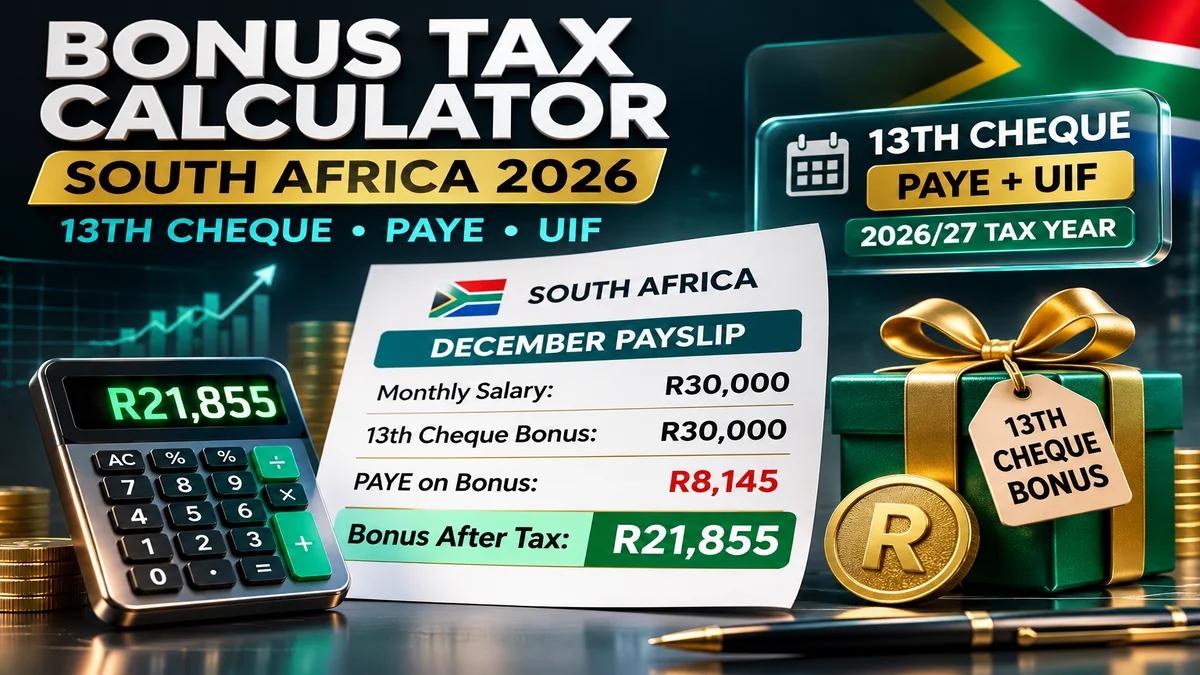
Your bonus is taxed as an annual payment. Payroll works out the tax on a year of your normal pay with and without the bonus, and deducts the difference in the bonus month. So the bonus is taxed at your marginal rate, between 18% and 45%. On a R30,000 salary, a R30,000 13th cheque attracts R8,145 PAYE.
Bonus Tax Calculator South Africa 2026/27
Short answer: Put in your monthly salary and bonus to see the PAYE, UIF and the cash you keep. It uses the same annual payment method SARS tells employers to use.
Enter your normal monthly salary and the bonus you expect. The calculator uses the 2026/27 tax tables, your age rebate, medical scheme fees tax credits, your retirement contributions and the UIF ceiling. It then shows what you’ll actually receive.
Want your full monthly payslip instead? Use the income tax and PAYE calculator for your take-home pay without the bonus.
How Is a Bonus Taxed in South Africa?
Short answer: SARS classes a bonus or 13th cheque as an annual payment, reported under code 3605 on your IRP5. There’s no separate bonus rate: the tax is the extra annual tax the bonus causes, and it can’t be spread across earlier months.
SARS’s FAQ on annual payments lists an annual bonus, an incentive bonus, leave pay paid out on resignation and merit awards as examples. It says they appear on your tax certificate (IRP5) under code 3605. A 13th cheque works the same way.
SARS’s Guide for Employers in respect of Employees’ Tax (2027) sets out the method. Payroll takes the annual equivalent of your normal pay, adds the bonus, and works out the tax on both figures. The difference is the employees’ tax on the bonus:
Formula: PAYE on bonus = tax on (annual salary + bonus) minus tax on annual salary
Two things follow from this. First, the bonus is taxed at the top of your income, so it’s taxed at your marginal rate, not your average rate. Second, all of the bonus tax comes off in one payslip, because the annual payment method deducts it in the month the bonus is paid.
In practice, this method lands close to what you’d pay if the bonus were spread across the year. It’s not an extra tax. Your final tax is set when SARS assesses your return, using the 2026/27 tax brackets on everything you earned.
A note on the law: the 2026/27 tables come from the February 2026 Budget. The 2026 Rates and Monetary Amounts Bill that puts them into law was still a draft as at 6 November 2026. Even so, SARS has applied the new tables to PAYE since 1 March 2026, as it does every year. The Rates Act 3 of 2026 you may see cited is last year’s law, giving effect to the 2025 Budget.
How Do You Calculate Tax on a Bonus? (Step by Step)
Short answer: Tax a year of normal pay, tax it again with the bonus added, and subtract. On R30,000 a month, a R30,000 bonus raises the annual tax from R56,172 to R64,317, so the bonus PAYE is R8,145.
Assumptions: R30,000 a month for the full 2026/27 tax year, under 65, no medical aid, no retirement contributions, R30,000 bonus paid in December 2026. Figures are PAYE estimates, not your final assessment.
- Annualise your normal monthly payMultiply your normal monthly taxable pay by 12. On R30,000 a month that’s R360,000. SARS calls this the annual equivalent.
- Work out the tax on that yearApply the 2026/27 tax table, then subtract your rebate (R17,820 under 65) and any medical scheme fees tax credits. On R360,000 the tax is R56,172.
- Add the bonus and work out the tax againAdd the bonus to the annual figure and repeat the calculation. R360,000 plus a R30,000 bonus is R390,000, and the tax on that is R64,317.
- Subtract the two figuresThe difference is the PAYE on your bonus. R64,317 minus R56,172 is R8,145, deducted in full in the bonus month.
- Check UIF and the cash you’ll receiveIf your salary is below R17,712 a month, add 1% UIF on the bonus up to the R177.12 cap. Subtract PAYE and UIF from the bonus to see what lands in your account.
Here’s the bracket maths behind the R8,145. The R360,000 salary sits in the 26% bracket, which ends at R383,100. The first R23,100 of the bonus is taxed at 26% (R6,006) and the last R6,900 crosses into the 31% bracket (R2,139). R6,006 plus R2,139 is R8,145, or 27.2% of the bonus.
So the R30,000 bonus pays out R21,855. UIF is nil here because the salary is already above the R17,712 UIF ceiling.
What if the assumptions change? If you’re 65 or older, or you have medical aid, the bonus PAYE stays R8,145, because rebates and credits cancel out. If R2,000 a month goes to your pension through payroll, the bonus PAYE falls to R7,800, since less of the bonus lands in the 31% bracket.
That’s how to work out tax on a bonus by hand. If you’d like to skip the maths, the bonus calculator above runs the same five steps for you, including rebates for age and medical aid credits.
How Much Tax Will You Pay on Your 13th Cheque?
Short answer: It depends on your salary, not on the bonus itself. A one-month 13th cheque is taxed at 18% on R15,000 a month, about 27% on R30,000, 36% on R50,000 and 41% on R75,000.
This table assumes your 13th cheque equals one month’s salary, you’re under 65, and you have no medical aid or retirement deductions. It uses the 2026/27 tables and the R17,712 UIF ceiling.
| Monthly salary | PAYE on 13th cheque | UIF on it | You receive | Taxed |
|---|---|---|---|---|
| R8,000 | R900.00 | R80.00 | R7,020.00 | 11.3% |
| R10,000 | R1,800.00 | R77.12 | R8,122.88 | 18.0% |
| R12,000 | R2,160.00 | R57.12 | R9,782.88 | 18.0% |
| R15,000 | R2,700.00 | R27.12 | R12,272.88 | 18.0% |
| R20,000 | R4,792.00 | R0.00 | R15,208.00 | 24.0% |
| R25,000 | R6,500.00 | R0.00 | R18,500.00 | 26.0% |
| R30,000 | R8,145.00 | R0.00 | R21,855.00 | 27.2% |
| R40,000 | R12,400.00 | R0.00 | R27,600.00 | 31.0% |
| R50,000 | R18,000.00 | R0.00 | R32,000.00 | 36.0% |
| R75,000 | R30,750.00 | R0.00 | R44,250.00 | 41.0% |
| R100,000 | R41,000.00 | R0.00 | R59,000.00 | 41.0% |
13th cheque = one month’s gross salary. 2026/27 rates, under 65, no deductions. Calculated with the SARS annual payment method.
Look at the R8,000 row. A year of R8,000 a month is R96,000, below the R99,000 tax-free threshold. The 13th cheque takes the year to R104,000, so only the R5,000 above the threshold is taxed, at 18%. That’s why the PAYE is just R900.
A fixed bonus of R20,000 shows the bracket effect more clearly:
| Monthly salary | PAYE on a R20,000 bonus | Share of bonus |
|---|---|---|
| R15,000 | R3,600.00 | 18.0% |
| R20,000 | R4,792.00 | 24.0% |
| R30,000 | R5,200.00 | 26.0% |
| R40,000 | R6,200.00 | 31.0% |
| R50,000 | R7,200.00 | 36.0% |
| R75,000 | R8,200.00 | 41.0% |
2026/27 rates, under 65, no deductions.
Why Does Your Bonus Feel So Heavily Taxed?
Short answer: Because it’s taxed at your top (marginal) rate while your monthly PAYE reflects your lower average rate. It isn’t a special bonus tax, and SARS doesn’t take more overall than if the bonus were spread over 12 months.
Take the R30,000 example. Normal monthly PAYE is R4,681, which is 15.6% of the salary. In December, PAYE on the payslip jumps to R12,826: the normal R4,681 plus R8,145 on the bonus.
Three things make that feel worse than it is:
- Your monthly PAYE reflects your average rate, which is pulled down by the 18% bracket and the R17,820 rebate. The bonus gets none of that benefit, because it sits on top.
- Part of the bonus can cross into the next bracket. On R30,000 a month, R6,900 of a R30,000 bonus is taxed at 31%.
- All the bonus tax comes out of one payslip, so it’s very visible.
The common myth is that a bonus is taxed at 45%. That’s only true if your income is already above R1,878,600 a year. Another myth is that a bonus pushes your whole salary into a higher bracket. It doesn’t: only the slice above each threshold pays the higher rate.
One thing that catches people out is comparing the bonus with take-home pay. A R30,000 bonus doesn’t add R30,000 to your account. On these figures it adds R21,855.
What Is a 13th Cheque? (13th Cheque vs Bonus)
Short answer: A 13th cheque is a fixed extra month’s pay, while a performance bonus depends on results. SARS taxes both the same way, as annual payments.
A 13th cheque is an extra month’s pay, usually paid in November or December. You get 13 payments in a year instead of 12. A performance bonus depends on how you, your team or the business did.
| Feature | 13th cheque | Performance bonus |
|---|---|---|
| Amount | Usually one month’s basic salary | Varies with targets or company results |
| When it’s paid | Usually November or December | Often after year-end or a review cycle |
| Guaranteed? | Often, if it’s in your contract | Usually discretionary, within the policy’s rules |
| How it’s taxed | Annual payment, marginal rate | Annual payment, marginal rate |
| IRP5 code | 3605 (annual payment) | 3605 (annual payment) |
So what’s the difference between a 13th cheque and a bonus for tax? There’s none at all. Both run through the same PAYE calculation and the same 2026/27 tables. The difference is in your employment terms, which decide whether you’re entitled to the payment in the first place.
Some employers use the terms loosely, so read the wording in your contract or policy rather than relying on what the payment is called on your payslip.
How Do You Calculate a Pro Rata 13th Cheque?
Short answer: Multiply your monthly basic salary by the months you worked in the bonus cycle and divide by 12, if your contract allows a pro rata payment. Nine months on R18,000 gives R13,500.
Assumptions: basic salary R18,000 a month, the bonus cycle runs January to December, you started on 1 April 2026 and the contract allows a pro rata 13th cheque.
The usual formula is:
Pro rata 13th cheque = monthly basic salary × months worked in the cycle ÷ 12
So R18,000 × 9 ÷ 12 = R13,500. On 2026/27 rates, PAYE on that amount depends on your annual pay, which you can check in the calculator.
Contracts differ in three ways that change the answer:
- The cycle: some run January to December, others run December to November or follow the financial year.
- Resignation: many policies say you only qualify if you’re still employed on the payment date. Others pay a pro rata amount when you leave.
- Basic or total pay: most 13th cheques are based on basic salary, not on allowances or commission.
If you’re leaving before December, ask HR in writing how your bonus will be handled before you hand in your notice. The answer can be worth a full month’s pay.
Is a Bonus Taxed Like Leave Pay or a Severance Package?
Short answer: No. A bonus and cashed-in leave are taxed at your marginal rate, but a qualifying severance benefit uses the retirement lump sum table, where the first R550,000 is tax-free for 2026/27.
When you leave a job, your final payslip can hold several different payments, and SARS taxes them differently. Getting this wrong is common: people expect their whole package to be taxed like a bonus, or the other way round.
| Payment | How it’s taxed in 2026/27 | Paperwork |
|---|---|---|
| Annual bonus or 13th cheque | Annual payment, at your marginal rate (18% to 45%) | Code 3605 on your IRP5; payroll uses the annual payment method |
| Leave pay on resignation or cashed-in leave | Annual payment, at your marginal rate | Code 3605; no tax directive needed |
| Notice pay or pro rata bonus when you leave | Normal tax rates, like salary | Not part of a severance benefit, even if you’re retrenched |
| Severance benefit (retrenchment, age 55+, ill health) | Lump sum table: first R550,000 tax-free (less earlier lump sums), then 18%, 27% and 36% | Employer must get a SARS tax directive (IRP3(a)) before paying |
Sources: SARS annual payments FAQ, SARS Tax and Retrenchment page, Budget 2026 Tax Guide.
A payment only counts as a severance benefit if your employer paid it because your job was terminated. One of these must also apply: you’re 55 or older, you can’t work because of illness, accident or injury, or your employer is closing or cutting staff. It doesn’t apply if you’ve ever held more than 5% of the company’s shares.
The difference can be large. A R300,000 payment on top of a R30,000 salary would attract R98,335 PAYE as a bonus. As a qualifying severance benefit with no earlier lump sums, it falls inside the R550,000 tax-free amount, so the tax is R0. The R550,000 is a lifetime amount shared with retirement fund lump sums, so earlier withdrawals reduce it.
Does Your Employer Have to Pay a 13th Cheque?
Short answer: Not in general. No law forces employers to pay a bonus, but if your contract, a policy or a collective agreement provides for one, it’s enforceable.
The Basic Conditions of Employment Act sets minimums for leave, hours and notice, but it doesn’t require employers to pay a bonus or 13th cheque. Your right to one comes from:
- Your employment contract, if it promises a 13th cheque or a bonus.
- A company policy or handbook, which can create a right or set the rules for a discretionary bonus.
- A collective agreement or bargaining council agreement in your sector.
- A consistent, long-standing practice, which may create a reasonable expectation of payment, depending on the facts.
If the 13th cheque is contractual, your employer generally can’t stop paying it without your agreement. The Labour Court in Cape Town decided one such case on 4 February 2026: CEPPWAWU obo Members v Avacare Health Group (Pty) Ltd and Another (C438/2024) [2026] ZALCCT 18. The court found that scrapping a contractual 13th cheque without the employees’ agreement was a breach of contract. It ordered the employer to pay the 45 remaining employees their 13th cheque for every year since 2021. It also noted that a contractual 13th cheque must be paid whatever the employer’s financial position.
A discretionary bonus is different. The employer can decide not to pay it, but it still has to apply its own criteria fairly and can’t withhold it for a discriminatory reason. If you think you’ve been unfairly denied a bonus, a dispute usually goes to the CCMA or your bargaining council. This is general information, not legal advice.
Is UIF Deducted From Your Bonus?
Short answer: Only if your normal salary is below R17,712 a month. UIF is 1% of your pay for the month, capped at R177.12, so a bonus adds UIF until you hit the cap.
UIF is 1% of your remuneration for the month, with the employer paying a further 1%. Contributions stop at a monthly ceiling of R17,712, so the most you’ll pay in any month is R177.12.
That gives two cases:
- Salary at or above R17,712: you already pay R177.12 every month, so the bonus adds no UIF.
- Salary below R17,712: the bonus adds UIF until the month’s pay reaches the ceiling. On R12,000 a month, normal UIF is R120. With a R12,000 bonus the month’s pay is R24,000, UIF hits the cap of R177.12, and the bonus costs R57.12 in UIF.
Commission is excluded from UIF remuneration, but an annual bonus isn’t, which is why it shows up on the bonus payslip. The calculator applies the cap for you. Untick UIF if you don’t contribute, for example if you work fewer than 24 hours a month for that employer.
Do Age and Medical Aid Change the Tax on Your Bonus?
Short answer: Usually not. Rebates and medical credits cut your tax with and without the bonus by the same amount, so they cancel out. The exception is a salary so low that some of them go unused.
Both your age rebate and your medical scheme fees tax credits come off the tax on your salary and the tax on salary-plus-bonus equally. When you subtract one from the other, they cancel out. That’s why two people on the same salary pay the same bonus tax, even if one has medical aid and the other doesn’t.
One condition applies to medical aid. Payroll can only use your medical credits if your contributions are deducted through payroll or paid by your employer. If you pay your medical aid yourself, you’ll get the credits when SARS assesses your return instead.
The exception is when your tax without the bonus is already nil. Then part of your rebate or credits hasn’t been used, and it absorbs some of the bonus tax:
- On R8,000 a month with no medical aid, the 13th cheque pays R900 PAYE.
- On R8,000 a month with two people on medical aid paid through payroll (R752 a month in credits for 2026/27), the 13th cheque pays R0 PAYE. The unused credits cover it.
The same applies to people 65 and older. The extra rebates (R9,765 from 65 and a further R3,249 from 75) lift the tax-free threshold to R153,250 and R171,300. So smaller bonuses for older employees on modest pay may attract little or no PAYE. You can read more about credits in our medical aid tax credit guide.
How Can You Pay Less Tax on Your Bonus?
Short answer: The best tip is to have payroll pay part of the bonus into a pension, provident fund or retirement annuity. Within the 27.5% and R430,000 limits that part isn’t taxed now, so the bonus PAYE drops.
Assumptions: R30,000 a month, R30,000 bonus, under 65, payroll pays R10,000 of the bonus straight into your pension fund or retirement annuity in December 2026. Within the 27.5% and R430,000 limits for 2026/27.
The PAYE on the bonus drops from R8,145 to R5,200, a saving of R2,945. You get R14,800 in cash and R10,000 goes into your retirement savings. Without the contribution, that R10,000 would have been taxed at 31% and 26% now. You’ll pay tax on it when you take it out of the fund, often at a lower rate in retirement.
Your options, from most to least effective for the bonus month:
- Payroll contribution: ask HR before the bonus payroll closes to pay part of it into your pension, provident fund or RA. This cuts PAYE in the same month. Since 1 September 2024, a third of new contributions go to your two-pot savings component, which you can access once a tax year, taxed at your marginal rate. See our two-pot retirement guide.
- Private retirement annuity: paying into your own RA by 28 February 2027 still gives a deduction for 2026/27, but PAYE doesn’t change. The saving comes back as a refund after you file. Our retirement tax calculator shows the effect.
- Tax-free savings account: it won’t cut the tax on the bonus, but from 2026/27 you can put in up to R46,000 a year and the growth is tax-free. See the TFSA guide.
Keep an eye on the limit. Your own contributions, your employer’s contributions and the bonus amount together count towards the 27.5% and R430,000 caps for 2026/27. Anything above them is still taxed now and carries forward to later years. The calculator flags this, and warns you if the PAYE would be more than the cash left from the bonus.
Spreading the bonus over 12 months, if your employer offers it, lowers the monthly hit but rarely changes your total tax for the year.
Will SARS Refund Some of Your Bonus Tax?
Short answer: Only if too much PAYE was taken over the whole year. The bonus PAYE is designed to match your final tax, so refunds usually come from deductions payroll didn’t apply, not from the bonus itself.
The bonus method gets PAYE close to your final tax for the year, so the bonus itself rarely creates a large refund. SARS works out your actual tax when it assesses your 2026/27 return in tax season 2027, often through an auto-assessment.
You’re more likely to get money back if:
- You paid into a private retirement annuity that payroll didn’t know about.
- You had large out-of-pocket medical expenses that qualify for the additional medical expenses tax credit.
- You joined your employer during the year, so payroll treated your pay as if you’d earned it for 12 months.
You may owe SARS if you had two employers in the year or income that wasn’t taxed at source. Provisional taxpayers should include the bonus in their second estimate, due by the end of February 2027, to avoid an underestimation penalty. Our guide to IRP6 deadlines and penalties explains how. You can also estimate your position with the tax refund calculator.
Started Your Job This Tax Year? Here’s What Happens to Your Bonus Tax
Short answer: Payroll taxes your salary as if you earned it all year and doesn’t reduce the bonus PAYE. If you had no earlier income, SARS usually refunds the difference when you file.
Assumptions: you start a new job on 1 September 2026 on R30,000 a month and get a R30,000 bonus in December 2026. You’re under 65 and had no other income from March to August 2026.
SARS’s employer guide tells payroll to work out an annual equivalent when you’re employed for only part of the tax year. Your salary PAYE is based on R30,000 × 12, then scaled back to the months you work. The bonus PAYE isn’t scaled back at all.
| Item | Amount |
|---|---|
| Salary PAYE for 6 months (R4,681 × 6) | R28,086 |
| PAYE on the R30,000 bonus | R8,145 |
| Total PAYE payroll deducts | R36,231 |
| Tax on what you actually earned (R180,000 + R30,000) | R19,980 |
| Likely refund on assessment | R16,251 |
The refund happens because you get the full R17,820 rebate on assessment, while you only earned six months of salary. The calculator shows this for you: enter the number of months in the “Months you’ll be paid” field.
If you moved from another job in the same tax year, the picture changes. Your two employers each taxed you separately, so you may owe SARS instead. Check both IRP5s when you file.
How Should Employers Process PAYE on a Bonus?
Short answer: Use the annual payment method, deduct UIF and include SDL, then declare and pay on the EMP201 within seven days after month end. Report the bonus under code 3605 on the IRP5.
If you run payroll, the bonus month needs a few extra checks. Here’s the process SARS sets out in its Guide for Employers in respect of Employees’ Tax (2027):
- Calculate PAYE with the annual payment method: tax on the annual equivalent of normal pay plus the bonus, minus tax on the annual equivalent alone. Don’t add the bonus to one month’s pay and multiply by 12, which over-deducts.
- Deduct employee UIF of 1% on the bonus, and pay the employer’s 1%, until the month’s pay reaches the R17,712 ceiling.
- Include the bonus in the Skills Development Levy base. SDL is 1% of pay, including bonuses, if your total payroll is expected to exceed R500,000 over 12 months.
- Declare and pay PAYE, UIF and SDL on the EMP201 within seven days after the end of the month. For a December 2026 bonus that’s Thursday 7 January 2027. If the 7th falls on a weekend or public holiday, pay by the last business day before it.
- Report the bonus on the employee’s IRP5 under code 3605 (annual payment), separate from salary.
- For a severance benefit, apply for a tax directive on the IRP3(a) before paying. Don’t run it through the bonus method.
A common payroll mistake is treating a December bonus as normal December pay. That pushes the employee’s monthly PAYE far too high and leads to queries. Most payroll systems have a separate bonus or annual payment item for this reason.
What Are the Most Common Bonus Tax Mistakes?
Short answer: Most mistakes come from comparing the bonus tax with your average rate, missing payroll cut-off dates, and not checking the IRP5 at tax season.
Comparing the bonus tax with your monthly tax rate
Your monthly PAYE is an average rate. The bonus is taxed at your marginal rate, so it usually looks higher. Check the bonus against the bracket table, not against your normal payslip.
Asking for a retirement contribution too late
Payroll often closes about a week before payday, and December payroll can close earlier. If you want part of your bonus in a retirement fund, ask in November. After the bonus is paid, the PAYE can’t be reversed on that payslip.
Expecting a private RA to cut December PAYE
A debit order into your own RA doesn’t change what payroll deducts. You’ll see the saving as a refund after SARS assesses your return, not in December.
Not checking code 3605 on your IRP5
When tax season 2027 opens, compare the annual payment on your IRP5 with your December payslip. A mismatch can lead to an incorrect auto-assessment. On eFiling, the IRP5 figures are pre-populated, so check them before you accept anything.
Resigning a month too early
Many 13th cheque policies require you to be employed on the payment date. Resigning in October or early November can cost you the whole payment unless your contract provides for pro rata.
What Should You Check Before Your Bonus Is Paid? (Checklist and Tips)
Short answer: Confirm your entitlement, estimate the after-tax amount, decide on any retirement contribution before payroll closes, and keep the payslip for tax season.
- Read the bonus or 13th cheque clause in your contract or policy, including the cycle and any pro rata rules.
- Run your figures through the bonus tax calculator so you budget with the after-tax amount.
- Decide whether to send part of the bonus to your retirement fund, and tell HR before the December payroll cut-off.
- Check the December payslip: PAYE on the bonus, UIF and any retirement contribution.
- Keep the payslip and compare it with code 3605 on your IRP5 when tax season 2027 opens.
- If you’re a provisional taxpayer, include the bonus in your second IRP6 estimate by the end of February 2027.
Bonus Tax FAQs
Short answer: These answers use the 2026/27 SARS figures and assume a full year with one employer.
How is a bonus taxed in South Africa?
SARS treats a bonus as an annual payment. Your employer works out the tax on a full year of your normal pay, then the tax on that amount plus the bonus. The difference is the PAYE on the bonus, and it’s deducted in full in the month the bonus is paid.
What is the bonus tax rate in South Africa?
There’s no separate bonus tax rate. A bonus is taxed at your marginal rate, the rate of the bracket the extra income falls into. For 2026/27 that’s between 18% and 45%. If the bonus crosses into a higher bracket, part of it is taxed at the next rate.
Is a 13th cheque taxed differently from a performance bonus?
No. A 13th cheque and a performance bonus are both annual payments for PAYE. They use the same method and the same 2026/27 tax tables. The only difference is the employment terms: a 13th cheque is usually a fixed extra month’s pay, while a performance bonus depends on targets.
How much tax will I pay on a R20,000 bonus?
On 2026/27 rates, for someone under 65 with no deductions, PAYE on a R20,000 bonus is R3,600 on a R15,000 monthly salary. It’s R5,200 on R30,000, R6,200 on R40,000 and R8,200 on R75,000. UIF of up to 1% may also apply if your salary is below R17,712 a month.
What is a 13th cheque?
A 13th cheque is an extra month’s pay, usually paid in November or December, so you earn 13 payments in a year instead of 12. It’s normally equal to one month’s basic salary and is set out in your employment contract, company policy or a collective agreement.
Is my employer obliged to pay a 13th cheque?
Not by law in general. The Basic Conditions of Employment Act doesn’t require a bonus or 13th cheque. You’re entitled to one if your contract, a company policy or a collective agreement provides for it, and a long-standing practice can also create a claim. If it’s contractual, your employer generally can’t stop paying it without your agreement.
How is a pro rata 13th cheque calculated?
Where your contract allows a pro rata payment, the usual formula is your monthly basic salary multiplied by the months you worked in the bonus cycle, divided by 12. For example, R18,000 a month for 9 of 12 months gives R13,500. Check your contract, because the cycle and the rules on resignation differ between employers.
Is UIF deducted from a bonus?
Yes, if your normal salary is below the UIF ceiling of R17,712 a month. UIF is 1% of your pay in the month, capped at R177.12. If your salary is already at or above R17,712, you won’t pay any extra UIF on the bonus.
Will SARS refund some of the tax on my bonus?
Only if too much PAYE was deducted over the whole tax year. The bonus method usually gets the tax close to your final liability, so most people don’t get a bonus-specific refund. A refund is more likely if you also have deductions payroll didn’t use, such as private retirement annuity contributions or extra medical expenses.
Can I legally reduce the tax on my bonus?
Yes. The most effective way is to ask payroll to pay part of the bonus into your pension, provident fund or retirement annuity before the bonus is processed. Within the 27.5% and R430,000 limits, that part isn’t taxed now. Paying into a private retirement annuity also cuts your tax, but the saving comes back as a refund when you file.
Does a bonus push my whole salary into a higher tax bracket?
No. South Africa’s tax is progressive, so only the part of your income above each bracket threshold is taxed at the higher rate. A bonus can move the top slice of your income into the next bracket, but the rest of your salary is taxed exactly as before.
Why is the PAYE on my payslip different from this calculator?
Payroll may use SARS’s tax deduction tables, your year-to-date earnings, fringe benefits, a part-year start date or other deductions this calculator doesn’t model. Small differences are normal. Large differences are worth raising with payroll, and any over- or under-deduction is squared up when SARS assesses your return.
When is a 13th cheque paid in South Africa?
Most employers pay it in November or December, often with the November or December salary. The exact month is set by your contract, company policy or collective agreement, so check there. Some employers pay it at another time, such as the end of their financial year.
What should I do if my employer doesn’t pay my 13th cheque?
First check that your contract, policy or collective agreement promises it, then raise it with HR or payroll in writing. If it isn’t resolved, you can refer an unfair labour practice dispute about benefits to the CCMA or your bargaining council, generally within 90 days. A union or labour lawyer can advise on your case.
Is a severance package taxed like a bonus?
No. A severance benefit paid because you’re retrenched, 55 or older, or can’t work due to illness or injury is taxed with the retirement lump sum table. For 2026/27 the first R550,000 is tax-free, less any earlier lump sums, and your employer needs a SARS tax directive first. Leave pay, notice pay and a pro rata bonus paid when you leave are taxed at normal rates.
I started my job this year. Will I get some of the bonus tax back?
Often, yes, if you had no other income earlier in the tax year. Payroll taxes your salary as if you earned it all year, and the bonus PAYE isn’t reduced for the months you didn’t work. When SARS assesses your return, it uses what you actually earned, so the difference usually comes back as a refund.
Is a bonus paid in March taxed in the new tax year?
Yes. The tax year runs from 1 March to the end of February. A bonus paid in December 2026 or February 2027 falls into the 2026/27 year. A bonus paid on or after 1 March 2027 falls into the 2027/28 year, which uses the rates announced in the February 2027 Budget.
Sources
Short answer: Every figure on this page was checked against these SARS and National Treasury documents on 6 November 2026.
- SARS: Rates of tax for individuals (2027 tax year)
- National Treasury and SARS: Budget 2026 Tax Guide (2026/27 brackets, rebates, thresholds, R430,000 retirement cap)
- SARS: Guide for Employers in respect of Employees’ Tax (2027), annual payments method
- SARS FAQ: What does SARS mean by annual payments? (code 3605)
- SARS: Tax and retrenchment (severance benefits, R550,000 tax-free, tax directive)
- SARS: Skills Development Levy (1%, R500,000 payroll threshold, includes bonuses)
- SARS: Medical tax credit rates (2027 year: R376 and R254)
- SARS: UIF earnings ceiling of R17,712 a month (maximum R177.12)
- SARS: Draft Rates and Monetary Amounts and Amendment of Revenue Laws Bill, 25 February 2026 (2026/27 tables, rebates, R46,000 TFSA limit)
- National Treasury: Two-pot system updated FAQ (August 2024)
Check your full payslip next
See your monthly PAYE, UIF and take-home pay on 2026/27 rates.
Open the PAYE calculatorThis guide and calculator give general information and estimates based on SARS figures for the 2026/27 tax year. They’re not tax, legal or financial advice. Your payroll may calculate PAYE differently depending on your circumstances, and your final tax is determined when SARS assesses your return. For advice on your own situation, speak to a registered tax practitioner.